Kristin von der Goltz Barockvioloncello
Thomas C. Boysen Laute
Daniel Rosin Barockvioloncello (Continuo)
Andreas Küppers Cembalo
Programm
Werke für Barockvioloncello von
Giovanni Battista Vitali
Andrea Falconieri
Rocco Greco
Giovanni Battista Bononcini
Francesco Alborea
Francis (Andrea) Caporale
Francesco Paolo Supriani
Jakob Herman Klein
Benedetto Marcello
Domenico Gabrielli
Louis-François-Joseph Patouart
Francesco Geminiani
Giovanni Battista Vitali (1632–1692)
Bergamasca
aus Partite sopra diverse sonate per il violone (um 1680)
Andrea Falconieri (1585–1656)
La suave melodia
aus Il primo libro di canzone, sinfonie, fantasie, capricci [...] (1650)
Rocco Greco (um 1650–1717/18)
Sinfonia viggesima seconda à due
Giovanni Battista Bononcini (1670–1747)
Sinfonia prima D-Dur (um 1696–97)
I. Largo
II. Allegro
III. Adagio
IV. Minuet
Francesco Alborea (1691–1739)
aus der Sonate für Violoncello und Basso continuo D-Dur
I. Amoroso
Francis (Andrea) Caporale (? – nach 1757?)
Sonate für Violoncello und Basso continuo Nr. 6 G-Dur
I. Adagio –
II. Allegro
III. Cantabile
Francesco Paolo Supriani (1678–1753)
Toccata quinta e-moll
aus Principij da imparare à suonare il violoncello e con 12 toccate à solo
Jakob Herman Klein (1688–1748)
Sonate für Violoncello und Basso continuo a-moll op. 4 Nr. 5 (1746)
I. Poco allegro
II. Adagio
III. Allegro
Pause
Giovanni Battista Vitali
Chiacona
aus Partite sopra diverse sonate per il violone
Benedetto Marcello (1686–1739)
aus der Sonata à tre c-moll op. 2 Nr. 2 (um 1736)
I. Largo
Domenico Gabrielli (1659–1690)
Sonate für Violoncello und Basso continuo Nr. 1 G-Dur (1689)
I. Grave
II. Presto
III. Adagio
IV. Allegro
Louis-François-Joseph Patouart (1719–1793)
Sonate en trio a-moll op. 2 Nr. 6 (1760)
I. Adagio
II. Gavotta I. Gratioso – Gavotta II
III. Minuetto I. Gratioso – Minuetto II
Francesco Geminiani (1687–1762)
Sonate für Violoncello und Basso continuo d-moll op. 5 Nr. 2 (1746)
I. Andante
II. Presto
III. Adagio
IV. Allegro
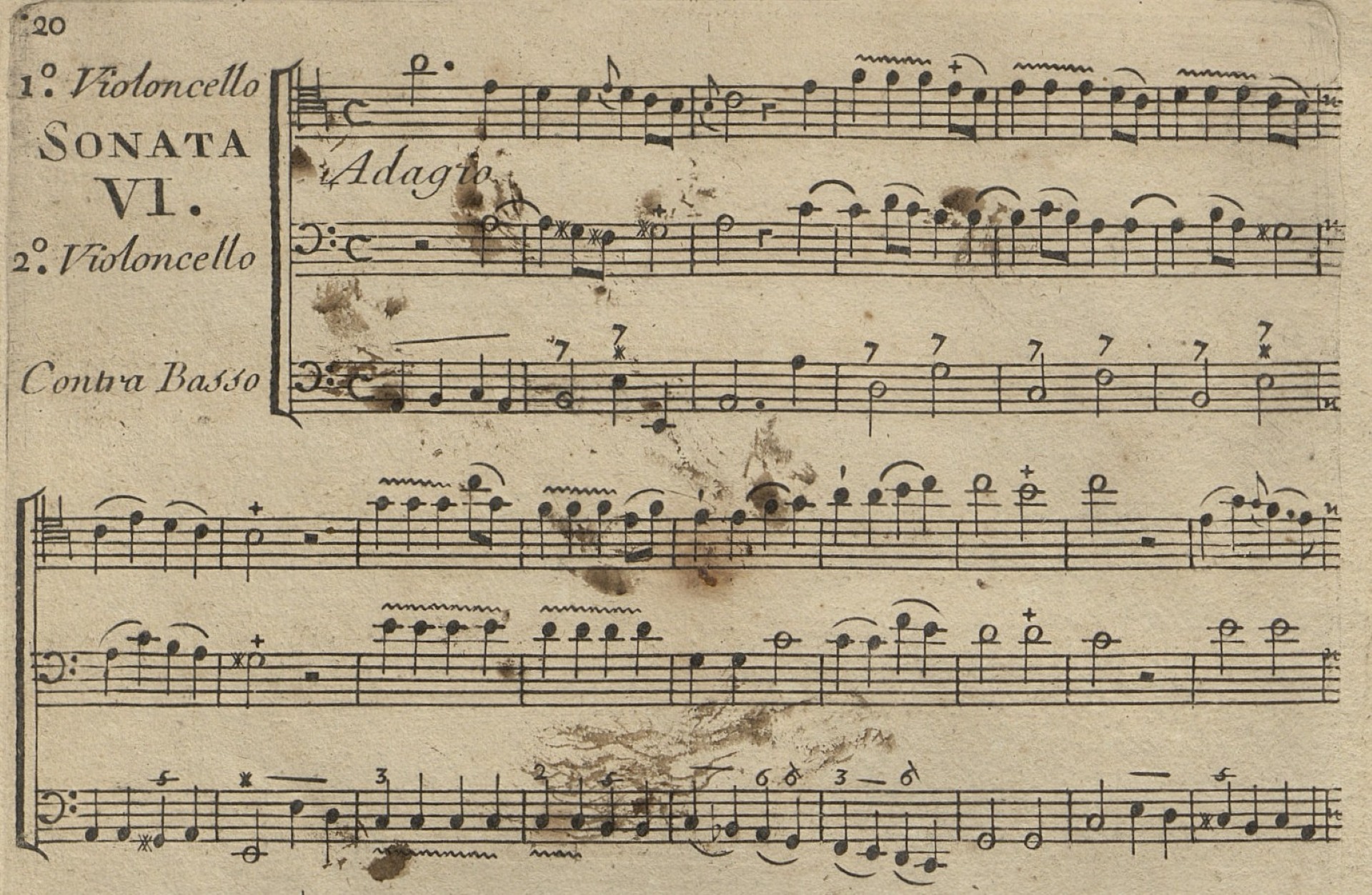
Louis-François-Joseph Patouarts Triosonate für zwei Violoncello und Basso continuo (Paris, 1760)
Die liebliche Melodie
In Werken des 17. und 18. Jahrhunderts verfolgt Kristin von der Goltz gemeinsam mit ihrem Ensemble die frühe Geschichte ihres Instruments.
Essay von Jürgen Ostmann
Die liebliche Melodie
Musik für Barockvioloncello
Jürgen Ostmann
Das Violoncello ist schon ein merkwürdiges Instrument. Zwar gehört es zusammen mit Violine und Viola zur Familie der Armgeigen (italienisch „viola da braccio“ – daher das deutsche Wort Bratsche), wird aber wie eine Beingeige („viola da gamba“) zwischen den Knien gehalten. Und auch der Name: Im Italienischen bewirkt das Suffix „-one“ eine Vergrößerung, „-ino“ bzw. „-ina“ dagegen eine Verkleinerung. Der Violone ist eine große Viola, die Violine eine kleine. Doch auf das „-one“ folgt noch ein weiteres Suffix, nämlich jenes „-[c]ello“, das umgangssprachlich auch für das ganze Instrument herhalten muss. Es dient als Diminutiv wie das deutsche „-chen“ oder „-lein“ und nimmt somit von der Größe des Violone (einem Vorläufer des Kontrabasses) wieder etwas weg. Eine kleine Großgeige also, und eine Armgeige, die man mit den Beinen hält.
Etwa 100 Jahre älter als der widersprüchliche Name, der erstmals 1665 in einer Notenausgabe erscheint, ist das Instrument selbst. Andrea Amati baute um 1570 die ersten Exemplare, deren Maße ungefähr den heutigen entsprechen. Allerdings waren die Größen und Bauweisen damals noch ebenso wenig standardisiert wie die Bezeichnungen, die beispielsweise „violone“, „basso“, „basso violino“ oder „basso di viola da brazzo“ lauten konnten. In dieser Frühzeit gab es Celli, die nur wenig größer als eine Bratsche und andere, die kaum kleiner als ein Kontrabass waren. Die Zahl der Saiten schwankte zwischen vier und sechs, verschiedene Stimmungen waren möglich, Bein- oder Armhaltung, Ober- oder Untergriff des Bogens, Benutzung eines Stachels oder Podests zum Abstützen des Instruments oder Verzicht darauf. An Vereinheitlichung hatte man in Italien, dem Ursprungsland des Cellos, offenbar wenig Interesse.
Ganz anders in Frankreich, wo im 18. Jahrhundert die ersten Traktate über das Cellospiel erschienen. Deren Verfasser, die sich vielfach aufeinander bezogen, legten die Maße und Spielweise des Instruments immer detaillierter fest – erst recht, nachdem 1795 mit dem Pariser Conservatoire die erste moderne Musikhochschule gegründet worden war. Cello wurde dort von Beginn an unterrichtet, und auch die Inhalte heutiger Barockcello-Studiengänge orientieren sich an den in dieser Epoche (d.h. eher der Klassik) geschaffenen Normen. Das ist auch durchaus sinnvoll, denn die ganze Vielfalt der kleinen Bassinstrumente Italiens und ihrer Spielweisen ließe sich kaum vermitteln, und das standardisierte Barockcello – viersaitig in der bekannten Stimmung C–G–d–a mit einer Korpuslänge von etwa 75 cm – war ja schon früh zumindest eine von mehreren Optionen.
Von außen betrachtet sieht ein solches Cello nicht viel anders aus ein modernes, doch sein Innenleben unterscheidet sich von dem der neuen (oder umgebauten alten) Instrumente. Erst im Lauf des 19. Jahrhunderts verstärkte man die schwingungsübertragenden Bassbalken und Stimmstöcke unter der Decke des Korpus, so dass die resultierende Lautstärke den immer größeren Konzertsälen gerecht wurde. Ähnlich wirkten sich der Einsatz von Stahlsaiten statt der zuvor üblichen Darmsaiten sowie eine deutlich höhere Saitenspannung aus, ebenso die veränderte Bogenform und -bauart. Barockcelli erreichen also nicht die Klangkraft moderner Instrumente, doch dafür lassen sich der intime, farbenreiche Klang und die „sprechende“ Artikulation, die das Repertoire der Zeit verlangt, auf ihnen leichter verwirklichen.
Bologna – Modena
Für ihr Programm hat Kristin von der Goltz überwiegend Werke von Komponisten gewählt, die selbst auch Cellisten waren. Die meisten wirkten in Bologna oder Neapel, den wichtigsten Zentren des Cellospiels in Italien, und einige von ihnen waren durch Lehrer-Schüler-Verhältnisse verbunden. Verantwortlich für Bolognas Aufstieg zur Cello-Metropole war vor allem die Musikkapelle der Basilika San Petronio. Als Maurizio Cazzati dort 1657 Kapellmeister wurde, strukturierte er das Ensemble radikal um. Er installierte eine feste Besetzung aus Violinen, Violen und Violonen, und es entstand ein großer Bedarf an neuen Streicherkompositionen, was wiederum die Nachfrage nach Instrumenten ankurbelte. Seit langem gab es in der Stadt angesehene Lautenbauer, die sich nun flexibel auf den Geigenbau umstellten. In Bologna wurde außerdem um das Jahr 1660 eine wichtige Neuerung eingeführt: metallumsponnene C- und G-Saiten, die eine bessere Ansprache der tiefen Töne ermöglichten. Zudem erlaubten diese Saiten ohne klangliche Einbußen den Bau handlicherer Instrumente und damit ein virtuoseres Spiel.
Begünstigt wurde der Bologneser Cello-Boom noch dadurch, dass im benachbarten Modena mit dem Herzog Francesco II. d’Este ein kunstsinniger, selbst Cello spielender Mäzen residierte. Viele Musiker arbeiteten im Lauf ihrer Karrieren sowohl für ihn als auch für San Petronio – zu ihnen zählt beispielsweise Giovanni Battista Vitali, der 1658 als „Violone da brazzo“-Spieler in Bologna begann und 1674 Vizekapellmeister, 1684 Kapellmeister in Modena wurde. Hier schrieb er um 1680 seine Partite sopra diverse sonate per il violone. Darin sind die heute Abend zu hörenden Ostinato-Stücke Bergamasca und Chiacona enthalten, Variationen über sich wiederholende Harmoniemuster. Ein Schüler Vitalis sowie Petronio Franceschinis (Vitalis Nachfolger an San Petronio) war Domenico Gabrielli. Er diente von 1680 bis zu seinem Tod als Cellist an der Basilika, nur 1687/88 unterbrochen durch ein Engagement in Modena, wo er Vitali wiedertraf. Gabrielli, im Bologneser Dialekt als „Minghén del violunzel“ (kleiner Domenico vom Violoncello) bezeichnet, schrieb 1689 sieben Ricercari für Violoncello solo. Außer ihnen sind noch zwei seiner Continuo-begleiteten Cellostücke erhalten, darunter die Sonate G-Dur, die auf eines der Ricercari zurückgeht.
Giovanni Bononcini stammte aus Modena, erhielt seine ersten Engagements in Bologna und begann von dort aus eine europaweite Karriere, die ihn in sämtliche bedeutenden Musikzentren führte – nach Rom und Venedig ebenso wie nach Wien, Berlin, London, Paris, Madrid und Lissabon. Er wirkte dort zwar vor allem als Opernkomponist und -unternehmer, gab aber regelmäßig auch Proben seines virtuosen Cellospiels. Seine als „Sinfonia“ bezeichnete Sonate für Cello und Continuo D-Dur entstand vermutlich im Dezember 1696 in Neapel, wo Bononcini gerade seine Oper Il trionfo di Camilla auf die Bühne brachte.
Neapel
Wie die Bologneser ist auch die Neapolitanische Schule mit drei Komponisten in Kristin von der Goltz’ Programm vertreten. Für die Entwicklung des Cellospiels waren in der süditalienischen Stadt vor allem ihre vier berühmten Konservatorien von Bedeutung. Ursprünglich als Waisenhäuser gegründet, wurden sie zu musikalischen Ausbildungsstätten, an denen auch bedeutende Cellisten lernten und später lehrten. Die prestigeträchtigsten Arbeitgeber Neapels waren daneben die Hofkapelle des spanischen Vizekönigs, die mit ihr konkurrierende Kapelle der Kathedrale San Gennaro und die des Operntheaters San Bartolomeo. Rocco Greco, der als Begründer der Neapolitanischen Celloschule angesehen werden kann, lehrte ab 1677 am Conservatorio dei Poveri di Gesù Cristo, allerdings zunächst Violine. 1695 wurde er in die Hofkapelle berufen. Seine 28 Sinfonie a due viole sind im gleichen Manuskript in der Abtei von Montecassino überliefert, das auch Bononcinis Sinfonia enthält; vermutlich stammt es aus dem Besitz eines Amateurcellisten.
Francesco Paolo Supriani (oder Scipriani), ausgebildet am Conservatorio della Pietà dei Turchini, hatte selbst nie ein offizielles Lehramt inne, hinterließ aber eine handschriftliche, didaktisch angelegte Sammlung von Toccaten mit einer erläuternden Einleitung, die Principij da imparare a suonare il violoncello e con 12 toccate a solo; das Manuskript ist auf das Jahr 1720 datiert. Francesco Alborea studierte am Conservatorio di Santa Maria di Loreto, doch auch Supriani soll einer seiner Lehrer gewesen sein. Er war Solocellist der Hofkapelle in Neapel, bis ihn 1721 Kaiser Karl VI. auf einen hochdotierten Posten in der Wiener Hofkapelle berief. Zeitgenossen wie Johann Joachim Quantz, Franz Benda oder Francesco Geminiani äußerten sich begeistert über sein Spiel. Seine beiden erhaltenen Sonaten enthalten Passagen in ungewöhnlich hoher Lage; sie sind nur unter Einsatz des damals noch wenig üblichen Daumenaufsatzes spielbar, wenn man nicht ein Instrument mit einer fünften Saite verwendet.
Paris – Amsterdam – London
Von Italien aus unternehmen Kristin von der Goltz und ihr Ensemble kurze Abstecher nach Paris, Amsterdam und London. Dort wirkten drei Cellisten, über deren Leben nur wenig bekannt ist. Louis-François-Joseph Patouart trat 1756 der renommierten „Grande bande“ der „Vingt-Quatre Violons du Roi“ bei. Etwa um diese Zeit müssen seine sechs Sonaten op. 2 entstanden sein. Die Sammlung enthält fünf Stücke für ein Cello sowie ein abschließendes für zwei Celli und Generalbass. Dass Patouart selbst Cello spielte, lässt sich aus seiner anspruchsvollen Schreibweise für das Instrument schließen. Gleiches kann man auch von dem Niederländer Jakob Klein annehmen. Zu ihm finden sich im Amsterdamer Gemeindearchiv Geburts- und Sterbedatum, auch der Eintrag, dass er im März 1710 heiratete und im folgenden Jahr Vater einer Tochter wurde. Doch welchen Beruf er ausübte, bleibt unklar. Professioneller Musiker war er jedenfalls nicht – das ergibt sich aus den erhaltenen Druckausgaben seiner Werke, die ihn als „Amatore di musica“, also Musikliebhaber ausweisen. Insgesamt veröffentlichte Klein 36 Sonaten für diverse Kammermusik-Kombinationen. Nicht einmal die Lebensdaten kennen wir von Francis Caporale, der als Andrea Caporale wahrscheinlich in Italien geboren wurde und um 1734 nach London kam, wo er als Cellist großes Aufsehen erregte und in Aufführungen von dessen Oratorien und Opern mit Georg Friedrich Händel zusammenarbeitete. 1741 wird er erstmals als Komponist eines (nicht erhalteten) Cellokonzerts in der Londoner Daily Post erwähnt.
Während die zuvor erwähnten Stücke handschriftlich überliefert sind, gaben Patouart, Klein und Caporale ihre Werke in Druck – symptomatisch für den Popularitätsschub, den das Cello im 18. Jahrhundert auch unter Amateuren erlebte. In dieser Zeit wurde die erhöhte Nachfrage nach neuen Werken zunehmend auch von Nicht-Cellisten bedient. Zu ihnen zählt Benedetto Marcello, ein venezianischer Adeliger, der verschiedene Staatsämter innehatte, gleichwohl aber die Musik auf professionellem Niveau betrieb. Er veröffentlichte Anfang der 1730er Jahre sechs Cellosonaten op. 1 und – um 1736 in Amsterdam – die sechs Triosonaten op. 2 für zwei Celli oder zwei Viole da gamba und Basso continuo. Ein ausgeprägtes Gespür für den neuen Markt bewies auch Francesco Geminiani, ein berühmter Violinvirtuose, der von 1714 bis zu seinem Tod überwiegend in London lebte. Er komponierte zwar bevorzugt für sein eigenes Instrument sowie für Orchester, daneben aber auch sechs Cellosonaten op. 5, die 1746 in Paris erschienen. Nachzutragen bleibt noch Andrea Falconieri, ein Neapolitaner des 17. Jahrhunderts, der hier bisher keine Erwähnung fand, weil sein Instrument nicht das Cello, sondern die Laute war. Sein Primo libro di canzoni, sinfonie, fantasie, capricci, brandi, correnti, galiarde, alemane, volte ist auch nicht handschriftlich überliefert wie die Werke der frühen Cellisten – Falconieri, seit 1648 Kapellmeister am Königshof, gab die Sammlung zwei Jahre später in Druck. Als Instrument verlangte er im Übrigen nicht ausdrücklich das Cello, sondern „Violini, e Viole, overo altro Stromento“. Derlei unspezifische Besetzungsangaben waren im Frühbarock eher die Regel als die Ausnahme. Für die Allemande mit dem Titel La suave melodia („Die liebliche Melodie“) ist allerdings das Violoncello mit seinem warmen, der menschlichen Stimme ähnlichen Ton zweifellos eine gute Wahl.
Jürgen Ostmann studierte Musikwissenschaft und Orchestermusik (Violoncello). Er lebt als freier Musikjournalist und Dramaturg in Köln und arbeitet für verschiedene Konzerthäuser, Rundfunkanstalten, Orchester, Plattenfirmen und Musikfestivals.
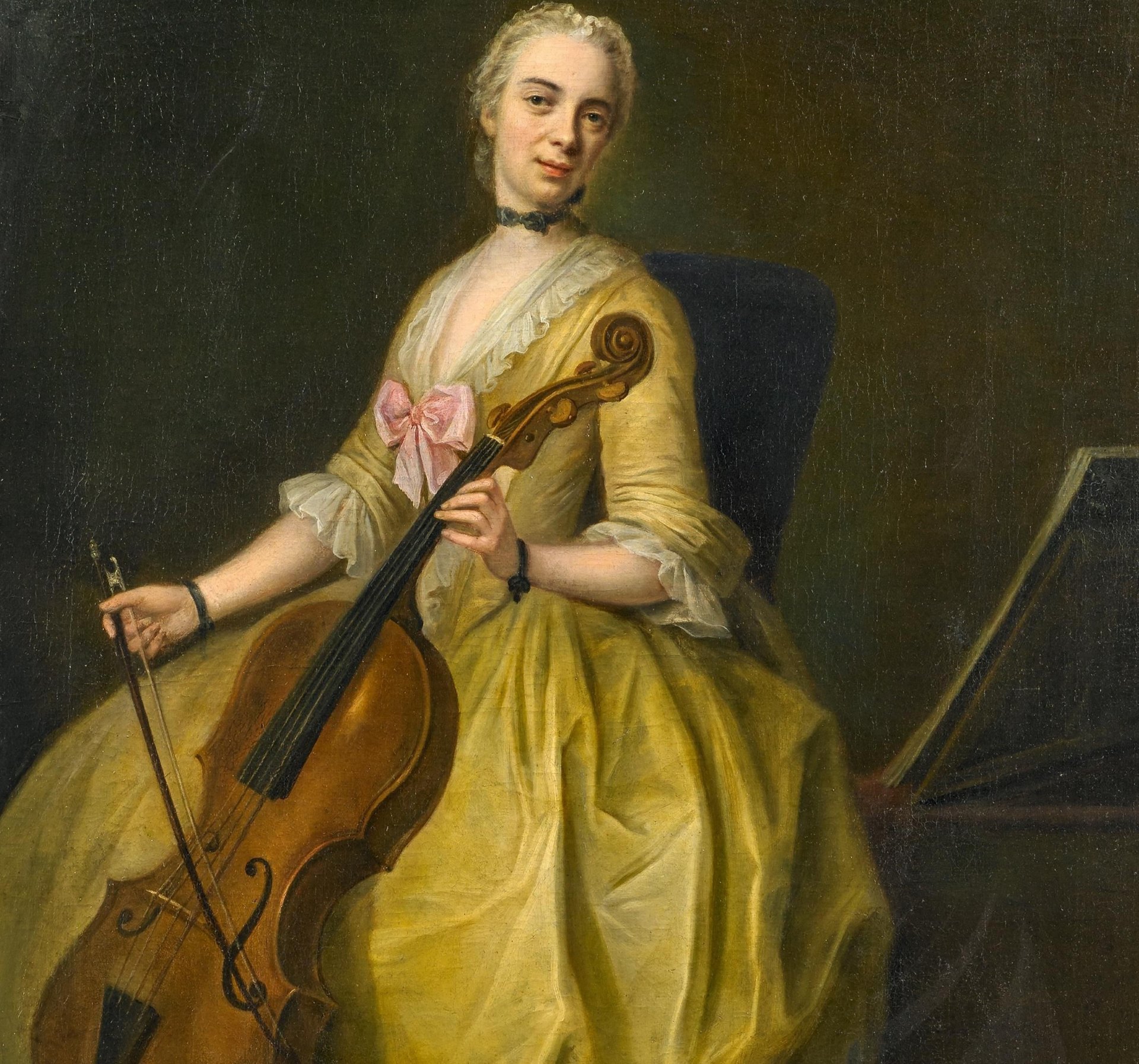
Balthasar Denner, Die Tochter des Künstlers am Violoncello (um 1730)
“Half Thunder, Half Prayer”
The cello’s emergence as a fully fledged solo instrument is commonly associated with the 19th-century cult of the virtuoso and and a who’s who of Romantic composers. As tonight’s program shows, however, the origins of its rise date back much farther.
Program Note by Harry Haskell
“Half Thunder, Half Prayer”
Music for Cello from the 17th and 18th Centuries
Harry Haskell
The cello’s emergence as a fully fledged solo instrument is commonly associated with the 19th-century cult of the virtuoso and the concomitant outpouring of sonatas, concertos, and other solo works for the instrument by a who’s who of Romantic composers. As tonight’s program shows, however, the origins of the cello’s rise date back much farther. By the early 1700s, traveling virtuosi such as Giovanni Bononcini and Francesco Alborea—appropriately nicknamed Franciscello—had achieved unprecedented levels of technical proficiency and celebrity. The composer Francesco Geminiani was bowled over upon hearing Alborea perform in Rome. According to the English music historian Charles Burney, Geminiani recalled that his fellow listeners, “being good catholics and living in a country where miraculous powers have not yet ceased, were firmly persuaded that it was not Francischelli [sic] who had played the violoncello but an angel that had descended and assumed his shape.”
The roots of the cello’s long history lie deep in Italian soil. Having established itself in the 17th century in the northern cities of Bologna and Modena—the home ground of Bononcini, Giovanni Battista Vitali, and Domenico Gabrielli—the instrument soon made its way to Naples, where a succession of virtuosos including Alborea, Rocco Greco, and Francesco Paolo Supriani laid the foundation for a distinctive Neapolitan cello school. (Significantly, only two non-Italian composers are represented on Kristin von der Goltz’s survey: the Dutchman Jacob Herman Klein and the Frenchman Louis-François-Joseph Patouart; Francis Caporale, likely Italian-born, worked mostly in London.) The instrument that we call the cello was originally known as a “violone” or “bass violin,” to set it apart from its distant relative in the viol family. As the Grove Dictionary explains, “The violoncello’s present name means, in Italian, a ‘small large viol,’ as it employs both the superlative suffix -one, and a diminutive one, -ello.” This terminological duality is reflected in the cello’s characteristically wide tonal and expressive range, which Kate Kennedy, in her recent book Cello, describes as “half thunder, half prayer.”
The Baroque Cello
Like many of her colleagues, von der Goltz has played a variety of modern and historical instruments in the course of her career. Her recent recording of Bach’s violin sonatas with Isabelle Faust and Kristian Bezuidenhout, for example, features a cello made in 1785 by Leopold Widhalm, the second in a family line of notable luthiers at the ducal court in Nuremberg. On an older album of Vivaldi concertos with the Berlin Baroque Soloists, she plays a cello from the workshop of the contemporary Munich-based maker Dietmar Rexhausen, modeled on an early 18th-century Italian instrument. In fact, so-called Baroque cellos come in such an assortment of shapes, sizes, and other specifications that the generic designation is something of a misnomer; it was not until the middle of the 18th century that the instrument’s design become more or less standardized. Michel Corrette, who published a pioneering cello method in 1741, attributed the invention of the modern cello to Bononcini, but it is more accurate to say that legions of players and makers contributed to its development over many generations.
Still, it was largely owing to virtuosos like Bononcini that the cello came into its own as a solo instrument in the late 17th and early 18th centuries. Italy had already staked a claim to preeminence in cello making, with luthiers in Cremona and Brescia turning out instruments that were prized throughout Europe for their exquisite craftsmanship and depth of tone. Compared to the modern cello, the typical “Baroque” instrument had a shorter, more upright neck, a lower bridge, a shorter fingerboard, a thinner sound post, and softer-toned gut strings. These features—plus the fact that most premodern cellos were held between the legs, viola da gamba fashion (endpins did not come into common use until the late 1800s)—combined to make the early cello’s sound sweeter and less assertive than that of its descendants. As the Baroque era passed into history, further innovations in design and materials, such as longer bows and silver-wound strings, gave the newer instruments a clearer, more penetrating sound that went hand in hand with the new techniques and expressive devices that were coming into vogue.
The Music
Giovanni Battista Vitali was an up-and-coming church musician in Bologna when he composed his “Bergamasca” and “Chiacona” sometime around 1650. Among the earliest pieces written specifically for the cello, both are essentially bravura exercises based on simple, repeating chord progressions and designed to show off the fluency and agility of the player’s technique. A peripatetic composer and lutenist, Andrea Falconieri’s career took him from his native Naples to Spain, France, and ultimately back to his birthplace. La suave melodia (Sweet Melody) illustrates his special gifts as a song writer: its two sections, slow and fast, are closely related thematically and marked by internal repetition. A century or so later, another Neapolitan musician, Rocco Greco, carved out a liturgical role for the cello in the form of virtuosic variations on the bass parts of vocal motets, suitable for performance during Vespers services. In 1699, Rocco wrote a set of 28 sinfonie, or sonatas, for two “viole,” by which he apparently meant a transitional instrument combining features of the cello and gamba. The Sinfonia No. 22 is another short piece in binary form, characterized by searching harmonies and intricate passagework.
By contrast, Giovanni Bononcini’s contemporaneous Sinfonia prima in D major, for cello and continuo, is a more extended work in four movements that anticipates the elegant, melodious galant style of the mid-18th century. Bononcini was especially renowned for his operas and oratorios; alongside its sustained cantabile passages, the sinfonia features lively and technically demanding writing for the cello’s upper register. Like Bononcini, Francesco Alborea spent many years at the Habsburg court in Vienna; according to Grove, he became the highest-paid cellist in the Hofkapelle. The first movement of his D-major Sonata is a tenderly beguiling essay in light-textured lyricism, fittingly marked “amoroso” (loving or affectionate). The stately Toccata quinta by Alborea’s fellow Neopolitan virtuoso Franceso Paolo Supriani is fleshed out with elaborate “diminutions” (diminuzione in Italian), a form of quasi-improvisatory embellishments that viol players, especially in England, had long excelled at. That Supriani’s toccatas were partly designed as pedagogical exercises—he also wrote a treatise on the art of diminution—detracts not a whit from their expressive eloquence.
The odd man out in von der Goltz’s lineup, Jacob Herman Klein made his living as a businessman in Amsterdam and modestly styled himself “amateur de la musique” on the title page of his Op. 1 Sonatas for “basse de violon” and continuo. Published around 1720, these six works foreshadowed the more advanced string techniques that Klein would employ a quarter-century later in a set of highly virtuosic solo sonatas for the cello. The opening Allegro of the A-minor Sonata is a lesson in bariolage, with rapid string crossings and repeated notes. It is followed by a pair of slow movements—the first in dotted rhythms, the second in flowing three-quarter time—and a vivacious finale characterized by wide leaps. Markedly more conservative in style is the poignant, lavishly ornamented Largo from the Sonata for two cellos in C minor by the aristocratic Italian composer Benedetto Marcello, Klein’s almost exact contemporary. Marcello, who believed that music should express a “noble simplicity,” was something of a classicist in an age given to Baroque extravagance. Although he and Antonio Vivaldi were active in Venice in the same period, they seem to have had little to do with each other. Even so, the brilliantly extraverted style of Vivaldi’s string concertos left a perceptible mark on Marcello’s fast movements.
Domenico Gabrielli’s G-major Sonata, dating from 1689, is overtly virtuosic in character, befitting his status as one of Italy’s most celebrated cellists. Like Vitali, with whom he studied in Bologna, Gabrielli was for a time employed by the music-loving Duke Franecsco II d’Este in Modena. The Sonata—one of many technically demanding cello solos that he produced in the last decade of his short life—is cast in four sharply contrasting movements, ranging from a bouncy, boisterous Allegro to a long-breathed Largo in suave legato style. The prominent dance elements in Louis-François-Joseph Patouart’s Sonata for two cellos in A minor—which includes pairs of gavottes and minuets, liberally festooned with grace notes and trills in the French manner—may reflect the circumstances of his employment as a member of the celebrated 24 Violons du Roi at the court of Louis IV. Francesco Geminiani, another prominent violinist, cut his musical teeth in Rome and Naples before moving to London in 1714 to join the burgeoning community of Italian musical expatriates. (This later also included Francis (Andrea) Caporale, who became the city’s most popular cellist after arriving in London around 1734.) Geminiani’s D-minor Sonata exemplifies the by-then-standard four-movement format (slow–fast–slow–fast). In the words of Geminiani’s pupil Charles Avison, “there is such a Genteelness and Delicacy in the Turn of his musical Phrase … and such a natural Connection in his expressive and sweet Modulation throughout all his Works, which are every where supported with so perfect a Harmony, that we can never too often hear, or too much admire them.”
Harry Haskell is a program annotator for Carnegie Hall in New York, Shriver Hall in Baltimore, and other venues, and the author of four books, including The Early Music Revival: A History, whose French edition was awarded the Prix des Muses in musicology by the Fondation Singer-Polignac.