PIERRE BOULEZ
THE VISIONARY
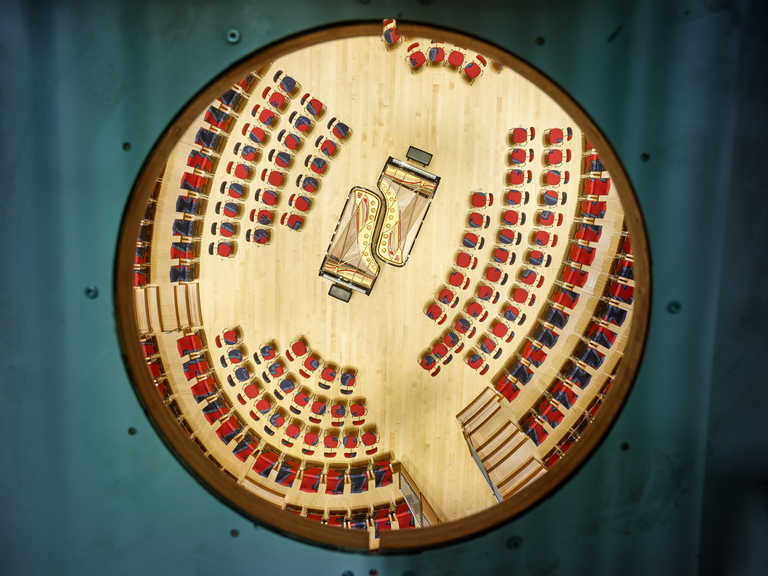
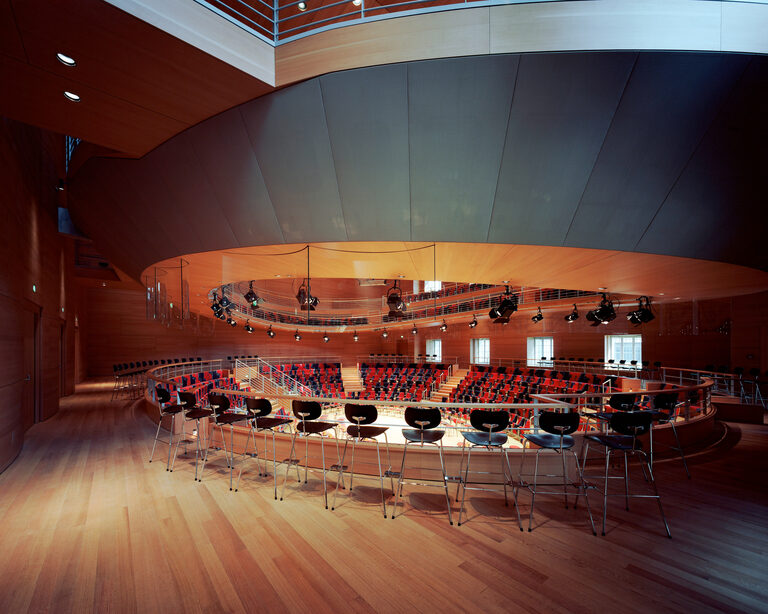
Born in 1925 in Montbrison, France, 50 kilometers west of Lyon, Pierre Boulez was one of the leading universal thinkers in music history. As a composer, conductor, theorist, and cultural emissary he left his mark on many disciplines, and his intellectual legacy has only grown since his death in January 2016. The concert hall named after him is a tribute to Boulez’s lifelong championing of curiosity and education, while also being a testament to his close personal and professional friendship with Daniel Barenboim.
“In principle a concert should be regarded as a means of communication, a live contact between active participants, whether they are listeners or creative artists.” Pierre Boulez
Communication and Curiosity
Music’s role as a means of communication is essential—Pierre Boulez was keenly aware of this and always emphasized its importance for all his artistic endeavors in a career spanning more than 70 years. His striving for clarity, exactitude, and creativity was an integral part of his personality. “A composer should always be looking far ahead, looking for something new. He should be a trailblazer,” Boulez said. His life and work were dedicated to the ideal of discovering new forms of musical expression and to always maintain curiosity. It was equally clear to him that the more one invests themselves in learning about music the fuller the listening experience would be. It is our hope that his spirit will live on in this new concert hall in the heart of Berlin’s cultural center, and that his curiosity will touch visitors for generations to come, imparting a desire to listen, learn, and discover.
music for the thinking ear CELEBRATING PIERRE BOULEZ AT 100
The storm has passed. The furious sky is clearing. The waves abate. Pierre Boulez is becoming a figure of the past.
The Boulez storm, one could say, settled down long ago. Boulez as a young man was furious with everything in the musical world around him; we can hear that in his Second Piano Sonata of 1947–8, an explosion of Beethoven’s “Hammerklavier.” He wanted, with Paul Klee, whose work he admired, to forget Europe and found a new artistic language, with just some elements from the most challenging European music before him—Webern, late Debussy, pre-1920 Stravinsky, Messiaen—reframed with aspects of music from Africa and East Asia.
It was a synthesis he achieved in 1957 in Le Marteau sans maître, scored for an ensemble echoing with sounds from European traditions both high (viola) and vernacular (guitar), from other continents (percussion), and from the universal flute (alto variety). Bullet-hard poems by René Char, the preferred poet of his youth, are set for mezzo-soprano voice but also inform purely instrumental movements.
However, Le Marteau not only affirmed the revolution but forestalled it. The wild man had come up with a masterpiece—Stravinsky agreed—and although the work set itself against the norms of European musical culture, that culture opened to embrace it. A whole array of ensembles for new music grew up to present works that similarly positioned themselves between orchestral and chamber music. The perpetrator, too, became accepted, if perhaps only because he turned out to be a strikingly original conductor. Within a decade he had appeared with major orchestras throughout Europe and the United States, and in the pit at Bayreuth.
Before encountering Paul Klee, I only ever thought in musical terms, which is not always the best way to see things clearly. —Pierre Boulez, Le Pays fertile. Paul Klee (1989)

Paul Klee, Der Bote des Herbstes (The Harbinger of Autumn) (1923)
Creatively, though, he was all but silent. On the podium two or three times a week, he was learning a huge amount of new repertory. Another call on his time was his need to revise. Pli selon pli, setting poems by his new literary passion, Stéphane Mallarmé, was finished in 1960, brought out in a new version five years later, and further altered into the 1980s. Mallarmé was also the spur to an aesthetics of incompletion, whereby works would be deliberately left in suspension or made infinite in their multiple possible realizations.
The opening in 1977 of IRCAM, the Institut de recherche et coordination acoustique/musique in Paris that was built and equipped to Boulez’s specifications, offered a way out of this labyrinth—but into another, of electronic transformation. Boulez extended his first exhibit, Répons, through the early 1980s but left it with the potential to continue endlessly.
In the 1990s he reduced his commitments to IRCAM, returned to conducting regularly, and began to produce works of long duration: sur Incises, composed 1996–8, and Dérive 2, begun in 1988 and revised through 2006. But if in all these ways he seemed to be stepping back from adventure, that was far from the case. As a conductor he was not only returning to old favorites—Stravinsky, Debussy, Bartók, Ravel—but treading new paths: a Janáček opera, Richard Strauss. And his late works carry his always characteristic lightning bolts into uncustomary realms of continuous wonderment.
The storm was by no means over. Nor is it yet. Taken up by conductors of the next two generations, his repertory is now our repertory. His music continues to amaze students, scholars, and audiences, and it still has secrets to yield. There is also the signal challenge his whole life holds out to us: to maintain curiosity and, where necessary, make storms of our own.
—Paul Griffiths
Paul Griffiths has been writing about music for more than 50 years. He wrote the first book on Pierre Boulez in 1978.