Corina Belcea Violin
Suyeon Kang Violin
Krzysztof Chorzelski Viola
Antoine Lederlin Cello
Program
Ludwig van Beethoven
String Quartet in C minor Op. 18 No. 4
String Quartet in E-flat major Op. 74 “Harp”
String Quartet in F major Op. 59 No. 1
Ludwig van Beethoven (1770–1827)
String Quartet in C minor Op. 18 No. 4 (1799)
I. Allegro ma non tanto
II. Andante scherzoso quasi allegretto
III. Menuetto. Allegro – Trio
IV. Allegretto – Prestissimo
String Quartet in E-flat major Op. 74 “Harp” (1809)
I. Poco adagio – Allegro
II. Adagio ma non troppo
III. Presto – Più presto quasi prestissimo – Tempo I –
IV. Allegretto con variazioni
Intermission
String Quartet in F major Op. 59 No. 1 (1805–06)
I. Allegro
II. Allegretto vivace e sempre scherzando
III. Adagio molto e mesto –
IV. Thème russe. Allegro

Challenges and Illuminations
Why are we so obsessed with Ludwig van Beethoven? Among the reasons that might be given, one is so obvious that it tends to be overlooked: he changed what we expect from music. Inextricably connected with that radical change are the bold demands any serious engagement with his music imposes on performers and listeners alike. Nowhere is this circle of exchange more consistently operative than in Beethoven’s body of string quartets, stretching across his career from his first decade in Vienna to the last composition he completed before his death in 1827.
Essay by Thomas May
Challenges and Illuminations
On Beethoven’s String Quartets
Thomas May
Why are we so obsessed with Ludwig van Beethoven? Among the reasons that might be given, one is so obvious that it tends to be overlooked: he changed what we expect from music. Inextricably connected with that radical change are the bold demands any serious engagement with his music imposes on performers and listeners alike. Nowhere is this circle of exchange more consistently operative than in Beethoven’s body of string quartets. Stretching across his career from his first decade in Vienna to the last composition he completed before his death in 1827 (the second finale of Op. 130), the genre became an obsession for Beethoven himself.
If Beethoven changed how we perform and listen to music, he also changed how music is discussed—for example, in the post-mortem operation that we call criticism. The Ninth Symphony, when it was initially being digested, provoked new ways of thinking and writing about the very topic of music. Coming to terms with the challenges posed by compositions as unprecedented as the late string quartets required a process of adaptation that strikes an uncannily familiar chord. It involved a “dialectic between initial befuddlement and subsequent illumination born of study,” the musicologist John Daverio has observed, that anticipates a pattern “closely associated with the reception of much 20th-century music.”
Indeed, the late quartets continued to resist assimilation into the mainstream well after Beethoven’s symphonies and piano sonatas had become its defining models. Daverio points out that “it was probably not by chance that the scores and parts of the late quartets were published more or less simultaneously”—thus allowing for in-depth study of each work as a whole—whereas there had been significant gaps between initial publication and the appearance of complete scores for Beethoven’s previous quartets. Thus the London-based Beethoven Quartet Society, which was founded in the 1840s, “took as one of its express aims the study of the late quartets from score.”
Digital Insights into Inexhaustible Music
“Illumination born of study” continues to motivate approaches to Beethoven’s quartets. As we approach the 200th anniversary of the composer’s death, the latest digital technology is being pressed into service to yield fresh insights into their inexhaustible secrets. Take the composer, software engineer, and inventor Stephen Malinowski (who goes by the handle “smalin” on YouTube). He began applying his technique of animated graphical representations of scores to Beethoven’s string quartets in 2010—using color theory, for example, to identify the tonic, dominant, and so on with specific colors as a way to illustrate changes in the underlying harmonic structure. By October 2019, Malinowski had created animated scores for every one of the quartets. (His complete cycle, accompanying performances by the Alexander String Quartet, can be viewed at www.musanim.com/BeethovenStringQuartets.)
The 16 string quartets—including the Grosse Fuge (the “Grand Fugue,” which Beethoven initially intended to serve as the finale of Op. 130)—comprise between eight and nine hours of music. According to the digital musicologist Fabian Moss—lead author of a 2019 study of the “statistical characteristics of tonal harmony” across the complete Beethoven quartets—the cycle contains nearly 30,000 chords. About 1,000 of these are different, while the most commonly occurring chords are, overwhelmingly and unsurprisingly, tonic and dominant chords. Such census-taking might bring an Anton Bruckner–like mania for counting to mind, but it provides the foundation for Moss and colleagues’ empirical analysis of what makes Beethoven sound like Beethoven.
Becoming Beethoven
That question was uppermost in the composer’s mind in his late 20s—or, more accurately rephrased, the question “What can make the string quartet sound like Beethoven?” During the waning two years of the 18th century and into the turn of the next, he worked intensively on Op. 18, which was issued in two separate volumes in 1801. The young transplant from Bonn to Vienna had been carefully preparing the way by focusing on other genres first (for example, the piano trio and piano sonata, which he chose as his Op. 1 and Op. 2, respectively; string trios; violin and cello sonatas; even a string quintet).
Beethoven reportedly had begun trying his hand at quartets already in 1795 in response to an aristocrat’s request, but these efforts were detoured into other compositions. The remarkable evidence of the sketchbooks so meticulously preserved by Beethoven documents the immense care that he devoted to this project. (Decades later, he produced more than 650 pages of sketches while composing Op. 131.) With regard to the string quartet (as well as such genres as the symphony, opera, and large-scale choral music), observes Joseph Kerman, Beethoven “moved into formidable competition with Haydn and Mozart in the forms they had cultivated with full responsibility and artistic intensity.”
While Haydn’s influence on Beethoven’s conception of this prestigious genre was inevitable—they even shared the same patron for quartet commissions: Carl Alois, Prince Lichnowsky—Mozart’s achievements in his “Haydn” Quartets of 1785 profoundly shaped the young German’s thinking (above all, the harmonic boldness of the “Dissonance” Quartet as well as K. 464 in A major, a direct model for Beethoven’s contribution in the same key, No. 5 in the Op. 18 set). At the same time, the “different” quality with which Beethoven’s brand was becoming associated can be gleaned from the first reviews. The Allgemeine musikalische Zeitung, based in Leipzig, acknowledged Beethoven’s artistry but noted that these works “must be played frequently, since they are difficult to perform and are in no way popular.”
Perfecter of Tradition or Iconoclast?
The biographer Maynard Solomon views this as representing the “classicist” perspective that would set a pattern of critiquing Beethoven “for perceived violations of normative precepts of order, unity, balance, and decorum.” Even Schubert, a contemporary who commanded a uniquely sympathetic understanding of Beethoven and who was impressed in particular by the quartets, initially resisted what he evidently viewed as disturbingly anti-classical (and the antithesis of his beloved Mozart). He deplored, in a famous diary entry of 1816, the older artist’s “eccentricity, which joins and confuses the tragic with the comic, the agreeable with the repulsive, heroism with howlings, and the holiest with harlequinades—without distinction, so as to goad people to madness instead of dissolving them in love, to incite them to laughter rather than lifting them up to God.” Beethoven himself would seem to have encouraged such takes with his reported response to naysayers, specifically referring to the string quartets: “They are not for you but for a later age” (Milton Babbitt avant la lettre).
Over time, the characterization of Beethoven’s art as quintessentially Romantic or even proto-Modernist has stood at one extreme; at the other is the image of his style as “a personal fusion of preexistent styles, traditions, and procedures rather than as a demonic or divinely inspired creation ex nihilo,” according to Solomon. Such a Classical-versus-Romantic dichotomy outlines shifting views of the composer, which have oscillated like a swinging pendulum up to the present—with the quartets in particular offering a rich proving ground for widely divergent perspectives.
Thus the Op. 18 Quartets show Beethoven both consolidating the High Classicism of Haydn and Mozart and also, to varying extents in each of these six works, pushing the known boundaries of the genre as he anticipates essential aspects of what we recognize as the “Beethoven style”—whether in the obsessive motivic saturation of the movement that launches the set (the F-major Quartet, though it was actually composed second) or the extraordinary structure of the finale of the Quartet in B-flat major (inscribed La Malinconia) that concludes Op. 18.
Because Beethoven so significantly affected the course of Western music history, we find ourselves in something like a musicological Heisenberg’s Uncertainty Principle situation: our own perspective inevitably affects however “objectively” we try to perceive the progression of Beethoven’s language in the quartets. The issue is further entangled in the traditional classification of Beethoven’s life work into three distinctive periods. Such tripartite division possesses an archetypal power—after all, it echoes the dialectical process. While skeptically assessing the well-known paradigm of early, middle, and late styles, Solomon finds that it is, in the end, defensible, aside from certain exceptions to the rule (such as the “Serioso” Quartet in F minor, Op. 95, from 1810–1).
Beethoven’s Quartets and the Three-Period Paradigm
The significant gaps in Beethoven’s quartet production underscore this three-period correlation. His Op. 18 quartets build on all he had absorbed from Haydn and Mozart, who in turn had secured the genre’s remarkable prestige: the string quartet as music for musicians, often compared to a conversational model—as Goethe later formulated it, music-making as “a conversation between four intelligent people.”
In 1806, five years after publishing Op. 18, Beethoven again took up the genre in the three quartets comprising Op. 59. The composer’s life experiences and artistic triumphs in the intervening half-decade had profoundly changed him. He had accomplished the miracles of the “Eroica” Symphony, the “Waldstein” Sonata, and the first version of Fidelio—and he had been forced to confront the trauma of his worsening and incurable deafness. Just as much as those works are for their respective genres, the C-major Quartet that launches Op. 59 is a Rubicon-crossing, game-changing composition: it forever altered what a string quartet could be.
But Beethoven was also responding to new developments in chamber music performance. Joseph Kerman notes the importance of the composer’s interactions with quartet players over the course of his career: above all, with the violinist Ignaz Schuppanzigh, who premiered some of his most important quartets. Kerman describes Schuppanzigh’s entrepreneurial approach to presenting chamber music in Vienna as a “harbinger of the professional world of the string quartet as we know it”—in contrast to the intimate circle of like-minded friends playing for each other evoked by the Op. 18 set.
The catalyst for Beethoven to return to string quartet writing was a commission from the Russian ambassador to the imperial court in Vienna (and amateur violinist), Count Andrey Razumovsky, Op. 59’s dedicatee. This time, Beethoven appears to have composed the set of three in the order in which they were published in 1808. Here, we encounter a fascinating example of Beethoven “toning down” his most experimental proclivities. His original version of the first movement of Op. 59 No. 1 resulted in an even longer duration for this work of immense architectural dimensions.
Beethoven had similarly “tamed” the opening movement of the F-major Quartet in Op. 18 by removing some of the recurrences of its six-note motif in his revision. Kerman notes that the first version “is decidedly more extreme in momentary musical inflection.” The notion of Beethoven steadily coming into his own with each phase of his quartets, starting with a more “conservative” approach, turns out to be simplistic and too tidy. Instead, it is more useful to think of “avant-garde” tendencies and a desire to be more accessible finding expression at different moments—whether within a given group of works or indeed across the otherwise neatly triadic span of Beethoven’s creative life.
Another period of change in the composer’s life circumstances, involving both personal loss and the stress of Napoleon’s second siege of Vienna in 1809, is associated with his ensuing string quartet efforts: Op. 74 and Op. 95 (1809 and 1810, respectively). Significantly, it is with these works that Beethoven began assigning a single opus number to each individual quartet. Considered side by side and also in relation to Op. 59, these two works posit an astonishing set of contrasts. The electrifying tautness of the F-minor Quartet (Op. 95), for example, inhabits a world very different from the confident expansiveness we had found in the C-major “Razumovsky” Quartet.
A dozen years elapsed after this before Beethoven again confronted the genre. In 1822, another Russian admirer, Prince Nikolai Galitzin (only 27 at the time), requested a set of three quartets on very generous terms. (An amateur cellist who promoted Beethoven’s music in Saint Petersburg, Galitzin had at first considered giving his commission to Carl Maria von Weber.) The composer completed his long-protracted Missa solemnis and Ninth Symphony first and then immersed himself in quartet writing.
Between 1824 and 1825, Beethoven was able to finish the three quartets, and he immediately embarked on two more, completing Op. 131 in the spring of 1826 and Op. 135, his last quartet, in the fall of that year. There followed the Allegro finale of Op. 130, his final completed composition. Once again, this represents a “concession” of sorts to something less radical. Beethoven initially intended to crown the B flat–major Quartet with the Grosse Fuge (Op. 133)—an “absolutely contemporary piece of music that will be contemporary forever,” as Igor Stravinsky characterized it. Yet, however reluctantly, Beethoven later was persuaded to write a less weighty, less technically and musically complex finale. (Incidentally, he died before ever hearing this subsequent version of Op. 130.)
The diametrically opposed tendencies that are threaded through the earlier quartets resurface in even more extreme ways in the late ones. Beethoven’s quartets for the Prince expanded steadily in design, from the four movements of Op. 127 to the six of Op. 132. He carried that tendency still further with the seven-movement Op. 131 that followed, yet he next plunged directly into Op. 135, whose compact design veers in the opposite direction.
The special aura around the late quartets has enhanced their status as the holiest of holies within the complete body of Beethoven’s works. Paradoxically, these compositions, which more than any defy paraphrase, have inspired two of the most impressive attempts in English literature to convey their musical truths through words: T. S. Eliot’s Four Quartets and Aldous Huxley’s 1928 novel Point Counter Point, which even incorporates the experience of listening to Heiliger Dankgesang from Op. 132 into its narrative.
Overall, the late quartets engage in a style of intense, fierce contrasts far more extreme than the ones against which Schubert had railed in his 1816 diary entry. Contradictory elements coexist in unprecedented ways, while visionary formal experimentation accommodates a dialogue with tradition (embracing Beethoven’s reexamination of his own past). Archaic procedures—above all, the composer’s obsession with counterpoint—are converted into innovations that have lost nothing of their capacity to astonish. In the late quartets, Beethoven gyrates without warning from the elated vision of a mystic to earthy, gruff humor—and somehow mingles it all together into unparalleled, unimagined unities.
The musical-historical, social, and political contexts of Beethoven’s life in Vienna had been inextricably linked with his changing approaches to the string quartet—as in the shift from the traditional model of lofty conversation to a more public, quasi-symphonic discourse in the “Razumovsky” Quartets, observes Joseph Kerman: “As Beethoven’s musical imagination turned inward, the quartet turned away from its earlier audiences.” That audience becomes “primarily the composer” in the late quartets, in which, as Kerman puts it, “Beethoven … achieved the privatization of the string quartet”—and we, the audience, become “an awestruck eavesdropper.”
Thomas May is a writer, critic, educator, and translator whose work has appeared in the New York Times, Gramophone, Opera Now, Musical America, Strings, and other publications. The English-language editor for the Lucerne Festival, he is also U.S. correspondent for The Strad and program annotator for the Los Angeles Master Chorale and the Ojai Festival.
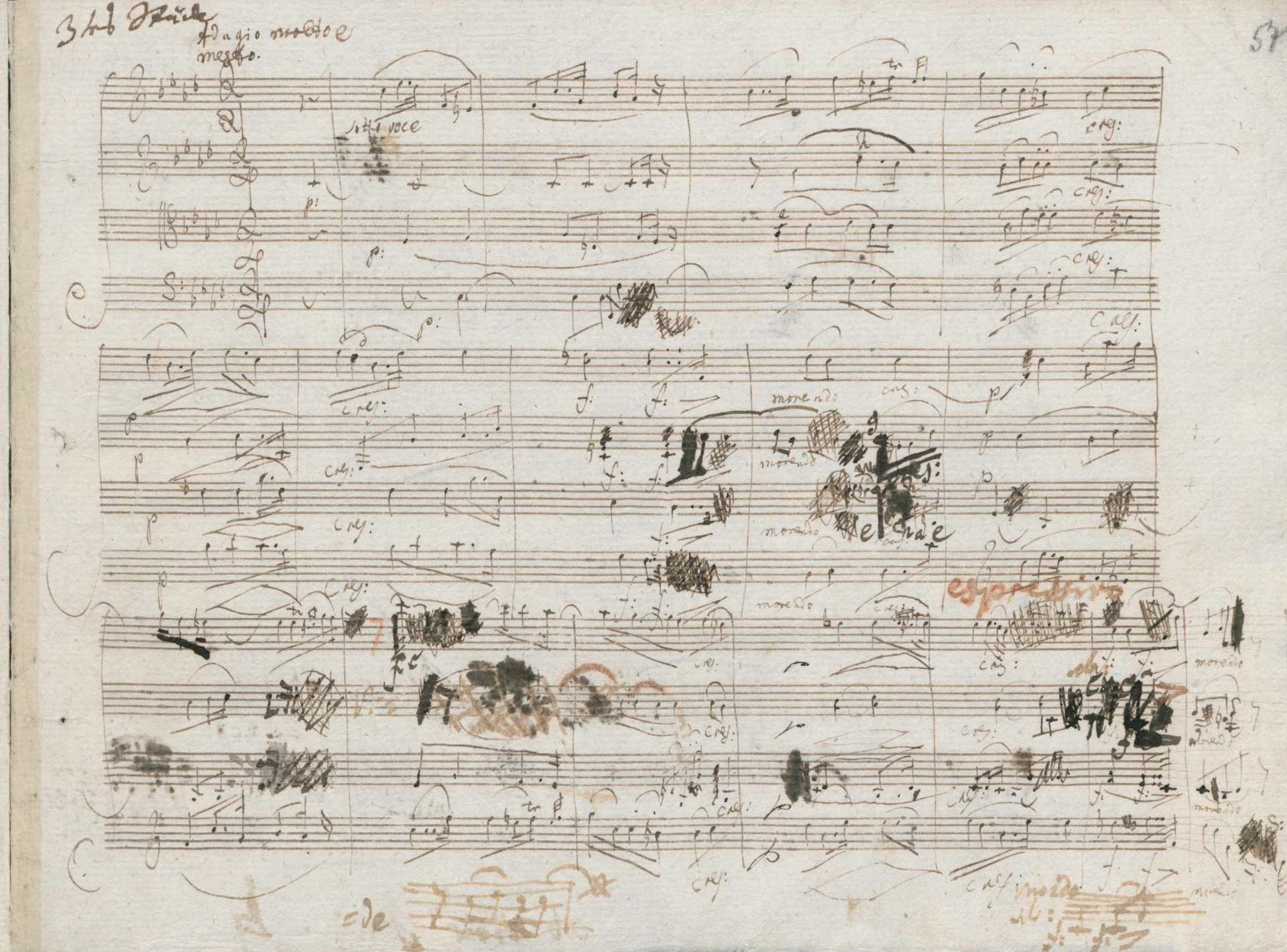
The third movement from the String Quartet Op. 59 No. 1 in Beethoven’s manuscript (Staatsbibliothek Berlin)
The Quartets
Notes on the works in today’s program
Quartet in C minor Op. 18 No. 4
Among the six Op. 18 Quartets, No. 4 is the only one in the minor mode. Yet its first movement does not quite comport with the full-on “C minor–mode” Beethoven that is more obviously on display in the contemporaneous Op. 13 “Pathétique” Sonata (published in 1799 and a bestseller from the start)—particularly in the dialectic between the first subject and the sunlit second one in E-flat major. Robert Simpson observes that with its “sense of movement … [p]erfect as a cat’s,” the Allegro ma non tanto conveys “strong purpose rather than the tragedy or pathos often associated with a minor key.”
Also out of keeping with the stereotype of “C-minor Beethoven” is the Andante scherzoso quasi allegretto. In lieu of a true slow movement, the composer presents this odd mixture of comic feints (note the use of dynamic contrasts) and fugal posturing. Returning to C minor, the minuet that follows gains urgency from accents that cut against the rhythmic grain. After a charming trio in the major, Beethoven specifies a speed-up of the reprise. The rondo finale spins out a Hungarian-flavored main theme—another aspect of Haydn’s influence—that works its way into the contrasting sections. Here, too, the tempo is speeded up at the end—to an even more dramatic Prestissimo.
Quartet in E-flat major Op. 74
In the summer and fall of 1809, Beethoven produced the first quartet he decided to confer with an opus all its own, sans companions. Op. 74 is one of several compositions in the key of E-flat major that he worked on around this time (including the Fifth Piano Concerto and the Piano Sonata “Les Adieux”). The E flat–major Quartet shares with these compositions an openness toward experimentation, argues Lewis Lockwood: Beethoven’s “choices of tempo, key, character, and formal plan” even point to “a new paradigm.” For example, the scherzo is unusually in the minor mode and, even more, is linked directly to the finale—one of several reminiscences of the Fifth Symphony. Beethoven’s innovations in the treatment of the quartet ensemble and its soundscape are so apparent to the ear that his publisher even gave this score the nickname “Harp,” with reference to the opening movement. Following the question-posing slow introduction (a ploy that recalls the third quartet of Op. 59), the Allegro incorporates a prominent role for pizzicato arpeggiation—not as mere “color” but “as a structural feature … unprecedented in the quartet literature” (Lockwood). It is intriguing to compare the effects of this pervasive sonority, which turns the ensemble into a kind of harp, with the Aeolian harp Beethoven evoked in the Largo of his Third Piano Concerto. But the latter’s ethereal associations are closer in spirit to the Adagio ma non troppo here.
The breakneck scherzo shifts to C minor. Its speeded-up variant of the “fate” motto rhythm echoes aspects of Beethoven’s recently premiered symphony in that key. Even the trio recalls the corresponding part of the Fifth’s scherzo, turning to boisterous figuration in C major. The theme that is varied in the Allegretto finale is almost understated—a clue to the surprise ending Beethoven supplies.
Quartet in F major Op. 59 No. 1
By the time Beethoven returned to the quartet genre after completing his Op. 18 set in 1801—on a commission from the Russian ambassador Count Razumovsky—he was a profoundly changed man and artist. This time, he appears to have composed the three Op. 59 quartets in the order in which they were published in 1808.
This first quartet in the Op. 59 set has often been likened to the “Eroica” as a game changer for the genre. Its dimensions alone are vast, unmatched in the composer’s quartet oeuvre until the late quartets. Beethoven even made some cuts, omitting the conventional repeat of the first movement exposition, for instance. The duration of his original version would have indeed been comparable to that of the Third Symphony. From the first measures, the opening Allegro conveys a similar sense of setting out on an epic journey—with the cello likewise playing protagonist. From its end of the registral spectrum, the music is passed on to the first violin, stretching the span over four octaves by the first fortissimo climax on the tonic chord. Formally, Beethoven expands the development—enriched by fugal intricacy—and coda, continuously developing his ideas. There is a sense throughout this work that Beethoven’s concern is not only for the musical arguments he is posing but for the expressive potential of the genre itself.
There is no lightening of mood and tension in the conventional way. Remarkably, all four movements are cast in sonata form. Switching the conventional order of the inner movements, Beethoven opens the Allegretto vivace e sempre scherzando with a gesture that must have struck its first audiences as experimental music: a theme made entirely of rhythm, articulated as a repeat-note pattern (again, starting with the cello). Then comes an emotionally weighty slow movement marked “Adagio molto e mesto”—mesto (mournful) being a rarity in Beethoven’s tempo indications, which he had also used for the profoundly affecting slow movement of the Piano Sonata in D major Op. 10 No. 3. The turn to F minor and the rhetorical elaboration of a state of grieving suggest an analogue to the C-minor funeral march in the “Eroica.” On the sketches for this music, Beethoven scribbled the enigmatic phrase “a weeping willow or acacia tree on my brother’s grave.” As he had suffered no recent loss of an actual brother, this has been interpreted as a symbolic reference (possibly Masonic).
The music eventually thins out into a solo violin cadenza, its trill leading the way into the finale and its spirited play with the “thème russe”—a Russian folk tune that is a tribute, of course, to Beethoven’s patron Razumovsky—that the cello initially proposes. Although the mood has brightened, the architecture of this movement is expansive, like the rest of the quartet.
—Thomas May
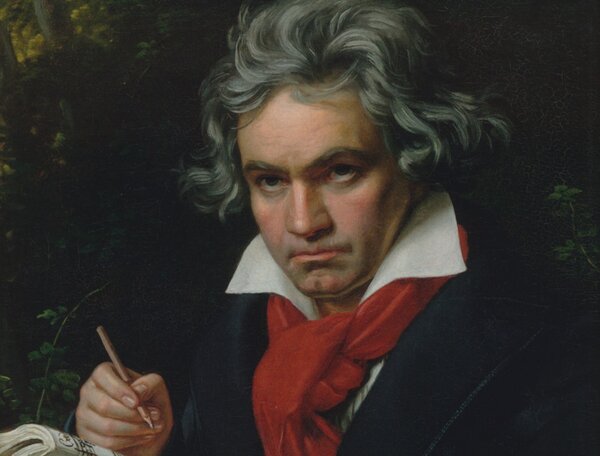
Ludwig van Beethoven, portrait by Joseph Karl Stieler (1819)
Wege und Wegmarken
Die Streichquartette Ludwig van Beethovens stellen innerhalb der Gattungsgeschichte einen zweifachen Meilenstein dar: Sie markierten zu Beginn des 19. Jahrhunderts die Weiterentwicklung der bis dahin von Haydn und Mozart dominierten Gattung und zogen so das zeitgenössische Publikum in ihren Bann; zugleich übten sie nachhaltigen Einfluss auf die weitere Entwicklung der Kammermusik aus – in den unmittelbar folgenden Jahrzehnten und bis weit ins 20. Jahrhundert hinein.
Essay von Michael Kube
Wege und Wegmarken
Beethovens Streichquartette
Michael Kube
Die Streichquartette Ludwig van Beethovens stellen innerhalb der Gattungsgeschichte einen zweifachen Meilenstein dar: Sie markierten zu Beginn des 19. Jahrhunderts die Weiterentwicklung der bis dahin von Haydn und Mozart dominierten Gattung und zogen so das zeitgenössische Publikum in ihren Bann; zugleich übten sie nachhaltigen Einfluss auf die weitere Entwicklung der Kammermusik aus – in den unmittelbar folgenden Jahrzehnten und bis weit ins 20. Jahrhundert hinein. Beethoven, der mit der Komposition und Herausgabe seiner ersten Quartett-Sammlung (op. 18) sichtlich zögerte und sich entgegen einem weit verbreiteten Usus mit drei als op. 1 veröffentlichten Klaviertrios der breiten musikalischen Öffentlichkeit präsentierte, war sich im Alter von knapp 30 Jahren des binnen kürzester Zeit zur Norm avancierten hohen Anspruchs an Satztechnik und Ausdruck eines Streichquartetts vollauf bewusst. Dem Verlangen nach ästhetisch herausragenden Werken kam er charakteristischerweise zunächst mit Kompositionen nach, die unüberhörbar bei den beiden großen Meistern des Genres anknüpfen, während er im Klaviertrio und in der Klaviersonate schon längst Neuland betreten hatte. Beethoven war damit Teil einer Entwicklung und zugleich eines Aufschwungs, den die junge Gattung Streichquartett um 1800 in verschiedene Richtungen nahm. Diese betreffen zunächst den Ort ihrer Aufführung, die nicht mehr ausschließlich im Salon des Adels oder in der bürgerlichen „guten Stube“ stattfand. Vielmehr drängte das Streichquartett in den öffentlichen Konzertsaal – erstmals wohl in aller Deutlichkeit abzulesen an den für London bestimmten Quartetten op. 71 und op. 74 von Joseph Haydn, die Anforderungen und „Spielregeln“ reflektieren, wie sie die Darbietung vor einem größeren und damit nicht mehr durchweg musikalisch erfahrenen Publikum mit sich brachte. Parallel dazu lässt sich – zumindest in Wien – ein erhöhter „Bedarf“ an spielbaren Werken feststellen, so dass man von einer regelrechten Mode sprechen kann. In der habsburgischen Hauptstadt erschienen zwischen 1800 und 1828 in einer beeindruckenden Kontinuität mehr als 400 Streichquartette von insgesamt fast 70 Komponisten, hinzu kamen noch zahlreiche Arrangements aus Opern und anderen Werken der Kammermusik.
Die musikgeschichtliche Situation war mithin durch zwei sich wechselseitig verstärkende Momente bestimmt: zum einen durch den unverkennbaren Wunsch der Musikschaffenden, sich mit der Gattung und ihren jungen Traditionen schöpferisch auseinanderzusetzen, zum anderen durch die musikliebende Gesellschaft, die privat leichtgewichtigere Quartette „konsumierte“ und doch an der Präsentation anspruchsvoller Werke in öffentlichen Konzerten teilhaben wollte. Dieses Vexierspiel war den Zeitgenossen durchaus bewusst. Bereits Johann Friedrich Reichardt, selbst Komponist und eloquenter Autor, schildert in seinen autobiographischen Berichten von einer Reise nach Wien in den Jahren 1808/09 einen Quartettabend eben unter diesen Aspekten; aufgeführt wurden ein Werk von Haydn, eines der Haydn gewidmeten Streichquartette von Mozart und ein Werk aus Beethovens Opus 18: „Es war mir sehr interessant, in dieser Folge zu beobachten, wie die drei das Genre so jeder nach seiner individuellen Natur, weiter ausgebildet haben. Haydn erschuf es aus der reinen hellen Quelle seiner lieblichen, originellen Natur. An Naivität und heiterer Laune bleibt er daher auch immer der einzige. Mozarts kräftigere Natur und reichere Phantasie griff weiter um sich und sprach in manchem Satz das Höchste und Tiefste seines inneren Wesens aus; er setzte auch mehr Wert in künstlich durchgeführte Arbeit und baute so auf Haydns lieblich-phantastisches Gartenhaus seinen Palast. Beethoven hatte sich früh schon in diesem Palast eingewohnt und so bleibt ihm nur, um seine eigene Natur auch in eigenen Formen auszudrücken, der kühne, trotzige Turmbau, auf den so leicht kein zweiter etwas setzen soll, ohne den Hals zu brechen.“
Gespielt hatte an diesem Abend das nach dem Primarius Ignaz Schuppanzigh benannte und für seine gründlich ausgearbeiteten Interpretationen hochgeschätzte Schuppanzigh-Quartett. Aufführungen wie diese stellten jedoch nur einen Teil der Aktivitäten des Ensembles dar, das gleichermaßen den Konzertsaal wie den Salon bediente. So nahm im Jahre 1808 der musikbegeisterte und enthusiastisch die Quartettkunst fördernde Graf Rasumowsky das Quartett in seine Dienste und versah es mit einer Pension auf Lebenszeit. Die solchermaßen für die Entwicklung der Gattung besonders förderlichen Umstände (zumal Beethoven für Proben seiner eigenen Werke auf das Ensemble zugreifen konnte) änderten sich, als am Silvesterabend des Jahres 1814 das Palais des Grafen ein Raub der Flammen wurde. Bereits wenige Wochen später gab das Ensemble sein Abschiedskonzert, und Schuppanzigh brach zu einer mehrere Jahren währenden Reise auf, die ihn bis nach Russland führte.
***
Umso auffälliger ist der Bruch, den Beethoven nur wenige Jahre darauf zum Spätwerk hin vollzog – etwa in dem Sinne, wie es die mit dem Komponisten befreundete Fanny Giannatasio del Rio 1816 in ihrem Tagebuch notiert. Als sie Beethoven ihre Bewunderung für sein bisheriges Schaffen gestand, soll dieser vor sich hingesprochen haben: „Mir schweben ganz andere Dinge vor.“ Wie anders Beethoven dann konzipierte und gestaltete, lässt sich durch einen Blick auf die gewichtigsten Werke der folgenden Jahre ermessen: dazu zählen die „Hammerklaviersonate“, die „Diabelli-Variationen“, die Missa solemnis und die Neunte Symphonie – und eben auch die letzten fünf Streichquartette. Sie alle nötigen bis heute nicht nur tiefen Respekt ab, sondern stecken auch voller musikalischer Herausforderungen. So geht es in den Quartetten um eine subjektiv geprägte Aussage, realisiert in einer strengen Charakterisierung jedes einzelnen Satzes und bestimmt durch die äußerste Beschränkung des zugrunde liegenden thematisch-motivischen Materials. Dahingehend äußerte sich etwa auch der mit Beethoven befreundete Geiger Karl Holz – mit einer Bemerkung, die kompositorische Prinzipien benennt und von Beethovens Seite offenbar unwidersprochen blieb: „Ihre Stücke haben durchaus den eigentlich ausschließlichen Charakter. Ich möchte den Unterschied zwischen den Mozart’schen und Ihren Instrumental-Compositionen so erklären: zu einem Ihrer Stücke könnte ein Dichter nur ein Werk schreiben; zu einem Mozartschen könnte er aber 3 bis 4 analoge schreiben.“ Für Mozart ließe sich dies mit dem Schlagwort der „Einheit in der Vielfalt“ der Gedanken bezeichnen; bei Beethoven geht es um die „Vielfalt in der Einheit“, den Gestaltenreichtum weniger Motive.
Auch wenn Beethoven nach Abschluss seiner „mittleren“ Quartette offenbar schon längere Zeit wieder an die Komposition eines Streichquartetts gedacht hatte, konkretisierten sich seine Pläne erst, als die erforderliche aufführungspraktische Infrastruktur wiederhergestellt war und ein konkreter Auftrag vorlag. Im April 1823 kehrte Schuppanzigh nach Wien zurück, bildete eine neue Quartett-Formation und bemerkte anlässlich seines ersten Besuchs bei Beethoven, gewissermaßen launig an alte Zeiten erinnernd: „Auf dem Lande werde ich ihn besuchen, da wollen wir zusammen ein neues Quartett komponieren.“ Den entscheidenden Anstoß zur Komposition des Es-Dur-Quartetts op. 127 dürfte jedoch ein Brief des Fürsten Nikolai Galitzin gegeben haben, in dem dieser Beethoven um „un, deux ou trois nouveaux Quatuors“ bat. Umso enttäuschender verlief dann die Uraufführung zwei Jahre später, am 6. März 1825 in Wien. Aufgrund verschiedener unglücklicher Umstände stand am Ende nicht der erhoffte Erfolg, sondern Unverständnis. Beethovens Neffe Karl berichtete seinem Onkel: „Es geschahen viele Störungen. Erstlich gings nicht recht zusammen, dann sprang dem Schuppanzigh eine Saite, was auch viel beytrug, da er nicht einmahl eine 2te Violine bey der Hand hatte.“ Bereits am 23. März kam es zu einer weiteren Aufführung, nun durch das konkurrierende Böhm-Quartett. Dabei wurde das Werk gleich zweimal hintereinander gespielt, außerdem stand mehr Zeit zur Vorbereitung zur Verfügung. Neffe Karl bemerkte dazu unter Verweis auf Schuppanzigh: „Ich weiß aber, daß es bloß dadurch nicht durchaus verständlich wurde, weil die Primstimme so schlecht ging. Steiner [ein Wiener Verleger] sagte bey der Probe [des Böhm-Quartetts] jetzt erst fasse er es vollkommen, und begreife gar nicht, wie das ein und dasselbe Quartett sey, was Schuppanzigh gespielt habe.“
Noch im März kam es zu einer klärenden Aussprache zwischen Beethoven und Schuppanzigh über die sprichwörtlich „vergeigte“ Uraufführung. So tragisch das Schicksal eines ertaubten Komponisten auch sein mag, so hat dieser Umstand doch dazu geführt, dass uns weite Teile der Unterhaltungen quasi im Originalton überliefert sind – jedenfalls all jene Beiträge, die Beethovens Gesprächspartner in seine Konversationshefte eintrugen. Im Fall dieser Unterredung hatte sich der hochverdiente Primarius für die misslungene Aufführung zunächst zu rechtfertigen: „Es ist wahr, daß wir es zu bald gemacht haben, und es nicht gegangen ist, wie es seyn sollte, jedoch hat es nicht nur allein an mir gefehlt, sondern an uns allen 4.“ Später dann heißt es, im Ton bereits gelassener, mit Blick auf die Konzertdarbietungen und über die Anforderungen der Komposition: „Die öffentlichen Quartetten gehen so gut zusammen, als es nur möglich ist. Mechanische Schwierigkeiten sind ja nicht darinn, nur die Originalität macht es schwer, welche man im ersten Augenblik nicht fassen kann.“
Diese „Originalität“ schließlich macht Beethovens späte Streichquartette zu einem Sonderfall in der Musikgeschichte – den Werken wurde gleichermaßen Unverständnis wie tiefer Respekt entgegengebracht. Von Anfang an waren die Rezensionen beherrscht von der Diskussion um die immensen Schwierigkeiten, die sich bei der ersten Konfrontation mit diesen klingenden Ausnahmeerscheinungen einstellten und sich erst allmählich, nach näherer Beschäftigung und mehrfachem Hören auflösten. So heißt es Ende 1825 über das neue Quartett op. 132 bereits relativierend: „Was unser musikalischer Jean Paul hier gegeben hat, ist abermals gross, herrlich, ungewöhnlich, überraschend und originell, muss aber nicht nur öfters gehört, sondern ganz eigentlich studirt werden. […] Wie das zuletzt vor diesem erschienene Quartett (in Es) Anfangs lau aufgenommen, dann erst begriffen, erkannt, und nun den geschätztesten Meisterwerken beygezählt wurde, so wird es wohl auch diesem neusten gehen.“ Zugleich gaben die Werke Anlass, erstmals über das noch vergleichsweise neue Kritikerwesen umfassend zu reflektieren. Friedrich Rochlitz, Herausgeber und Redakteur der in Leipzig erscheinenden Allgemeinen musikalischen Zeitung schreibt im Sommer 1828 einleitend über das Quartett op. 131: „Wir erklären uns darüber, obgleich diess keine Recension jenes Quartetts (eher eine, des Recensenten) abgibt.“
***
Überblickt man die fünf späten Streichquartette, so ergeben sich in jedem Werk immer wieder neue Konstellationen – hinsichtlich der Disposition der Sätze insgesamt, der formalen Anlage der einzelnen Sätze, der zugrunde liegenden diatonischen Skalen sowie der Harmonik, des Ambitus und der Klanglichkeit. Es entspricht der damit verbundenen Individualisierung, der Schärfung des Profils einer jeden Partitur, dass Beethoven diese Werke nicht nur mit einer eigenen, separaten Opuszahl versah, sondern die Quartette auch an verschiedenen Orten bei jeweils anderen Verlagen erscheinen ließ: op. 127 bei Schott in Mainz, op. 130 in Paris bei Schlesinger und op. 131 bei Artaria in Wien. Damit war grundsätzlich auch die Bündelung einzelner Kompositionen zu einer Sammlung von drei oder gar sechs Werken endgültig aufgegeben. Dennoch wurden dem Fürsten Galitzin die drei Werke op. 127, op. 132 und op. 130 (so die chronologische Reihenfolge) zugeeignet – nicht jedoch die Streichquartette cis-moll op. 131 und F-Dur op. 135, die Beethoven trotz größter Verdichtung des Materials und harter Arbeit in den Skizzen gewissermaßen in einem fort schuf, mit der Konsequenz, dass manche Motive sich auf einen Archetypus zurückführen lassen und damit die Kompositionen als Gruppe – wenn auch eher subkutan als ohrenfällig – untereinander in vielfacher Weise in Beziehung stehen und damit einen größeren Zusammenhang konstituieren.
Unter gattungsgeschichtlichen Aspekten lassen sich an Beethovens spätem Quartettschaffen zwei Tendenzen ausmachen, die nur auf den ersten Blick gegensätzlich erscheinen, jedoch voneinander nicht zu trennen sind: Da ist zunächst die weitreichende Abkehr von etablierten Formmodellen wie auch von der mittlerweile konventionellen viersätzigen Disposition; dies ist leicht zu erkennen an der Gliederung und den Satzüberschriften. So gibt es in op. 127 vordergründig noch eine viersätzige Ordnung, die freilich nach innen mit einem eigentümlich gegliederten Kopfsatz und hochkomplexen Charaktervariationen neu gestaltet wird. In den drei folgenden Streichquartetten erweitert Beethoven den Zyklus gar auf fünf, sechs, sieben Sätze, um in op. 130 mit dem ursprünglichen Finale der „Großen Fuge“ alle bestehenden formalen, satztechnischen und harmonischen Grenzen hinter sich zu lassen. Die zweite grundlegende Tendenz betrifft die Erweiterung des Spektrums der Satzcharaktere, mit der sich für die Gattung Streichquartett nun auch neue Horizonte eröffneten. Historisch realisiert sich hierin das allgemein aufkeimende Bewusstsein über Kompositionen der Vergangenheit (freilich nicht im Sinne des Klassizismus à la Mendelssohn). In Beethovens späten Streichquartetten haben vielmehr ganz unterschiedliche Modelle und Verfahren Eingang gefunden, die vielfach der Vokalmusik entlehnt sind (etwa Rezitativ und Arie, Lied, Hymne und Choral). Satztechnisch ist es der mehrfache Rekurs auf den Kontrapunkt, der sich prägend auswirkt – ein Kontrapunkt, der nicht mehr nur als ein Verfahren unter vielen anderen das Gleichgewicht der vier obligaten Stimmen mitbestimmt und regelt, sondern in verschiedener Weise selbst zum abstrakten Thema wird, sei es in Anlehnung an seine strenge Ausformung in der „klassischen Vokalpolyphonie“ oder – in rhythmisch provozierender Gestalt – etwa an Johann Sebastian Bachs Klavierwerke.
Am Ende erscheint es nur konsequent, wenn Beethoven nach all den beschrittenen neuen Wegen, nach den Werk um Werk auf verschiedenen Ebenen vollzogenen Innovationen sich wieder der Konvention versichert, sich gleichsam auf die äußeren Stützen der Gattungstradition zurückzieht: Sein letztes vollendetes Quartett, das Werk in F-Dur op. 135, ist wieder regulär viersätzig angelegt. Auch dem Umfang nach kann es den älteren Mustern der Gattung an die Seite gestellt werden, zudem wirkt der Tonfall vergleichsweise entspannt. Satztechnisch präsentiert sich indes ein Minimalismus, der die zuvor gewonnenen kompositionstechnischen Erfahrungen im Detail reflektiert.
Prof. Dr. Michael Kube ist Mitglied der Editionsleitung der Neuen Schubert-Ausgabe sowie Herausgeber zahlreicher Urtext-Ausgaben und war von 2012 bis 2025 Mitarbeiter des auf klassische Musik spezialisierten Berliner Streaming-Dienstes Idagio. Seit 2015 konzipiert er die Schul- und Familienkonzerte der Dresdner Philharmonie. Er ist Juror beim Preis der deutschen Schallplattenkritik und lehrt Musikgeschichte an der Musikhochschule Stuttgart sowie Musikwissenschaft und Musikvermittlung an der Universität Würzburg.
The Ensemble
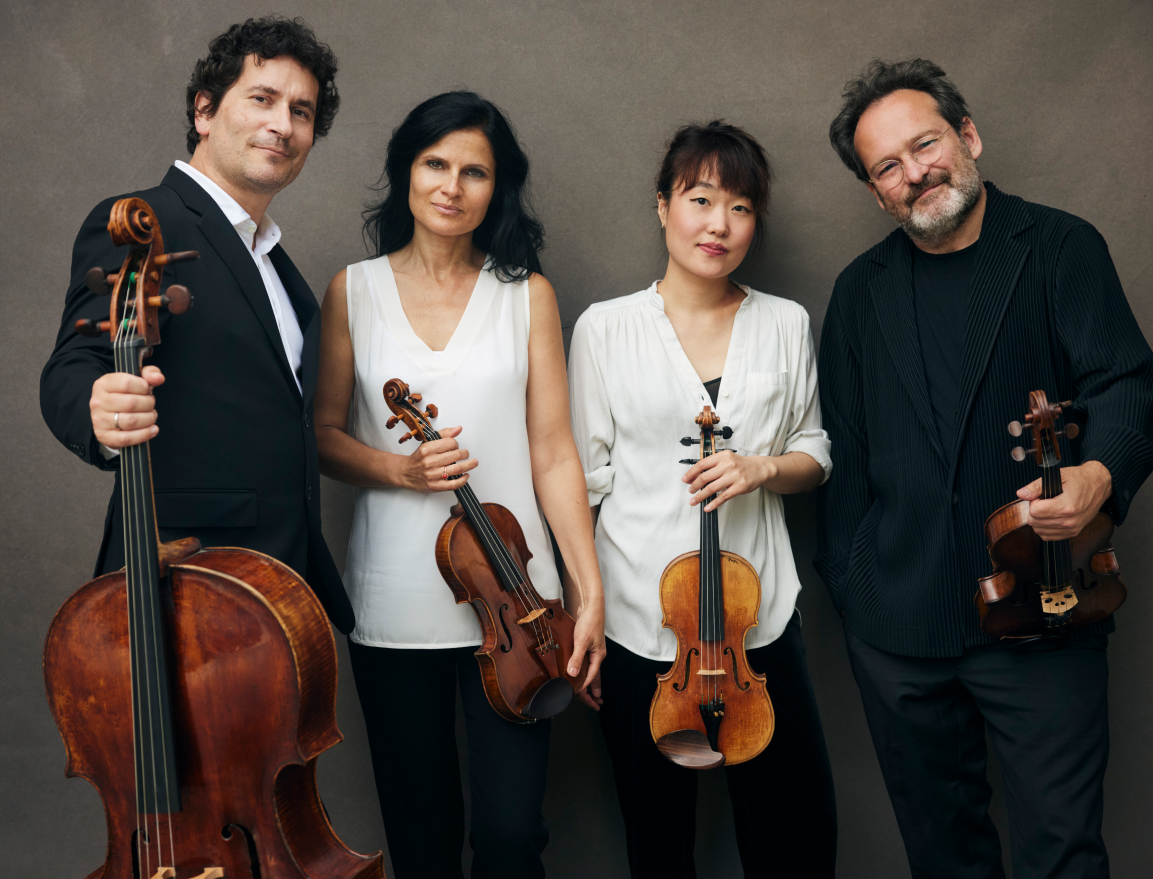
Belcea Quartet
Founded in 1994 at the Royal College of Music in London, the Belcea Quartet is among the world’s leading string quartets. Since the beginning of last season, the lineup has included Corina Belcea, Suyeon Kang (violin), Krzysztof Chorzelski (viola), and Antoine Lederlin (cello). The group has been ensemble in residence at the Vienna Konzerthaus for more than 15 years, a role in which the musicians were joined by Quatour Ébène in 2021. Among their many recordings, several of which have been honored with major awards, are the complete quartets of Beethoven, Brahms, Bartók, and Britten, as well as works by Mozart, Schubert, Berg, Dutilleux, Ligeti, and many others. A dedicated champion of contemporary music, the Belcea Quartet in recent years has premiered new works by Mark-Anthony Turnage, Thomas Larcher, Krzysztof Penderecki, Joseph Phibbs, Guillaume Connesson, and most recently Julian Anderson. At the Pierre Boulez Saal, the quartet has presented multiple concerts each season since the hall’s opening in 2017. For its 25th anniversary, which coincided with the Beethoven Year, the ensemble performed a number of the composer’s string quartets here in the 2019–20 season. The cycle remained incomplete due to the pandemic and is now being heard in its entirety over the course of this current season, commemorating the 200th anniversary of Beethoven’s death. Several years ago the quartet created the Belcea Quartet Trust, which aims to support young string quartets through intensive individual coaching sessions and to commission new works from today’s leading composers.
October 2026