François-Xavier Roth Conductor
Jenny Daviet Soprano
Boulez Ensemble
François-Xavier Roth Conductor
Jenny Daviet Soprano
Anne Romeis Bass Flute
Nina Janßen-Deinzer Bass Clarinet
Martin Posegga Tenor Saxophone
Ronan Whittern Bassoon, Contraforte
Ben Goldscheider Horn
Mathilde Conley Trumpet
Ricard Ortega Ribera Trombone
Dominic Oelze, Martin Barth Percussion
Holger Groschopp Piano, Synthesizer
Teodoro Anzellotti Accordion
Pierre Bibault Electric Guitar
Jiyoon Lee Violin
Álvaro Castelló Viola
Arne-Christian Pelz Cello
Otto Tolonen Double Bass
Senay Uğurlu Synthesizer Assistant
Program
Maurice Ravel
Sonata for Violin and Cello
Rebecca Saunders
Skin
for Soprano and 13 Instruments
Rebecca Saunders
Skull
for 14 Instruments
Maurice Ravel (1875–1937)
Sonata for Violin and Cello "À la mémoire de Claude Debussy" (1920–2)
I. Allegro
II. Très vif
III. Lent
IV. Vif, avec entrain
Rebecca Saunders (*1967)
Skin
for Soprano and 13 Instruments (2015–6)
Intermission
Rebecca Saunders
Skull
for 14 Instruments (2022–3)
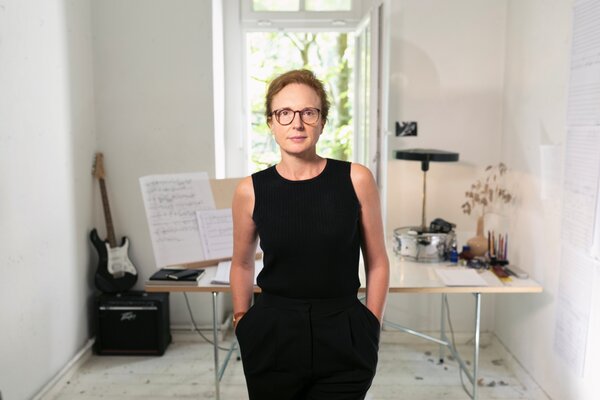
Rebecca Saunders (© Astrid Ackermann)
Corporeal Sounds
What if our concept of the modern were rooted not in abstract structure and rupture with the past but on corporeality, on the sense of music as a physical body composed of sound? The works by Maurice Ravel and Rebecca Saunders that make uo tonight’s program illustrate this question.
Program note by Paul Griffiths
Corporeal Sounds
Music by Maurice Ravel and Rebecca Saunders
Paul Griffiths
I. Sonata
Maurice Ravel has not usually been counted among the central moderns, but perhaps it is time, following his sesquicentenary last year, to rethink. What if our concept of the modern were rooted not in abstract structure and rupture with the past but on corporeality, on the sense of music as a physical body composed of sound, with rhythms of muscular movement and rounded surfaces that might stimulate and invite? Ravel was a master here, and—though he may never have had a physical relationship with another human being—a composer who could marshal his music to the urges, exuberant or dangerous, of sex. Daphnis et Chloé and La Valse are supreme examples. Seduction is his music’s principle move.
We may feel this to be less the case in his Sonata for Violin and Cello—and we would have Ravel’s own word for thinking so: “I believe this sonata marks a turning point in the evolution of my career,” he wrote. “Reduction here is pushed to the extreme. Renunciation of harmonic charm; an increasingly marked reaction towards melody.” Reduction and renunciation give no sense of being in contact with a vital, vibrant body, almost warm to the touch. Listen, though, to how this work begins, with two instruments in exactly the same registral space, accommodating one another, corresponding with one another, engaging in a game of flirtation that cannot be stopped (and that briefly returns more than once in the finale).
Ravel wrote this opening movement in 1920, and when the editors of the main French music magazine of the time, the Revue musicale, wanted memorials to Debussy (who had died in 1918), this, rather curiously, is what he gave them. He finished the work two years later.
It was a difficult time for Ravel. Besides being affected by the war, he had lost his mother, in 1917, and had since written La Valse as musical autodestruction (which, of course, does not stop it being also rampantly orgasmic, since sex and death are signatories to the same human phenomena and cultural expressions). However, as we have begun to observe, the teasing, sensuous chords are still there in the Sonata, in the guise of arpeggios, even if much of the piece indeed works as line-against-line counterpoint—and it is also perfectly possible for this counterpoint to have an embodied character, as it does in the scherzo second movement, a dance of come-on and evasion.
Corporeality can even be invested in canon at the beginning of the slow movement, on a theme brought back with a new countermelody to effect a completion, a theme with a characteristic modal color, Dorian A minor. Similar modalities elsewhere are responsible for allusions—for example, to Asian music in the violin’s incremental pizzicato tune in the scherzo or to something like a sea shanty in the main theme of the finale, where the paired instruments, paired dancers might be two sailors (but let that pass). Hence, too, the extracurricular contrapuntal techniques Ravel needs, notably in the finale’s frenzied consummation, where the dazzle almost obliterates the shadow, but not quite.
II. Skin
Rebecca Saunders has not been shy of disclosing her engagement with the human body in several of her more recent titles—not only those of Skin and Skull but also of Scar for new-music ensemble (2018–9), The Mouth for soprano and tape (2018–20), Wound for new-music ensemble and large orchestra (2022), Breath for violin duo (2023) and, by no means least, Lash, her opera premiered at Deutsche Oper Berlin last year, where the sense is of “eyelash,” an eyelash lost in the act of sex to find an exquisite new place. And not only the titles but the music has to be corporeal. “For me,” she has said, “what’s really important is enabling the listener to feel the magical physicality of sound—the timbre, the color, the mass, the weight of sound.”
Her program note for Skin, which she composed in 2015–6 for Juliet Fraser and Klangforum Wien, begins with a sequence of definitions that, though they are presented as if taken from a dictionary, are her own and certainly include the corporeal, even the carnal. For example: “the delicate membrane separating the body and its environment—implies touch.” Or: “Under one’s skin: so deeply penetrative as to irritate, stimulate, provoke thought, or otherwise excite. Under the skin: beneath apparent or surface differences: at the heart. Skin as a metaphor for transience—the continuous process of shedding dead skin and the growing of new.” She ends with a note on what in the piece is sung: “The main text in Skin is my own, which gradually materialized during the long compositional process, and was partly inspired by the collaborative sessions with Juliet Fraser. The close of Molly Bloom’s monologue from Joyce’s Ulysses is quoted towards the end.”
Unashamed by its obligations as a virtuoso piece—indeed, fulfilling those obligations to the utmost—the work stretches its soprano protagonist across the feverishly alive body of instrumentalists. She is this music’s skin. Voice is this music’s skin. It is to voice we listen first, and through voice to the veins of instrumental color to which voice is so often attached: as voice and instrument or instruments combine in blurred sounds, or as voice’s pitch echoes on through the ensemble, through the densely reverberant void of which voice is the skin, or as players themselves whisper, but so rarely, or as voice becomes instrument in losing traction on words.
Words of course are important, in a work of voice, by a composer who returns again and again to her chosen authors. There is the stretch from Molly’s monologue introduced, though largely subsumed, subcutaneous, immediately after a long pause from voice. Before and beyond that, the composer’s text alights on words received from, heard through, plays and prose pieces by Beckett: “dust” (Ghost Trio), “still” and “stir” (Stirrings Still), “clouds” (…but the clouds…), “breath” (Breath). Shed by others, shed then by the composer (“crimson,” from the Joyce, the title of a piano work written in 2004–5), these words are reformed as a skein, a skin. How they sound is crucial to creating their multifarious sonic realizations of phoneme, their glides and resonances of similarity (more/nor, quite/quietly, stay/say/so) or identity. Even so, what they mean is always implicit, and will sometimes rise above the waves—rise, one might say, “like fire,” to quote the words from Molly that voice enunciates right before that long pause. Like the nebula left by a star’s explosion, the words are hot evidence something happened but cannot disclose what. It is their utterance that makes them hot, utterance so resourcefully and precisely composed as to make a clean sweep of vocal hysterics. Voice is not reactive but active. So fierce as to hold us at bay. So fierce as to demand our attention.
III. Skull
Skull, written in 2022–3, goes with Skin and also Scar to form a triptych that has so far had only one full performance, in Paris in November 2024. Skull itself was composed for the Ensemble Modern, who gave the first performance at their home in Cologne in May 2023.
The three works are for ensembles of similar size that are alike in other ways: all three include a brass trio, and Skull and Skin avoid high woodwind. Saunders points out in her program note, though, that “in Skull the instrumentation differs greatly from the other works. The central timbral focus lies with the lower range of the wind and brass instruments, and the piano and electric guitar are replaced with an analogue electric Korg BX3 drawbar organ, chosen for its flexibility and striking sound.”
With this work, she goes on, “I sought a cohesive formal unity for the triptych. Simultaneously, and in stark contrast to Skin and Scar, Skull pursues a complex web of lyrical polyphony stretching from the very first sound to the final fermata.
“Skull partially draws on Skin and Scar, setting up passing points of reference, and reflecting on timbral fragments, individual gestures, and sounds inherent to the earlier works. These fragments are both diffused and condensed, transformed and mutated, and seek to delve from the outermost surface of the acoustic body to the edge of the innermost, of consciousness—as it were, to the skeletal essence within.”
She ends then with a quotation from Haruki Murakami’s Hard-Boiled Wonderland and the End of the World: “The skull is enveloped in a profound silence that seems nothingness itself. The silence does not reside on the surface but is held like smoke within. It is unfathomable, eternal, a disembodied vision cast upon a point in the void.”
The pace of the music is nearly always slow but always inexorable, and the motif of a falling tear, a falling semitone often sliding, is almost omnipresent but changed a thousand ways—in color, with microtonal intonation, turned upside-down as if a tear could fall upwards and go on falling that way forever—so that it never loses the poignancy and the grace of freshness. Percussion instruments seem to be remembering how all this came to happen, how the world is as it is. When it all seems to be coming to an end, the four string instruments break out to try to make this not be so, until they tie themselves into a knot.
The repeated instruction above the music to “Move on!” is barely necessary, for this music knows exactly where and how it is going because it has gained thorough independence from its author and has turned its gaze to its audience.
Paul Griffiths has been writing on music for more than 50 years. He also writes novels, including most recently let me go on (2023).
Rebecca Saunders: Skin
The text heard in Rebecca Saunders’s Skin consists of six “Text Images,” fragments of which are sung and spoken by the soloist.
The main text in Skin is my own, which gradually materialized during the long compositional process and was partly inspired by the extensive collaborative sessions with Juliet Fraser, who sang the premiere. A section from James Joyce’s Ulysses, from the final passage of Molly Bloom’s Monologue, is quoted towards the end.
—Rebecca Saunders
Text Images
No more. Quite quietly. Trick steady shit. Quantities oh. Skin that awful deep down. One below and burning. Biting of the skin and. Melt, melt. Fabulous, it is wonderful.
Charging thoughts remnants.
Shielded well sometimes like a secret. Disclosure still. And saw me. So, so, so. Quite simple. Quite stirring.
One below and burning. Biting. Melt, melt. Fabulous. So still, so, so. Stay so, stay, more dust. More skin. More skin. More said. Nor unsaid. (Untold, untruth.)
Quite never understood. Biting of the skin. Melt, melt. Fabulous.
Oh still.
***
So, so, so. Stay so. Not unsaid. Some thing. Some moment. More dust. More skin. More said. Yes. No more no say. Untold untruth. Conclude remnants and......dust.
***
More said. Nor unsaid. So, so, so. Quite. Quite simple. So still, so. Stay, more dust. More skin. Untold. Untruth. Even if you quite. Ah! Shit no never. Quite quietly.
One below and burning. Biting. Melt, melt. Fabulous oh skin! That awful deep down. TRICK steady shit. Quantities of.
Biting of the skin and charging. Thought’s remnants. Some thing. Some moment. Yes unnamed, remnants and dust. Crimson crimson. No more no say untold untruth.
Conclude unnamed. Clouds, breathe and dust. Nearly, quite quietly. Quite almost remnants, our shadows. Untold of dust. More dust my skin. Yes quite simple. Stir still so quietly. More quietly. Yes deep down. Some light. Some burning. This dust. Biting more dust. More lies. So told. So so. Quite simple, still so.
Quite quietly. Quite melting. Yes crimson no more....
***
Fabulous I know it is wonderful. Told low. Marmor, dimmed in shadow. Stirring as if late. Oh yes and saw me. So, so. Quite simple. Quite quiet. So still, so. Stay, more dust. More skin. Shielded well, sometimes like a secret. Disclosure still. Untold, untruth, even if you quite never understood. Ah! trick steady and one below and burning.
Melt, melt and charging. Thought’s remnants. Some thing. Some moment. Crimson crimson, no? No more no say, untold untruth. Conclude unnamed....
More remnants. Some breath and dust.
***
…turbans like kings asking you to sit down in their little bit of a shop and Ronda with the old windows of the posadas 2 glancing eyes a lattice hid for her lover to kiss the iron and the wineshops half open at night and the castanets and the night we missed the boat at Algeciras the watchman going about serene with his lamp and O that awful deepdown torrent O and the sea the sea crimson sometimes like fire and the glorious sunsets and the figtrees in the Alameda gardens yes and all the queer little streets and the pink and blue and yellow houses and the rosegardens and the jessamine and geraniums and cactuses and Gibraltar as a girl where I was a Flower of the mountain yes when I put the rose in my hair like the Andalusian girls used or shall I wear a red yes and how he kissed me under the Moorish wall and I thought well as well him as another and then I asked him with my eyes to ask again yes and then he asked me would I yes to say yes my mountain flower and first I put my arms around him yes and drew him down to me so he could feel my breasts all perfume yes and his heart was going like mad and yes I said I will Yes.
(excerpt from Molly Bloom’s monologue from James Joyce’s Ulysses)
***
More dust. Dust. More lies caught. Mine so told low. Marmor, dimmed in shadow. Oh.....yes.
And saw me. So, so, quite simple. Tender. So still. So say. More dust, more skin. Shielded well, sometimes like a secret. Disclosure.....still.
More said. Nor unsaid. Shadows untold, untruth, even if you quite never, ah! Shit no never no more. Quite quietly. Tricky steady quantities more skin. Oh that awful deep down. Below and burning. Biting of the skin and. Melt, melt. Fabulous, it is......won-der-ful! Thought’s remnants. Some thing. Some moment. Yes unnamed, remnants and dust. Crimson crimson. No? No more no say. Untold, untruth. Conclude unnamed. Clouds. Breath and dust. Skin. Nearly, quite quietly, our shadows. Inaudible. Of no name. Untold of dust. More dust. my skin, my...skin.
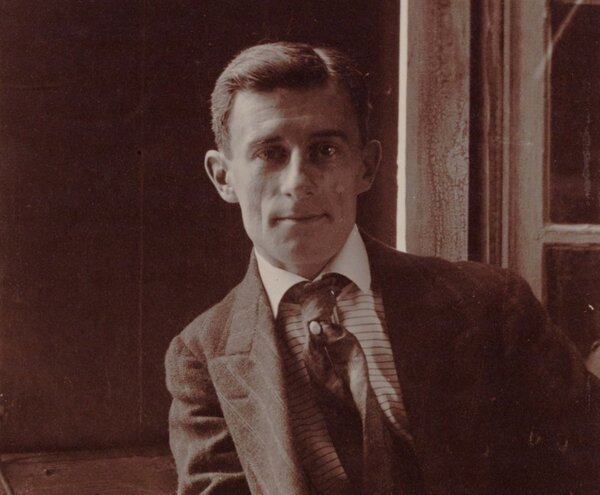
Maurice Ravel, c. 1910
Sinn und Sinnlichkeit
Weder Rebecca Saunders noch Maurice Ravel überlassen die Dinge gern dem Zufall. Jeder Ton in Saunders’ Partituren ist mit genauesten Spielanweisungen versehen, und auch Maurice Ravels Musik lebt von der handwerklichen Perfektion ihres Schöpfers.
Essay von Meike Pfister
Sinn und Sinnlichkeit
Musik von Maurice Ravel und Rebecca Saunders
Meike Pfister
Weder Rebecca Saunders noch Maurice Ravel überlassen die Dinge gern dem Zufall. Jeder Ton in Saunders’ Partituren ist mit genauesten Spielanweisungen versehen, was die exakte Art der Dämpfung, des Vibratos, des Trillerns oder des zu verwendenden Hilfsmaterials (wie etwa Keramikdeckel oder Wassergläser) anbelangt. Und jedes der vielfältigen klanglichen Mittel, das sie einsetzt, ist erforscht, mit Sinn aufgeladen und erarbeitet. Triller etwa erlaubte sie sich erstmals 2011 in ihrem Violinkonzert: „Ich hatte mir gesagt, so etwas schreibe ich erst, wenn ich verstehe, wie ein Triller an sich Sinn hat, wie das in meiner Musik verankert werden kann.“
Auch Maurice Ravels Musik lebt von der handwerklichen Perfektion ihres Schöpfers, von der Sinnhaftigkeit ihrer Strukturen und den oft fast mechanisch anmutenden Ostinatobewegungen. Igor Strawinsky bezeichnete seinen Zeitgenossen gerade aufgrund dieser Präzisionsbesessenheit als „horloger suisse“, als Schweizer Uhrmacher.
Und dennoch – oder vielleicht gerade deshalb? – birgt die Musik von Saunders und Ravel eine immense Leidenschaft und Sinnlichkeit. Nicht umsonst wählte Saunders für ihr 2016 entstandenes Ensemblestück den Titel Skin – ein Wort und Phänomen, das die Komponistin schon lange faszinierte und dem sie nicht nur mit Tönen, sondern auch mit Worten nachspürte. Wahrscheinlich war es auch in diesem Fall kein Zufall, dass die Saunders hier zum ersten Mal überhaupt die menschliche Stimme einsetzte – das Instrument, das unter die Haut zu gehen vermag wie kein zweites. Skin bildet den Auftakt eines Triptychons, das in den folgenden sieben Jahren entstehen sollte und 2023 mit Skull (Schädel) seinen Abschluss fand.
Eigenständigkeit statt Verschmelzung
Maurice Ravel: Sonate für Violine und Violoncello
Unter die Haut gehen auch die scharfen Dissonanzen und die nackte Zweistimmigkeit in Ravels Sonate für Violine und Violoncello. Der erste Satz entstand 1920 in Gedenken an Claude Debussy, der zwei Jahre zuvor verstorben war. Zahlreiche Komponisten wie etwa Paul Dukas, Igor Strawinsky oder Béla Bartók lieferten zu diesem Anlass Werke, die in der Zeitschrift Revue musicale veröffentlicht wurden.
Obwohl das Verhältnis der beiden führenden französischen Komponisten ihrer Zeit keineswegs spannungsfrei war, huldigte auch Ravel dem berühmten Kollegen. Vermutlich nimmt seine äußerst linear konzipierte und weniger nach impressionistischem Flirren strebende Sonate Bezug auf Debussys Spätwerk, in dem auch dieser sich bereits vom Impressionismus abwandte. „Vielleicht ist es doch besser, dass wir unseren Kontakt kühl halten, aus belanglosen Gründen“, befand Ravel, als das Verhältnis zu Debussy zu Beginn des 20. Jahrhunderts immer angespannter wurde. Zunächst war Debussy noch begeistert von den Werken des jüngeren Kollegen gewesen, doch die gegenseitige Sympathie litt zunehmend unter dem ständigen öffentlichen Vergleich der beiden in vieler Hinsicht ähnlichen Komponisten. Wer bei wem angeblich abgeschaut hatte, sollte ein wiederkehrender Streitpunkt sein, bei dem Ravel wohl einige Ungerechtigkeiten schlucken musste. Dennoch gestand er 1931 dem Kritiker Pierre Lalo, dass sein größter Wunsch sei, weich gebettet auf den ebenso zarten wie wollüstigen Klängen von Debussys Prélude à l’après-midi d’un faune zu sterben, diesem „einzigartigen Wunder der Musik“.
Vom Verhältnis der beiden auf die klanglichen Härten in Ravels Sonate zu schließen, wäre wohl zu weit gegriffen. Tatsache ist jedoch, dass Ravel hier nicht nach einer Verschmelzung, sondern nach größtmöglicher Eigenständigkeit der beiden Stimmen zu streben scheint. Schonungslos konfrontiert er gleich zu Beginn auch die beiden Tongeschlechter Dur und Moll – ein Effekt, den er in allen vier Sätzen immer wieder aufgreift.
Der zweite Satz mit seinen scharfen Pizzicati erinnert an die ungarische Folklore der Musik Bartóks und Kodálys – letzterer hatte 1918 selbst eine Sonate für Violine und Violoncello geschrieben, die Ravel vermutlich kannte. Nach einem choralhaften dritten Satz, in dem Ravel das Prinzip des klanglichen „dépouillement“ (Entkleidung oder Reduktion) auf die Spitze treibt, bricht sich im letzten Satz seine extrovertiert leidenschaftliche und spielerische Seite Bahn. Unter Rückgriff auf das Anfangsmotiv des ersten Satzes sowie auf verschiedenste folkloristische Elemente verlangt Ravel den Interpretierenden hier höchste Virtuosität ab.
Offenbar überforderten die technischen wie klanglichen Anforderungen der Sonate die Musiker:innen bei der Uraufführung restlos. Die Geigerin Hélène Jourdan-Morhange, eine Freundin des Komponisten, klagte darüber, dass Ravel verlange, auf dem Cello Flöte und auf der Geige Trommel zu spielen. Nach wiederholter Beschäftigung mit dem Stück musste sie jedoch eingestehen, dass es sich um eines der „herausragendsten“ Werke Ravels handele.
„Unter der Oberfläche der Stille“
Rebecca Saunders: Skin
„die straffe, flexible und fortlaufende Außenbedeckung eines Körpers oder Gegenstands; eine
Schicht wie eine Haut an der Oberfläche einer flüssigen oder festen Substanz; […] die zarte Membran, welche den Körper von seiner Umgebung trennt – suggeriert das Phänomen des
Tastens, einen der fünf Sinne, durch den […] Temperatur, Schmerz und Vibration zum Teil wahrgenommen werden. […] Unter der Haut: so eindringlich, dass etwas reizt, stimuliert, Gedanken anregt oder auf andere Weise erregt. […] Haut als Metapher für Vergänglichkeit – der fortlaufende Prozess, bei dem die tote Haut abgelegt wird und die neue wächst.“
Nicht nur den Gesangstext des Ensemblestücks Skin entwickelte Rebecca Saunders im Zuge des Kompositionsprozesses selbst, sondern auch die zitierten Definitionen und Reflexionen rund um das Phänomen Haut, die der Partitur vorangestellt sind. Ausgangspunkt dieser Auseinandersetzung war ein Text aus Samuel Becketts Fernsehspiel Ghost Trio, in dem es heißt: „Staub ist die Haut eines Raumes. Geschichte ist eine Haut. Je älter sie wird, desto mehr Eindrücke bleiben auf ihrer Oberfläche zurück.“ Gemeinsam mit der Sopranistin Juliet Fraser beschäftigte sich die Komponistin mit Becketts Worten und überhaupt die Grenzen der menschliche Stimme und formte daraus ihre Textgrundlage.
Nur selten erscheint der Text in klar erkennbaren Sätzen; meistens zerlegt Saunders die Worte in ihre Einzelsilben oder Buchstaben, die teilweise auch in die Bassflöte oder Trompete gesprochen, geflüstert oder gesungen werden. Dennoch bilden geschlossene, rezitierte Textpassagen einen wesentlichen Bestandteil des Stücks. Zusammen mit einer energischen Geste der Trompete und des Soprans, sowie einem ausdrucksvollen Duo zwischen Bassflöte und Sopran waren die Rezitationen zum Ausgangspunkt für die formale Gestaltung des Stückes. „Wie lassen sich diese drei Arten von Materialien in einer einzigen Form kombinieren?“, fragte sich die Komponistin immer wieder. „Wie kann man sie ineinander übergehen lassen? Wie kann man mit ihrer jeweiligen Dichte spielen, um sie miteinander in Konflikt zu bringen? Wie kann man ihre Identität erhalten?“ Am Ende sucht sich jedes Stück selbst seine Form, ist Saunders überzeugt. Man muss nur genau genug hinhören – „unter die Oberfläche der Stille“.
„Ich kann kaum glauben, dass ich das gemacht habe“
Rebecca Saunders: Skull
Auch im Zusammenhang mit ihrem 2023 entstandenen Stück Skull erwähnt Saunders eine literarische Inspirationsquelle – und betont damit einmal mehr die Bedeutung der Stille für ihr Schaffen: „Der Schädel ist von einer tiefen Stille umgeben, die wie das Nichts selbst wirkt“, schreibt Haruki Murakami in seinem Roman Hard-boiled Wonderland und das Ende der Welt. „Die Stille liegt nicht an der Oberfläche, sondern hält sich wie Rauch im Inneren. Sie ist unergründlich, ewig, eine körperlose Vision, die auf einen Punkt in der Leere geworfen wird.“
Wie Skin entstand auch Skull in enger Zusammenarbeit mit den Interpret:innen. In diesem Fall war der Trompeter Sawa Stoianov vom Ensemble Modern entscheidend. Aus seiner Art, sich mit halboffenen, tiefen und luftigen Tönen warmzuspielen, entstand die Keimzelle des Stückes: eine Art Glissando einen Halbton abwärts. Das Motiv wandert durch die Stimmen, dem uralten polyphonen Prinzip der Imitation folgend – „Ich kann kaum glauben, dass ich das gemacht habe“, erklärte Saunders selbst über diese für sie völlig neue Art zu komponieren. „Es ist befreiend, ein Verbot aufzuheben.“ Tatsächlich war sowohl die Verwendung von Melodien oder melodischen Fragmenten als auch die traditionelle polyphone Schreibweise mit Imitationen lange Zeit tabu für die sie.
Nicht nur in diesem Punkt unterscheidet sich Skull von seinen beiden Vorgängern (zu denen außerdem das 2018/19 entstandene Scar (Narbe) gehört). Auch was den Umfang betrifft, war für Saunders klar, dass es das längste der drei Werke sein müsse. In knapp 40 Minuten erforscht sie darin neue Klangwelten, ersetzt Klavier und Akkordeon durch eine elektrische Orgel, greift aber immer wieder auch auf bereits bekannte Motive aus Skin und Scar zurück. In beiden Stücken seien Fenster offen geblieben, Fragen unbeantwortet, die in Skull weiterbearbeitet werden.
Die Musik der Siemens-Preisträgerin lebt von einer ausgeprägten Körperlichkeit, vom Spiel mit dem Raum und vor allem vom Zuhören – angefangen bei der Komponistin selbst, die in sich selbst hineinhört, den Musiker:innen lauscht, der Stille und den Alltagsgeräuschen. Dann kommen die Interpret:innen, die sie in der Partitur immer wieder ganz konkret auffordert, auf ein bestimmtes Instrument und den Zusammenklang zu hören. Und schließlich funktioniert all das natürlich nur mit einem Publikum, das – so ihr Wunsch – eine größtmögliche Neugierde mitbringt. „Wenn man ein Stück zum ersten Mal hört, ist das ein Angebot, sich zu öffnen und tatsächlich etwas zuzulassen. Man begegnet etwas Unbekanntem, das ist aufregend und wunderschön. Und das erlebt man nicht für sich allein mit dem Kopfhörer. Wir machen das gemeinsam.“
Meike Pfister lebt als Pianistin, Musikwissenschaftlerin und Moderatorin in Berlin und ist hauptsächlich an der Universität der Künste und der Philharmonie Berlin sowie an der Elbphilharmonie in Hamburg tätig.
The Artists
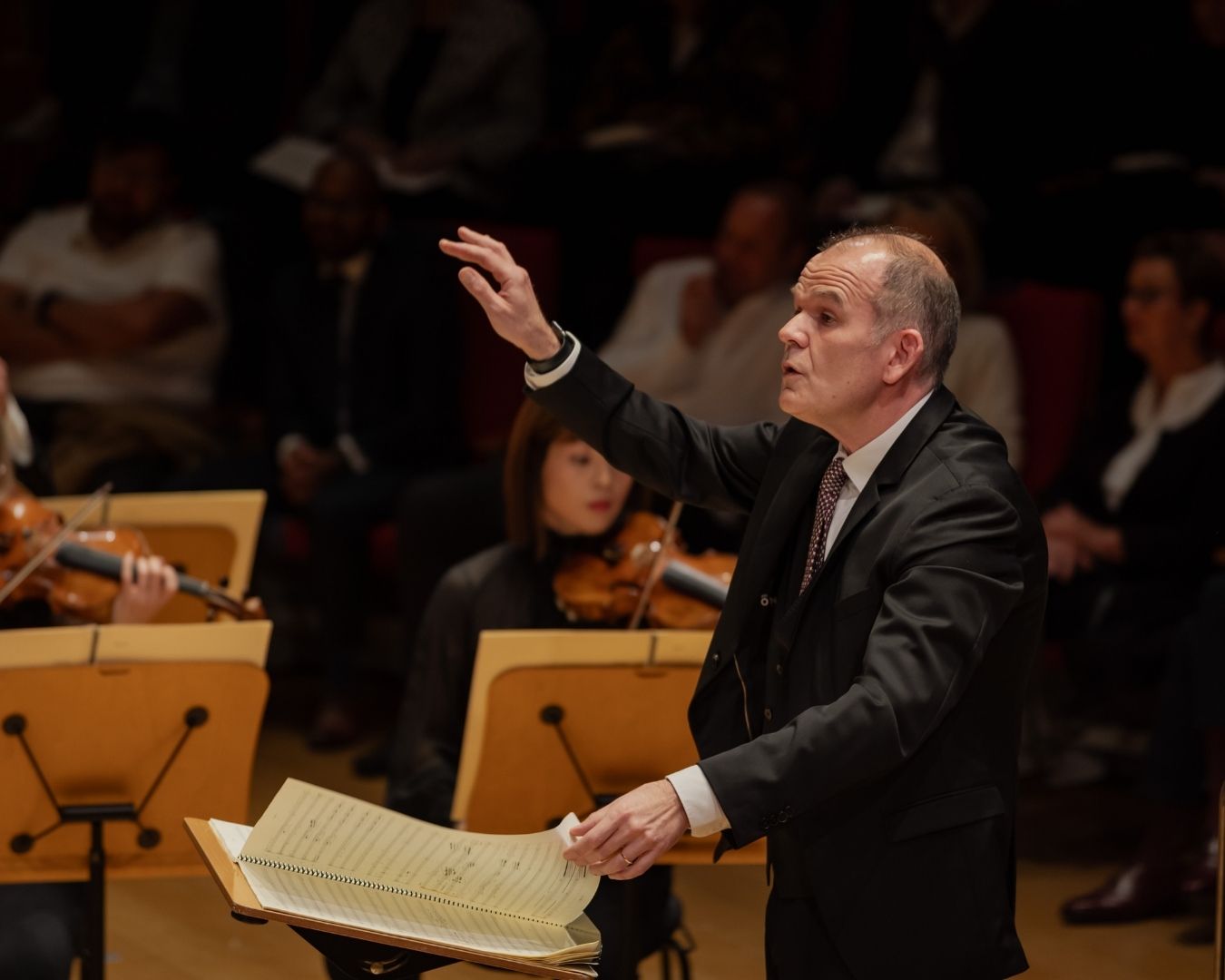
François-Xavier Roth
Conductor
Born in Paris in 1971, François-Xavier Roth has been chief conductor and artistic director of Stuttgart’s SWR Symphony Orchestra since September 2025. He previously served as chief conductor of its predecessor in Freiburg and Baden-Baden, where he conducted world premieres by Georg-Friedrich Haas, Yann Robin, and Simon Steen-Anderson, and as music director of the Gürzenich Orchestra and the Cologne Opera from 2015 to 2024. In Colgone, he led productions of Bernd Alois Zimmermann’s Die Soldaten and Philippe Manoury’s Cologne Trilogy, as well as numerous world premieres. He has also collaborated with the Berliner Philharmoniker and Staatskapelle Berlin, Amsterdam’s Concertgebouw Orchestra, and the Boston Symphony, among many others, and has been the London Symphony’s Principal Guest Conductor since 2017. In 2003 he founded the orchestra Les Siècles, which combines period performance and modern instruments in its concerts. Their recording of Stravinsky’s Le Sacre du printemps, The Firebird, and Petrushka was awarded the German Record Critics’ Prize. In the summer of 2017, François-Xavier Roth was made a Chevalier de la Légion d’Honneur. He has led several concerts with the Boulez Ensemble at the Pierre Boulez Saal since the hall’s opening in 2017.
February 2026
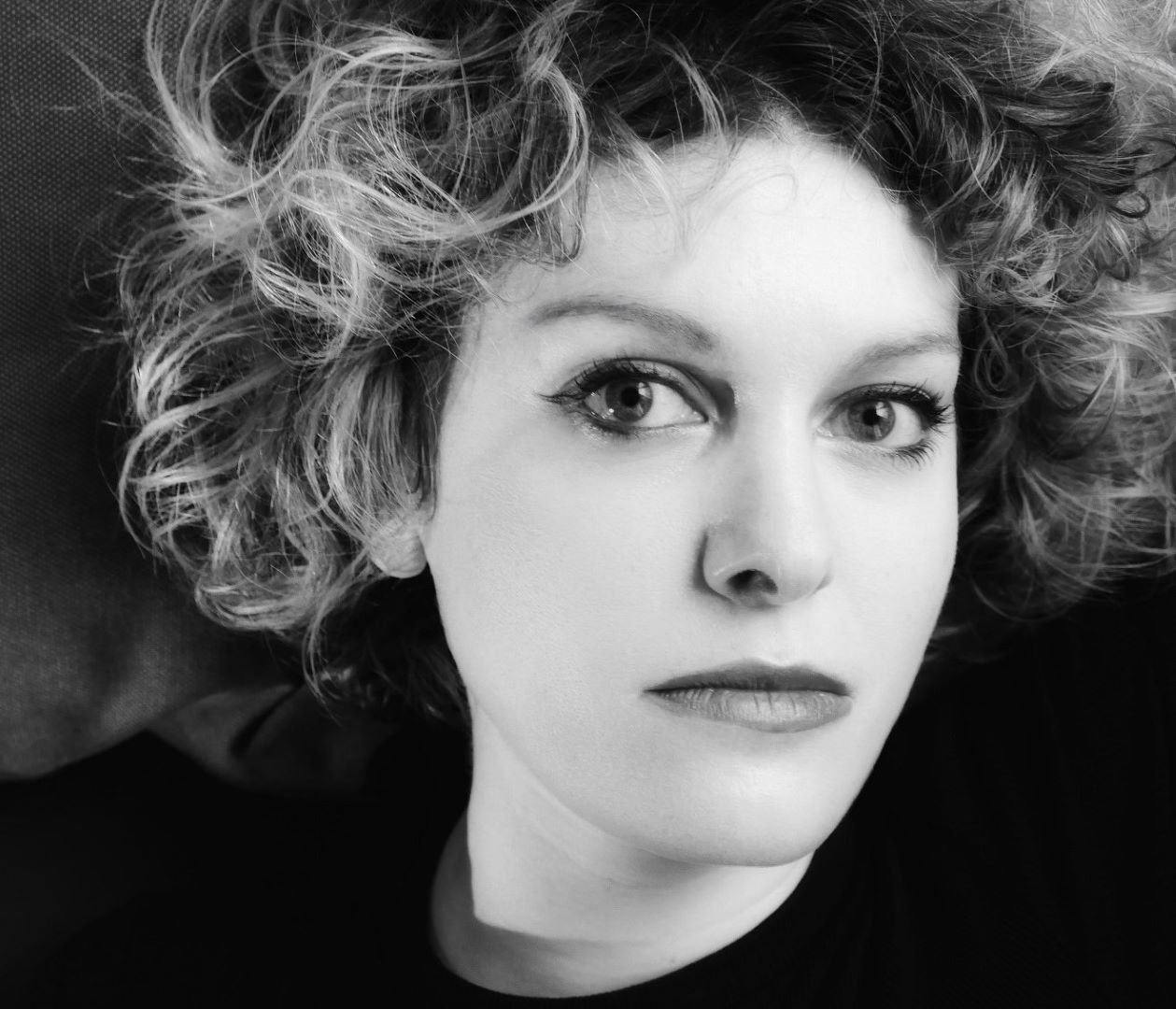
Jenny Daviet
Soprano
French soprano Jenny Daviet began her career at the Opéra de Rouen, where she made her role debuts as Blonde (Die Entführung aus dem Serail), Serpetta (La finta giardiniera), Pamina (Die Zauberflöte), and Micaëla (Carmen) and also sang Schönberg’s Pierrot lunaire. Since then, she has performed a wide repertoire at numerous venues and international festivals. Recent highlights include appearances as Eva in Stockhausen’s LICHT cycle at the Philharmonie de Paris, as Nadja in Georg Friedrich Haas’s Bluthaus at the Opéra de Lyon, in George Benjamin’s Into the Little Hill in Madrid, as Héro in Berlioz’s Béatrice et Bénédict and Countess de la Roche in Zimmermann’s Die Soldaten at the Cologne Opera, and as Mélisande in Debussy’s Pelléas et Mélisande with the orchestra Les Siècles and at the Malmö Opera. In 2021, she released a highly acclaimed recording of Messiaen’s Poèmes pour Mi with the Bavarian Radio Symphony Orchestra and Kent Nagano. In addition to her Pierre Boulez Saal debut, other performances this season include appearances with the chamber ensemble Le Balcon under Maxime Pascal and in several concerts with the Ensemble intercontemporain.
February 2026
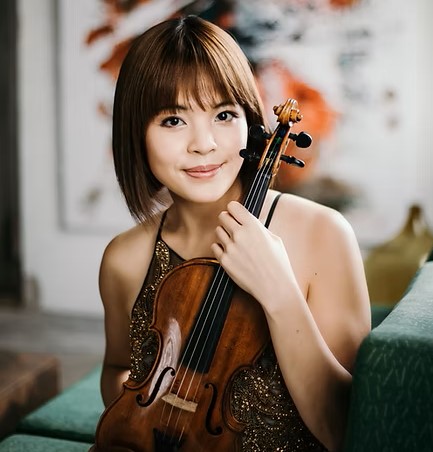
Jiyoon Lee
Violin
Born in Seoul in 1992, Jiyoon Lee studied violin at the Korean National University of Arts and at the Hanns Eisler School of Music in Berlin. She was a first-prize winner at Moscow’s 2013 David Oistrakh Competition and at the 2016 Carl Nielsen Competition; since the 2017–18 season, she has been concertmaster of the Staatskapelle Berlin. As a soloist, she has appeared with the Philharmonia Orchestra, the Orchestre National de Belgique, the Swedish Chamber Orchestra, and the Indianapolis Symphony Orchestra, among others, and collaborated with artists including Daniel Barenboim, Elisabeth Leonskaja, Nikolaj Znaider, Marin Alsop, and Martin Fröst. Chamber music performances have taken her to the festivals of Verbier and Tanglewood as well as to the Kronberg Academy Festival. She has been a frequent guest at the Pierre Boulez Saal since the hall’s opening in 2017. She plays a violin by Carlo Ferdinando Landolfi, made around 1760–70 and provided by the Deutsche Stiftung Musikleben.
February 2026
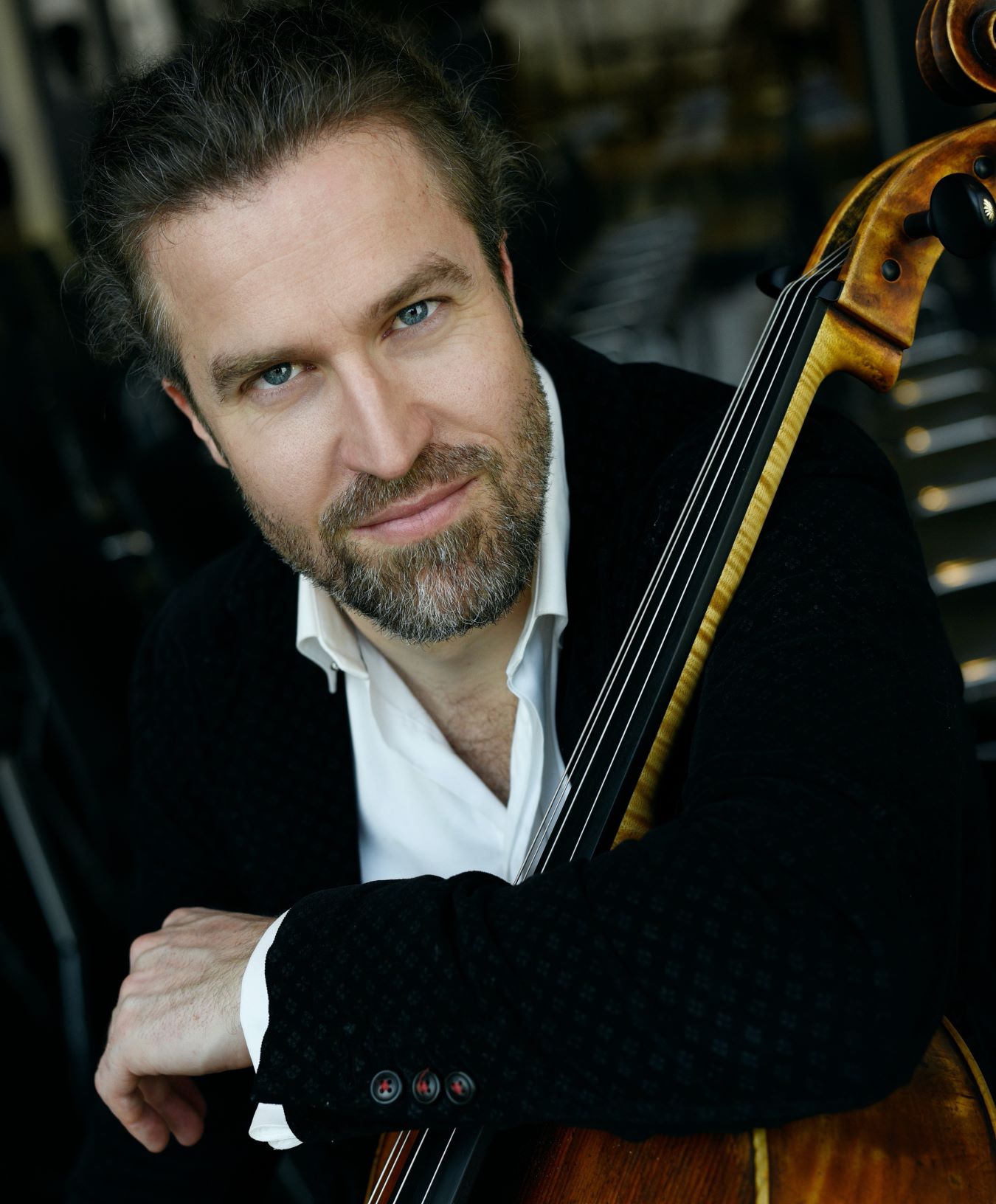
Arne-Christian Pelz
Cello
Arne-Christian Pelz has been principal cellist of Deutsche Oper Berlin since 2016. Born in Rostock, he studied in Houston, Berlin, and Leipzig. At the age of 25, he was appointed principal cellist of the Hamburg Symphony Orchestra by Sir Jeffrey Tate. He joined Trio Lirico in the summer of 2025 and has since performed with the ensemble throughout Germany, including appearances at Hamburg’s Elbphilharmonie and the WinterKlassik Festival in Bautzen. Regularly performing as a soloist, he was heard this month with Elgar’s Cello Concerto at Jesus Christus Kirche and Großer Sendesaal of rbb Radio in Berlin, as well as with Max Bruch’s Kol Nidrei at Berlin’s Konzerthaus. He has also appeared at renowned festivals including the Bad Kissingen Festival and Liedstadt Hamburg. Alongside his concert activities, he engages in interdisciplinary collaborations with choreographers and dancers. He taught at the Hanns Eisler School of Music in Berlin and has given international masterclasses, including in China and Canada. He performs on a cello made by Alexandre Breton in 2017.
February 2026
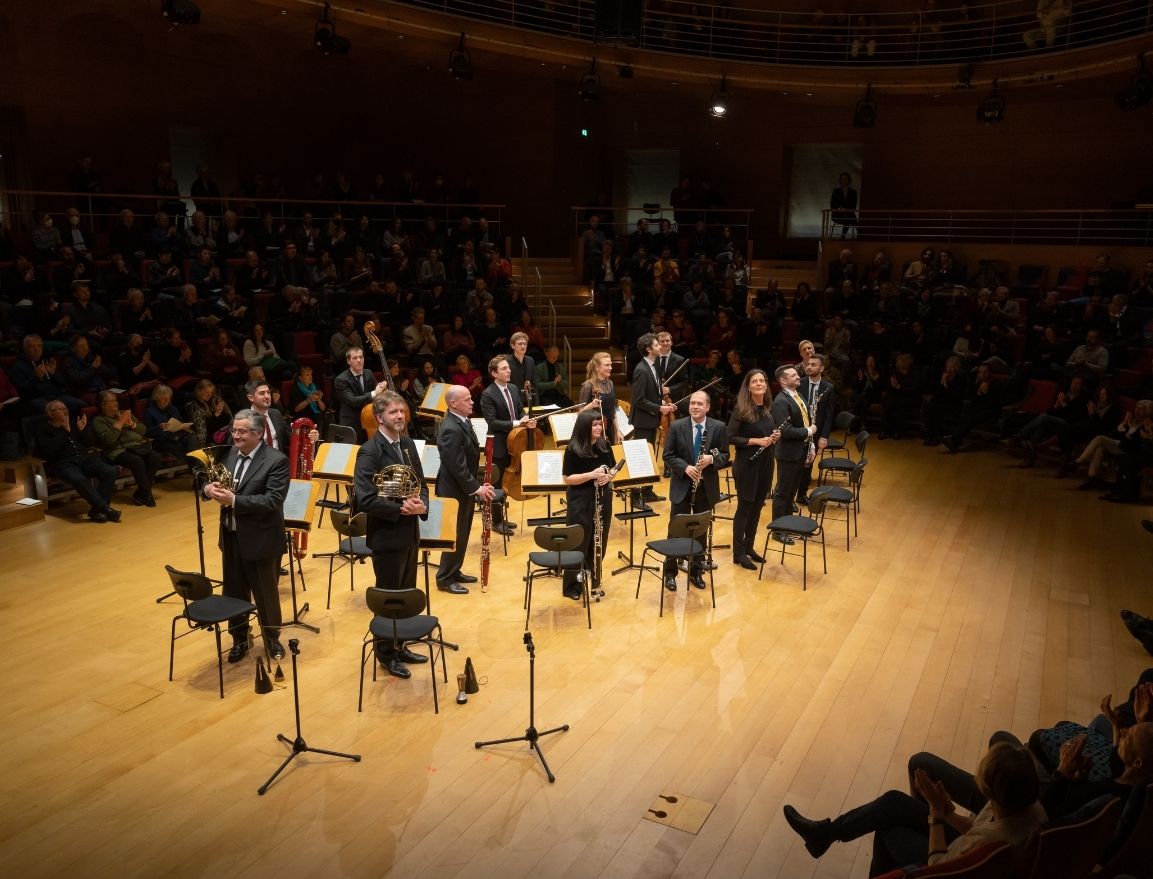
Boulez Ensemble
Founded by Daniel Barenboim, the Boulez Ensemble has its artistic home in the Pierre Boulez Saal at the Barenboim- Said Akademie, where it made its first appearance in June 2015 at the building’s topping-out ceremony. This was followed in January 2017 by the international debut at Carnegie’s Zankel Hall in New York as part of a memorial concert for Pierre Boulez. Since the opening of the Pierre Boulez Saal in March 2017, the ensemble has performed here with artists such as Thomas Guggeis, Oksana Lyniv, Zubin Mehta, Sir Antonio Pappano, Matthias Pintscher, Sir Simon Rattle, François-Xavier Roth, Lahav Shani, Giedrė Šlekytė, Jörg Widmann, Emmanuel Pahud, Mojca Erdmann, Christiane Karg, Magdalena Kožená, and Dominique Horwitz, among many others. As a flexible group not bound by a permanent roster of performers, the Boulez Ensemble consists of musicians primarily drawn from the ranks of the Staatskapelle Berlin and the West-Eastern Divan Orchestra, as well as faculty and students of the Barenboim-Said Akademie and international guest artists. The ensemble’s artistic identity is expressed in its concert programs, which combine compositions from the Classical and Romantic repertoire with masterpieces of the 20th century and works by contemporary composers, while also juxtaposing duo and trio pieces with music for larger ensemble. The works of Pierre Boulez form a central part of the group’s repertoire. The ensemble also regularly presents world premieres of newly commissioned works, including compositions by Benjamin Attahir, Johannes Boris Borowski, Luca Francesconi, Vladimir Genin, Matthias Pintscher, Aribert Reimann, Kareem Roustom, Vladimir Tarnopolski, and Jörg Widmann. The result of this programmatic approach is an inspiring combination of styles, in which the juxtaposition of diverse works opens up new perspectives of listening—facilitating musical discovery and artistic dialogue that pay tribute to the spirit and memory of Pierre Boulez.
February 2026