Isabelle Faust Violin
Kristian Bezuidenhout Harpsichord
Program
Johann Sebastian Bach
Sonata for Violin and Harpsichord in E major BWV 1016
Sonata for Violin and Harpsichord in F minor BWV 1018
Sonata for Violin and Harpsichord in G major BWV 1019
Domenico Scarlatti
Sonata for Solo Harpsichord in D minor K. 213
George Frideric Handel
“Suite imaginaire” for Solo Harpsichord
Prélude for Solo Harpsichord in G minor HWV 572
Carl Philipp Emanuel Bach
Sonata for Violin and Harpsichord in G minor g-moll H 542.5
Heinrich Ignaz Franz Biber
Passacaglia for Solo Violin in G minor
Johann Sebastian Bach (1685–1750)
Sonata for Violin and Harpsichord in E major BWV 1016 (before 1725)
I. Adagio
II. Allegro
III. Adagio ma non tanto
IV. Allegro
Domenico Scarlatti (1685–1757)
Sonata for Solo Harpsichord in D minor K. 213
Andante
George Frideric Handel (1685–1759)
“Suite imaginaire” for Solo Harpsichord
Allemande from the Suite in D minor HWV 428
Corrant from the Suite in D minor HWV 437
Air with Variations from the Suite in D minor HWV 428
Johann Sebastian Bach
Sonata for Violin and Harpsichord in F minor BWV 1018 (before 1725)
I. [without indication]
II. Allegro
III. Adagio
IV. Vivace
Intermission
George Frideric Handel
Prélude for Solo Harpsichord in G minor HWV 572
Carl Philipp Emanuel Bach (1717–1788)
Sonata for Violin and Harpsichord in G minor g-moll H 542.5
I. [without indication]
II. Adagio
III. Allegro
Heinrich Ignaz Franz Biber (1644–1704)
Passacaglia for Solo Violin in G minor
from the “Mystery” Sonatas
Johann Sebastian Bach
Sonata for Violin and Harpsichord in G major BWV 1019 (before 1725)
I. Allegro
II. Largo
III. Allegro
IV. Adagio
V. Allegro
We regret that, due to a last-minute program change, it has not been possible to include information on the Scarlatti sonata and the “Suite imaginaire” in the program notes.
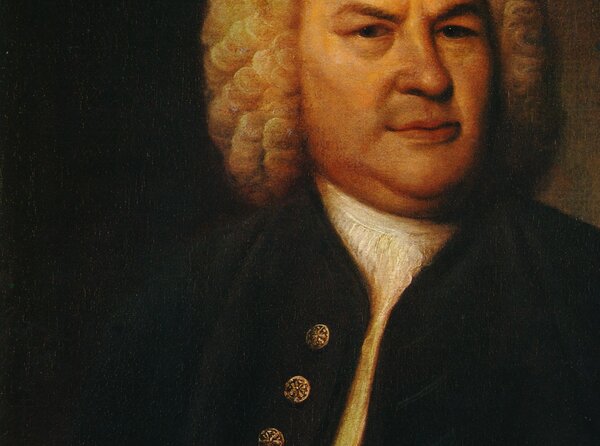
Johann Sebastian Bach, portrait by Elias Gottlob Haußmann (1748)
“They Give Me Much Joy”
Among his father’s crowning achievements, Carl Philipp Emanuel Bach counted his six Sonatas for Violin and Harpsichord. “They still sound excellent and give me much joy,” he wrote in 1774, “although they date back more than 50 years.” Isabelle Faust and Kristian Bezuidenhout present these works of the elder Bach in the context of solos and duets by some of his forebears, contemporaries, and successors.
Program Note by Harry Haskell
“They Give Me Much Joy”
Bach’s Sonatas for Violin and Harpsichord and Other Works
Harry Haskell
Bach and the Violin
Although Johann Sebastian Bach’s principal instrument was the organ, he was an accomplished violinist and violist as well. He learned to play the violin as a child—probably under the tutelage of his father, a town piper in Eisenach—and kept it up for the rest of his life. In later years, he was frequently to be found at Zimmermann’s popular coffeehouse in Leipzig, leading the resident collegium musicum ensemble from the concertmaster’s stand. According to his composer son Carl Philipp Emanuel, Bach played the violin “clearly and penetratingly.” Although it is unlikely that his technique was equal to the daunting challenges posed by his own music for the instrument, one can readily imagine the composer methodically trying out intricate passages on his fine violin by Jacob Stainer, a renowned luthier of the Baroque period. Bach’s solos are a virtual encyclopedia of 18th-century violin technique; no composer, before or since, has explored the instrument’s expressive capabilities more comprehensively than he did. C. P. E. Bach told his father’s biographer, Johann Nikolaus Forkel, that Bach “understood to perfection the possibilities of all stringed instruments” and quoted an eminent violinist of the time as saying that “he had seen nothing more perfect for learning to be a good violinist, and could suggest nothing better to anyone eager to learn,” than Bach’s six Sonatas and Partitas for unaccompanied violin.
The younger Bach also counted the six Sonatas for Violin and Harpsichord (BWV 1014–1019) among his father’s crowning achievements. “They still sound excellent and give me much joy,” he wrote in 1774, “although they date back more than 50 years. They contain some adagios that could not be written in a more singable manner.” Bach’s violin sonatas marked a significant departure from the three-part texture characteristic of the earlier Baroque trio sonata, in which two melodic voices—the violin and the right-hand part of the keyboard—were supported by a harmonic foundation notated in the numerical shorthand known as figured bass. By contrast, the harpsichord parts of BWV 1014–1019 are almost entirely written out; they mesh with the violin’s melodic line to create an integrated contrapuntal texture in which the two instruments play more or less equal roles. Significantly, several 18th-century manuscript sources identify the keyboard parts as concertato or obbligato, terms that suggest something more than mere continuo-style harmonic accompaniment. In constructing his exemplary set of six sonatas, Bach took pains to achieve an overall tonal equilibrium as well, composing three sonatas in major keys and three in minor. The sequence of the sonatas likewise reflects his penchant for order and symmetry; for instance, the major-key pairing of the second and third sonatas (BWV 1015 and 1016) is balanced by the fourth and fifth sonatas (BWV 1017 and 1018) in minor keys.
On this pair of programs, Isabelle Faust and Kristian Bezuidenhout present Bach’s Sonatas in the context of solos and duets by a half-dozen of his illustrious central European forebears, contemporaries, and successors: Johann Jakob Froberger, Nicola Matteis the Younger, George Frideric Handel, Georg Philipp Telemann, Domenico Scarlatti, C. P. E. Bach, and Heinrich Ignaz Franz Biber.
A Pair of Sonatas
Brilliance is the keynote of Bach’s Sonata in E major BWV 1016. In the opening Adagio, the violin’s floridly embellished melodic line mimics the vocal acrobatics of an 18th-century operatic diva. The ensuing Allegro is an invigorating three-voice fugue whose jaunty theme is volleyed back and forth both between the two instruments, and between the harpsichordist’s two hands. The Adagio ma non tanto casts a more seductive spell, with its insistently rising and falling triplet figures in plaintive C-sharp minor, and the sonata ends on a bravura note with another playfully imitative Allegro.
Bach switches things up in the opening movement of the F-minor Sonata BWV 1018: this time it is the harpsichord that plays the starring role, spinning an elaborate three-voice texture in imitative counterpoint while the violin remains in the background, making intermittent melodic interjections. A similar role reversal characterizes the third-movement Adagio in A-flat major, in which the harpsichord’s cascading 32nd-note runs and arpeggios stand out against a sonic scrim of gently throbbing double stops. The repartee between the two instruments is more evenly balanced in the Allegro and Vivace, with their propulsive motor rhythms and fast-flowing passagework.
Like Father, Like Son
Although most of Handel’s solo keyboard music dates from early in his career, he continued to perform publicly on the harpsichord and organ throughout his life. According to the music historian Sir John Hawkins, Handel often introduced his own concertos with improvised preludes that “stole on the ear in a slow and solemn progression; the harmony close wrought, and as full as could possibly be expressed; the passages concatenated with stupendous art, the whole at the same time being perfectly intelligible, and carrying the appearance of great simplicity. This kind of prelude was succeeded by the concerto itself, which he executed with a degree of spirit and firmness that no one ever pretended to equal.” The brief Prelude in G minor is one such preparatory flourish, though it may originally have been attached not to a concerto but to one of Handel’s many harpsichord suites.
C. P. E. Bach, the second of Johann Sebastian’s musical sons, blended his father’s contrapuntal skill with the finely nuanced introspection and expressive range of the newer empfindsamer Stil (sensitive style). The author of an influential treatise on “the true way of playing the keyboard,” he was renowned for the delicacy and precision of his touch. The younger Bach spent three decades in Berlin at the court of the music-loving Prussian King Frederick the Great before rounding off his illustrious career in Hamburg, where he succeeded his godfather, Georg Philipp Telemann, as music director of the city’s principal churches. The elder Bach was still in his prime in the 1730s, when the G-minor Sonata is thought to have been written, and for a long time this genial and inventive work was officially attributed to him. If the Sonata bears little trace of the free, fantastical, and often passionately expressive style for which C. P. E. Bach would become known, it nonetheless looks ahead to the less ornately contrapuntal idiom of the later 18th century, not least in the luminous, lilting, siciliana-style Adagio.
The “Fantastic Style”
Bohemian by birth, Heinrich Ignaz Franz Biber embraced the florid, richly melodic Italian style exemplified by his fellow composer-violinist Arcangelo Corelli. His innovative violin techniques, timbral effects, and tunings are characteristic of the “fantastic style” (stylus phantasticus), which a contemporary scholar described as “the most free and unfettered method of composition, bound to nothing, neither to words, nor to a harmonic subject.” No works better illustrate these flights of fancy than Biber’s 15 highly virtuosic “Mystery” Sonatas for violin and continuo, so called because they illustrate the Mysteries of the Rosary in the Catholic Church. At the end of the collection Biber appended a stand-alone movement, prefaced in the original manuscript by an image of a guardian angel holding the hand of a small child. In this majestic tailpiece he dispensed with keyboard accompaniment to create a Passacaglia for solo violin on the scale of Bach’s famous D-minor Chaconne: it consists of 65 brief but dazzlingly imaginative variations on a repeating four-note pattern known as a ground bass, which descends stepwise from G to D, a motif that Biber apparently borrowed from a contemporary hymn to the guardian angel.
The five-movement layout of Bach’s G-major Sonata BWV 1019 offered a change of pace as well as character from the basic four-movement model by allowing him to begin and end the work with a burst of energy. The two outer movements, in sunny G major, are predominantly vivacious and extraverted. In both Allegros, the violin and harpsichord trade off the thematic material—sometimes playing it in alternation and sometimes together—in a mesmerizing display of Bach’s contrapuntal wizardry. The three, relatively somber middle movements are all in minor keys. The short but emotionally intense Largo pauses fleetingly on a major chord before the harpsichord picks up the ball and runs with it in a propulsive Allegro that unexpectedly dispenses with the violin (and thus with the second treble voice). As if to compensate, Bach reunites the three parts on an equal footing in the poignant Adagio.
A former performing arts editor for Yale University Press, Harry Haskell is a program annotator for Carnegie Hall in New York, the Brighton Festival in England, and other venues, and the author of several books, including The Early Music Revival: A History, winner of the 2014 Prix des Muses awarded by the Fondation Singer-Polignac.
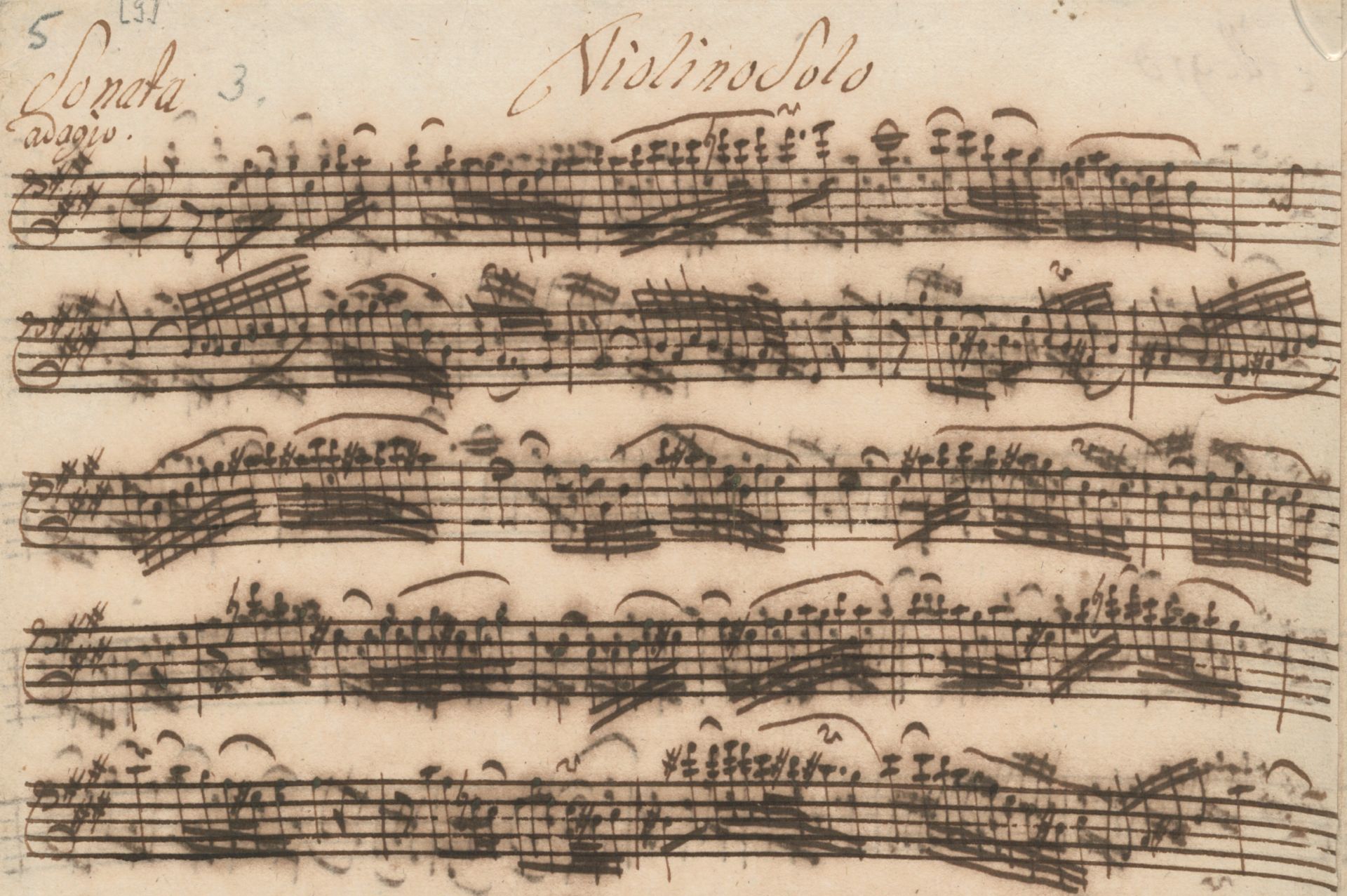
The violin part of Bach’s Sonata BWV 1016 in a contemporary copy by Georg Heinrich Ludwig Schwanenberger (Staatsbibliothek Berlin)
Pioniertaten
In den sechs Sonaten für Violine mit obligatem Cembalo erwies sich Johann Sebastian Bach – der sonst eher die musikalischen Errungenschaften der Vergangenheit zusammenfasste als neue Entwicklungen anzustoßen – als Pionier: Seine Duos für gleichberechtigte Instrumente weisen voraus auf die Sonaten der Klassik und Romantik.
Essay von Jürgen Ostmann
Pioniertaten
Bachs Violinsonaten mit obligatem Cembalo und andere Werke
Jürgen Ostmann
Johann Sebastian Bach war seinen Zeitgenossen als glänzender Orgel- und Cembalovirtuose bekannt, doch seine erste Anstellung hatte er 1703 als Geiger (und Lakai) am Weimarer Hof gefunden. Noch 1775 berichtete sein Sohn Carl Philipp Emanuel dem Göttinger Musikhistoriker Johann Nikolaus Forkel: „In seiner Jugend bis zum ziemlich herannahenden Alter spielte er die Violine rein und durchdringend und hielt dadurch das Orchester in einer größeren Ordnung als er mit dem Flügel [Cembalo] hätte ausrichten können. Er verstand die Möglichkeiten aller Geigeninstrumente vollkommen.“ Und gerade weil Bach sowohl das Cembalo als auch die Violine meisterhaft beherrschte, konnte er in der Duokomposition für beide Instrumente eine echte Neuerung einführen: Sonaten für Violine und obligates Cembalo. Üblich war es in der Barockzeit, nur die Bassstimme des Tasteninstruments zu notieren; die Begleitakkorde der rechten Hand improvisierte der Spieler nach den hinzugefügten Generalbassziffern. Dagegen schrieb Bach in seinen sechs Sonaten BWV 1014-1019, ebenso wie in den Gambensonaten BWV 1027–1029 und den Flötensonaten BWV 1030–1032, auch den Part der rechten Hand detailliert aus. Vor allem in den fugenartigen schnellen Sätzen ist dieser als Melodiestimme gestalte, die dem Geigenpart gleichwertig gegenübersteht. Bach, der sonst eher die musikalischen Errungenschaften der Vergangenheit zusammenfasste als neue Entwicklungen anzustoßen, erwies sich in diesem Fall als Pionier: Seine Duos gleichberechtigter Instrumente weisen voraus auf die Sonaten der Klassik und Romantik.
Zerlästert und alt, aber sehr vergnüglich
Carl Philipp Emanuel Bach zählte die Sonaten für Violine und Cembalo denn auch zu den „besten Arbeiten des seligen lieben Vaters“ und bemerkte im Begleitschreiben des Notenpakets, das er im Oktober 1774 an Forkel sandte: „Sie klingen noch jetzt sehr gut, u. machen mir viel Vergnügen, ohngeacht sie über 50 Jahre alt sind. Es sind einige Adagii darin, die man heut zu Tage nicht sangbarer setzen kann. Da sie sehr zerlästert sind, so belieben Sie solche gut in Acht zu nehmen.“ „Sehr zerlästert“ bedeutet natürlich nicht, dass unverschämte Kritiker die Sonaten negativ beurteilt hätten – vielmehr waren das Notenmaterial in schlechtem Zustand, was auf häufige Benutzung und große Beliebtheit hinweist. Den Hinweis „über 50 Jahre alt“ nahm Forkel übrigens ganz wörtlich und datierte die Sonaten auf Bachs Köthener Zeit (1717–1723). Das erscheint auch vernünftig, da Bach als Kapellmeister des Prinzen Leopold von Anhalt-Köthen viele Instrumentalwerke zu schreiben und einzustudieren hatte. Heute kann die Musikwissenschaft den Entstehungszeitraum noch etwas genauer eingrenzen: Bis 1719 verfügte die Hofmusik nur über ein Cembalo mit dem cʹʹʹ als höchstem Ton. Da die Sonaten aber eine Klaviatur bis dʹʹʹ verlangen, können sie erst danach auf einem Instrument gespielt worden sein, das Bach für seinen Dienstherrn bei Michael Mietke in Berlin bestellte. Die früheste erhaltene Abschrift stammt sogar erst aus dem Jahr 1725, also aus Bachs früher Leipziger Zeit.
Kompositorisch decken die Werke ein weites Feld ab, doch einige Züge, die man in der Sonate c-moll BWV 1017 erkennt, treten zumindest noch in vier weiteren auf: Sie alle folgen dem viersätzigen Schema langsam–schnell–langsam–schnell der barocken Sonata da chiesa (oder Kirchensonate). Dabei ähneln die langsamen Sätze oft Arien, während die schnellen fugenähnlich angelegt sind. Außerdem stehen die Sätze eins, zwei und vier immer in der jeweiligen Grundtonart; der dritte Satz wechselt dagegen in die parallele Dur- beziehungsweise Molltonart. Dieser Einheitlichkeit der Form steht jedoch eine große Mannigfaltigkeit im Detail gegenüber. So gestaltete Bach im Kopfsatz der Sonate E-Dur BWV 1016 den Cembalopart ausgesprochen originell: Nur ein einziges ab- und aufsteigendes Sechzehntelmotiv, in Terzen und Sexten vollstimmig gesetzt, wandert hier durch die Tonarten, während sich die Violine in weit ausgreifenden Melismen ergeht. Ein leichtfüßiges, galantes Thema bestimmt den fugenartigen zweiten Satz, der sich im Mittelabschnitt nach Moll wendet und so schon auf das Adagio ma non tanto vorausweist. Dieses scheint zunächst dem Muster einer Passacaglia folgen zu wollen: Über stetig wiederholtem Bass (hier eine absteigende Mollskala) entfalten sich Oberstimmenvariationen. Allerdings versetzt Bach im Folgenden das Bass-Ostinato oder Teile davon auf unterschiedliche Tonstufen. Das virtuose Finale lebt vom immer wieder überraschenden Wechselspiel zwischen Sechzehnteln und Achteltriolen.
Der langsame Eröffnungssatz der Sonate f-moll BWV 1018 ist in den meisten Abschriften ohne Bezeichnung überliefert; nur Bachs Schüler Kirnberger gibt ihm in seiner Kopie den treffenden Titel „Lamento“. Das Stück beginnt mit einem dreistimmigen Vorspiel des Cembalos (zwei Oberstimmen und Bass), dem sich die Violine zunächst mit lang ausgehaltenen Tönen hinzugesellt. Erst allmählich greift sie die vom Tasteninstrument vorgestellten Motive auf. An zweiter Stelle folgt ein Allegro in der typischen Satzart einer Triosonate. Eine ungewöhnliche Struktur hat das Adagio: Die Violine deutet in konstant pulsierendem Rhythmus und in Doppelgriffen Mollakkorde an, die das Cembalo in freien Melismen ausschmückt. Ein weiterer fugierter Satz, dieses Mal über ein chromatisches, von Synkopen bestimmtes Thema im raschen Dreiertakt, schließt die Sonate ab.
Die Sonate G-Dur BWV 1019 ist als einziges Werk der Serie fünfsätzig angelegt – zumindest in ihrer letzten Fassung, die heute als maßgeblich gilt und auch von Isabelle Faust und Kristian Bezuidenhout gespielt wird. Dass das Stück überhaupt in mehreren Versionen vorliegt, ist ein weiteres besonderes Merkmal. Die erste Fassung, die vermutlich vor den übrigen Sonaten entstand, hatte noch sechs Sätze, wobei anstelle eines Finales einfach der Kopfsatz wiederholt wurde. Zwei Sätze aus diesem Stück – ein Cembalo-Solo und ein „Violino solo e Basso l’accompagnato“ verwendete Bach in seiner sechsten Klavierpartita (BWV 830) noch einmal. Dafür fehlen diese Teile in der zweiten Fassung der Violinsonate, die stattdessen ein Cantabile enthält. Dieses ist in der Endversion wieder gestrichen, jetzt zugunsten eines neuen Cembalo-Solos. Neu ist hier weiterhin das folgende Adagio sowie das Finale, das die Wiederholung des Kopfsatzes ersetzt. Das Thema dieses Finales nutzte Bach in abgewandelter Form auch für seine Arie „Phöbus eilt mit schnellen Pferden“ aus der „Hochzeitskantate“ BWV 202.
Eine Trias in g-moll
In der zweiten Hälfte des heutigen Programms erklingen drei Werke von Komponisten unterschiedlicher Generationen, die durch die gemeinsame Tonart g-moll verbunden sind. Auf Georg Friedrich Händels kurzes Prélude HWV 572 für Solo-Cembalo folgt ein Stück, das hinsichtlich Besetzung und Autorschaft einige Räsel aufgibt. Sämtliche Quellen der Sonate g-moll H. 542.5 nennen zwar die Violine als Instrument, doch der Tonumfang (nicht unter dʹ) spricht eher für Flöte, ebenso der Klangcharakter und das Fehlen von Doppelgriffen. Darüber hinaus beschäftigt die Musikwissenschaft auch die Frage, von wem die Sonate überhaupt stammt. Ein Manuskript aus dem frühen 19. Jahrhundert weist sie Johann Sebastian Bach zu, in dessen Werkverzeichnis sie später unter der Nummer BWV 1020 aufgenommen wurde. Zwei frühere Abschriften sowie ein Katalogeintrag des Verlags Breitkopf von 1763 nennen jedoch Carl Philipp Emanuel Bach als Autor – daher findet man das Stück in Eugene Helms thematischem Katalog als H. 542.5, und so wird es auch in diesem Konzert von Isabelle Faust und Kristian Bezeuidenhout präsentiert. Wie Barthold Kuijken, der Herausgeber einer Neuausgabe, nachweist, erscheint allerdings der galante Stil der Sonate mit seinen Klopfbässen und gefälligen kurzen Phrasen weder für Johann Sebastian Bach noch für seinen zweitältesten Sohn Carl Philipp Emanuel typisch. Auch die Annahme einer Gemeinschaftsarbeit von Lehrer und Schüler löst dieses Problem nicht, ebenso wenig die Zuschreibung an einen dritten Komponisten wie etwa Johann Joachim Quantz. „Als Schlussfolgerung der vielen Überlegungen bleibt vorläufig“, so Kuijken, „dass […] BWV 1020 für Vater Bach viel zu dünn, für Carl Philipp Emanuel wie für die anderen Bach-Söhne untypisch und für Quantz zu gut ist. Andere Namen aus deren Generation drängen sich leider nicht auf: man würde sich freuen, diesen guten, ehrlichen Komponisten kennen zu lernen!“
Zu den Komponisten der Barockzeit, deren Werke seit dem Ende des 20. Jahrhunderts eine bemerkenswerte Renaissance erlebt haben, zählt der aus Böhmen stammende Heinrich Ignaz Franz Biber. Der englische Musikgelehrte Charles Burney schrieb 1789 über ihn: „Von allen Geigern des vergangenen Jahrhunderts scheint er der beste gewesen zu sein, und seine Soli sind bei weitem die schwierigsten und wunderlichsten seiner Zeit.“ Urteilt man nach Bibers Violinsonaten, dann müssen die geigerischen Fertigkeiten dieses Musikers tatsächlich erstaunlich gewesen sein. Seine bis heute bekanntesten Werke sind die sogenannten „Rosenkranz-“ oder „Mysterien-Sonaten“, eine Sammlung von 15 Kompositionen für Violine und Basso continuo, denen sich als letztes Stück eine umfangreiche Passacaglia für Solovioline anschließt. Die einzig erhaltene Handschrift des Zyklus entstand vermutlich um 1678; jedenfalls sind den einzelnen Sonaten Kupferstich-Medaillons vorangestellt, die aus diesem Jahr stammen. Jede Illustration stellt eines der Geheimnisse des katholischen Rosenkranz-Gebets dar. Die Passacaglia ist hingegen mit der Federzeichnung eines Kindes versehen, das von einem Schutzengel an die Hand genommen wird. Das nur aus vier Tönen bestehende Bassostinato wiederholt Biber 65 Mal. Darüber setzt er – wie später Bach im Adagio seiner Sonate BWV 1016 – eine Fülle phantasievoller Oberstimmenvariationen.
Jürgen Ostmann studierte Musikwissenschaft und Orchestermusik (Violoncello). Er lebt als freier Musikjournalist und Dramaturg in Köln und arbeitet für verschiedene Konzerthäuser, Rundfunkanstalten, Orchester, Plattenfirmen und Musikfestivals.