Ali Dridi Violin and Clarinet
Haitham Ben Ali Keyboard
Mohamed Ben Hamida Percussion
Khadija El Afrit Qanun
Program
Malouf Funk
Wasla (Suite) in Maqam Isba'yan
Tunisian Classics Medley
Wasla in Maqam Mazmoum
Lyrical Interlude
Tunisian Ballroom Medley
Parfum de Gitane
Wasla in Muhayyar Sikah
Tunisian Landscapes
Mahgreb Medley
Stambeli Finale
Malouf Funk (Fawzi Chekili)
Wasla (Suite) in Maqam Isba'yan
Bashraf / Sama i Isba'yan
Ala Ya Mudir ar-Rah
Ya Habibi Farraj Li
Min an-Nawa
(Tunisian Malouf)
Tunisian Classics Medley
Hobbi Yetbaddel Yetjadded (Hédi Jouini)
Qaletli Kelma w 'Awedtha (Ali Riahi)
El Youm Qaletli Zin ez-Zin (Hédi Jouini)
Tkouit w Ma Qolt Ahit (Ali Riahi)
Wasla in Maqam Mazmoum
Yalli Bo'dak Dhayya' Fikri (Khemaïs Tarnane)
'Ardhouni Zouz Sbaya (traditional / Tunisia)
Ya Laymi 'ala ez-Zin (Mohamed Triki)
Lyrical Interlude
Ardha 'Alina Ya Lmima (Salah Farzit)
Tunisian Ballroom Medley
Taht el-Yasmina (Hédi Jouini)
Lamouni Elli Gharou Menni (Hédi Jouini)
Samra Ya Samra (Hédi Jouini)
Parfum de Gitane (Anouar Brahem)
Wasla in Muhayyar Sikah
Nassaya (Hamadi Ben Othman)
Ritek Ma Na'ref Win (Anouar Brahem)
Tunisian Landscapes
Mahbouby (traditional / Tunisia)
Ki Ydhiq Bik ed-Dahr Ya Mezyana (Sadok Thraya)
Bahdha Hbibti Tahla Sahriya (traditional / Tunisia)
Mahgreb Medley
Chehilet Laayani (Abdelhakim Garami)
Ya Rayah (Dahmane El Harrachi)
Abdel Kader Ya Boualem (traditional / Algeria)
Stambeli Finale
Sidi Mansour
Baba Bahri
Sidi Mansour
(traditional / Tunisia)
Without intermission
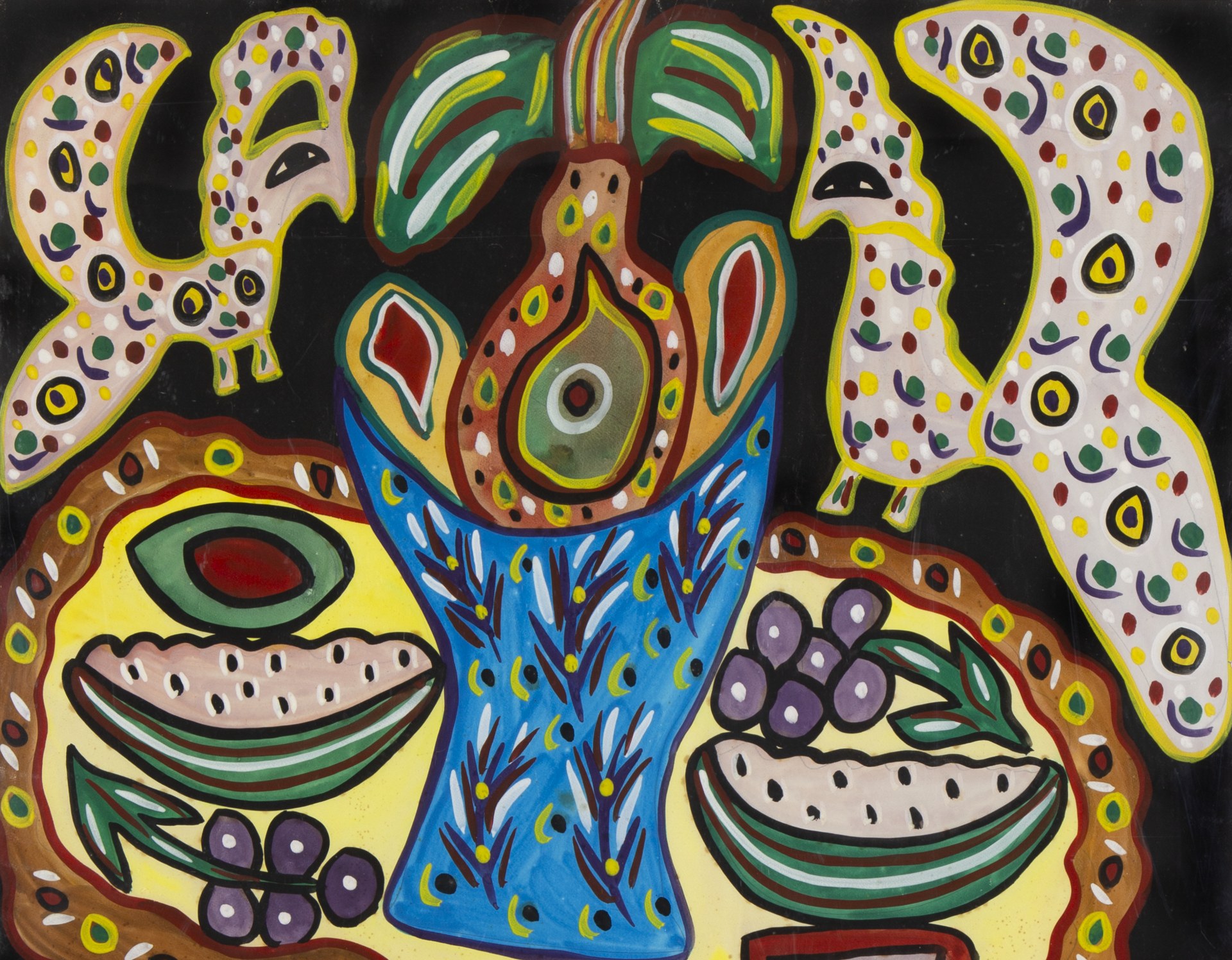
Baya, Untitled (Composition) (detail, 1980)
© Baya Estate, with kind permission by Baya Estate and Mennour, Paris
A Vast Cultural Landscape
When we speak of the “African-Arab world,” we are not referring to political borders or modern maps. We are describing a vast musical, cultural, and human landscape that has been shaped over thousands of years. Long before armies crossed deserts and merchants sailed the seas, sound had already made the journey. Music requires no translation and recognizes no borders. The relationship between Africa and the Arab world thus stands among the deepest and most enduring musical dialogues in history.
Essay by Naseer Shamma
A Vast Cultural Landscape
The Arabic Music Days explore African-Arab Dialogue
Naseer Shamma
When we speak of the “African-Arab world,” we are not referring to political borders or modern maps. We are describing a vast musical, cultural, and human landscape that has been shaped over thousands of years. Long before armies crossed deserts and merchants sailed the seas, sound had already made the journey. Before treaties were signed, rhythms had already traveled between communities, carrying memories, rituals, celebrations, and shared human experiences. Music is humanity’s oldest document of connection. It requires no translation and recognizes no borders. The relationship between Africa and the Arab world thus stands among the deepest and most enduring musical dialogues in history. It was never a one-way influence, but rather a continuous exchange that created a shared musical language that is still evolving today.
That is also why this African-Arab world has never believed in “cultural purity.” Every great city became a meeting place, every port a conservatory, and every caravan a moving school of music. It is often impossible to determine where a particular musical idea A began or where it ended, because music, by its very nature, refuses to recognize borders. Human movement played a decisive role in this exchange. Pilgrims, merchants, travelers, Sufi communities, scholars, and musicians all became cultural ambassadors. Songs often traveled more quickly than language itself, because melodies can settle into memory even when words change from one region to another.
If we were to draw a musical map instead of a political one, we would discover an immense network of routes stretching from the Red Sea to the Nile Valley, across the Sahara, through the Sahel and East Africa onward to the Atlantic coast. Along these paths traveled not only instruments, but also melodic systems, rhythmic ideas, vocal traditions, and entirely different ways of listening. The Arabic maqam tradition developed into one of the world’s most sophisticated melodic systems, while many regions of Africa cultivated their own distinctive musical languages, among them a rich variety of pentatonic scales. Wherever these musical worlds met, one never displaced the other. Instead, they entered into a dialogue that generated new forms of expression, traces of which can still be heard today in Sudan, Ethiopia, Eritrea, Somalia, Egypt, Morocco, Algeria, Tunisia, Mauritania, and throughout much of the African continent.
Rhythm might reveal this dialogue more clearly than any other musical element. In many African traditions, music is built upon layers of simultaneous rhythms that interact to create continuous movement rather than relying upon a single pulse. When these rhythmic concepts encountered the rhythmic vocabulary of Arab music, their meeting expanded the expressive possibilities of both traditions while preserving the identity of each.
No discussion of this shared world would be complete without acknowledging musical instruments. The oud, now one of the defining symbols of Arab music, did not remain confined to its original cultural environment. Throughout history it entered into dialogue with numerous African instruments, while African instrumental traditions influenced approaches to tone production, articulation, ornamentation, and musical color within Arab performance practice. Likewise, drums, frame drums, string instruments, and wind instruments traveled through trade routes, migration, and cultural exchange until they became part of a collective musical memory. Yet the deepest influence lies not in the instruments themselves but in the ways they are played. When a musician adopts an instrument from another culture, they do not simply inherit wood and strings; they inherit an entire philosophy of sound, silence, time, improvisation, and the relationship between performer and audience.
The central role of improvisation is one of the most remarkable characteristics shared by Arab and African musical traditions. Improvisation is not a departure from musical order; it is the highest expression of understanding that order. It allows the performer to recreate music in the present moment while remaining deeply rooted in tradition. In this sense, improvisation became one of the strongest bridges connecting musicians across this immense geographical and cultural landscape. Collective singing occupies an equally important place throughout many Arab and African societies. It is more than artistic performance; it is a social act that strengthens community and transforms music into a shared human experience rather than an individual product. This explains why music remains closely tied to everyday life: accompanying work, harvests, celebrations, worship, birth, mourning, and every significant transition in the human journey.
Looking at today’s musical landscape, many of the most innovative artistic projects are born from this shared heritage. A new generation of composers and performers increasingly views identity not as a boundary but as a point of departure for dialogue. This is precisely where the significance of these African-Arab connections lies. They are not merely a history to be celebrated, but a future waiting to be imagined. Our responsibility today extends beyond preserving tradition. We must continue to study it, document it, reinterpret it, and pass it on to future generations as a living human experience. Every maqam carries a story, every rhythm preserves a memory, and every instrument embodies centuries of cultural exchange.
A festival like this year’s Arabic Music Days, which brings together musicians from Africa and the Arab world, serves as a living laboratory for this dialogue. My hope is that it will do more than present concerts—it should create opportunities for artists to rediscover their common musical heritage while composing new chapters in a story that began centuries ago and continues today. The African-Arab world therefore is not simply a geographical expression. It is an ongoing sonic civilization where the Arab maqam meets the pentatonic scale, where complex African rhythms converse with Arab musical phrasing, where memory meets innovation, and where tradition becomes a source of creative renewal.
At a time when the world appears more divided than ever, music remains one of humanity’s most powerful reminders of what unites us. Music never asks for a passport. It never recognizes borders. It begins with, and always returns to, the human being. Perhaps this is why, whenever we truly listen to the music of Africa and the Arab world, we realize that we are not hearing two neighboring cultures, but one continuous human story told through many voices, one whose next chapter is still being written.
Naseer Shamma is among the world’s foremost players and teachers of the oud. Born in Kut, Iraq, he trained at the Music Academy in Baghdad with Iraqi grand master Munir Bashir, graduating in 1987, and subsequently completed a PhD in music philosophy. From 1993 to 1998 he taught at the Conservatory in Tunis, before founding the Arab Oud House in Cairo, a school dedicated entirely to his instrument. Other schools have since opened in Abu Dhabi, Riyadh, Baghdad, and Mosul. He has performed around the world with musicians from a wide range of artistic backgrounds, and in many of his projects combines traditions and instruments of classical Arabic music with those of Western music. Honored with more than 70 Iraqi and international awards, he received the Gusi Peace Prize in 2012, and in 2017 was named a UNESCO Artist for Peace for his humanitarian activities. He has been closely associated with the Pierre Boulez Saal since its inception as curator of the Arabic Music Days.
The Artists
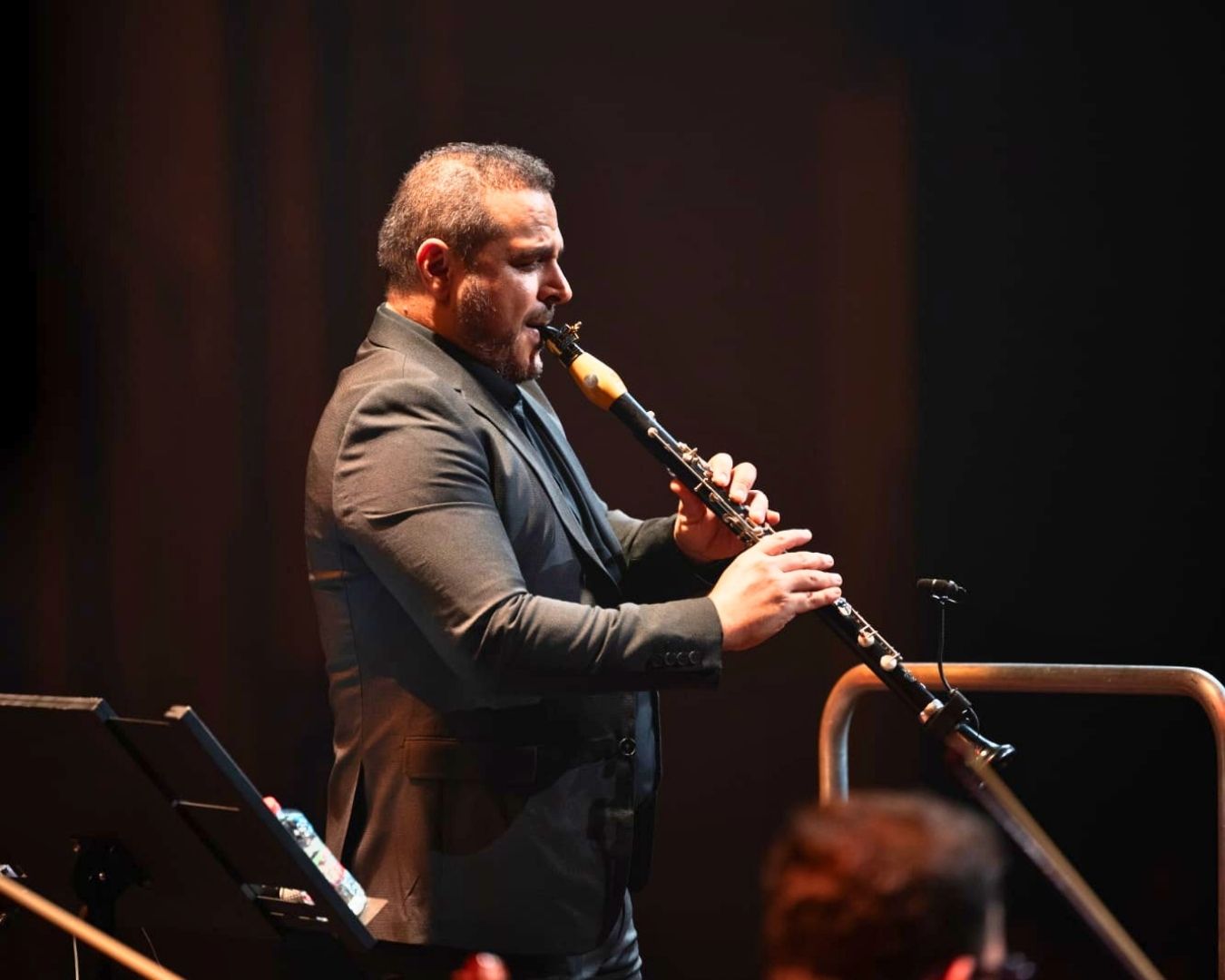
Ali Dridi
Violin and Clarinet
Ali Dridi is a Tunisian conductor, multi-instrumentalist, and music educator with more than two decades of international experience across North Africa, Europe, and the Middle East. He currently serves as conductor of the string orchestra at the Arab Oud House in Abu Dhabi, leading performances for major national and cultural events in the United Arab Emirates. A violinist and clarinetist, he holds a professorship in Music and Musicology from the Higher Institute of Music in Tunis and has performed with the Tunisian Symphony Orchestra as well as with distinguished artists including Naseer Shamma. He also actively contributes to advancing music education and curriculum development within music schools across Tunisia and the Gulf region. His work is inspired by Andalusian-rooted Tunisian music while embracing the full spectrum of Arabic musical traditions, spanning Khaleeji, Yemeni, Egyptian, Levantine, and Maghrebi styles, as well as Turkish and global influences. Having toured and performed across France, Germany, and Italy, he bridges Western classical traditions with Middle Eastern heritage.
September 2026
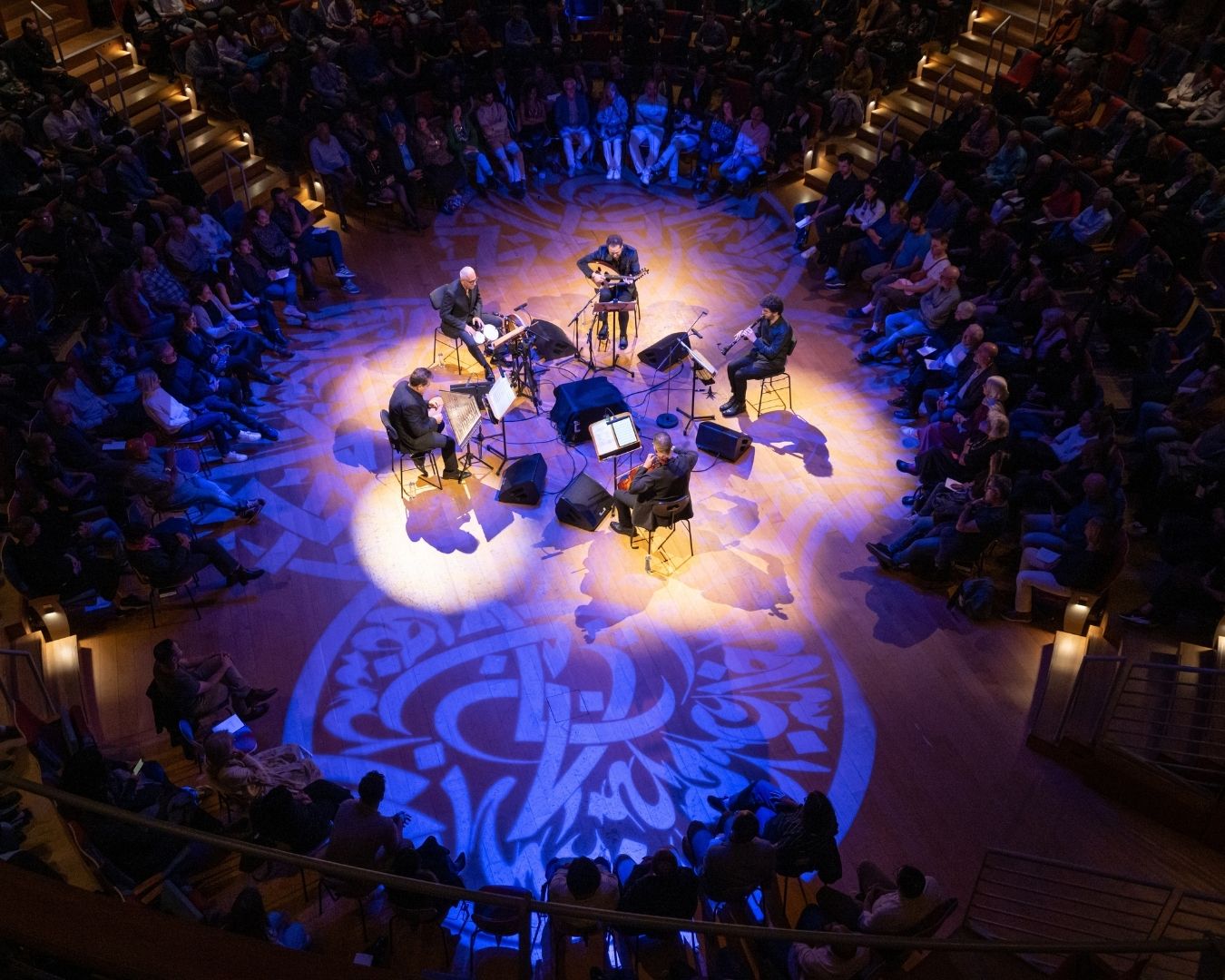
Haitham Ben Ali
Keyboard
A pianist, keyboardist, arranger, music producer, and music educator, Haitham Ben Ali was born in Tunisia and is based in the United Arab Emirates. His work encompasses Western, Arabic, and World music, and he has collaborated with renowned artists such as Saber Rebai, Ramy Ayach, Yara, Mohammed Fadel Shaker, Rami Sabri, Jassem Mohammed, and Mohammed Assaf. He has performed extensively throughout the United Arab Emirates and internationally, appearing in Tunisia, Algeria, Oman, Saudi Arabia, Kuwait, Qatar, France, Italy, Belgium, the Netherlands, and Spain. He holds a bachelor’s degree in Music and Musicology, specializing in piano, as well as a diploma in Arabic Music. As an arranger and keyboardist, he has contributed to major events and collaborated with ensembles including the Global Village Orchestra, Bayt Al Oud Chorus, and AD Jazz Band, in addition to appearances on MBC, Abu Dhabi TV, and Fujairah TV.
September 2026
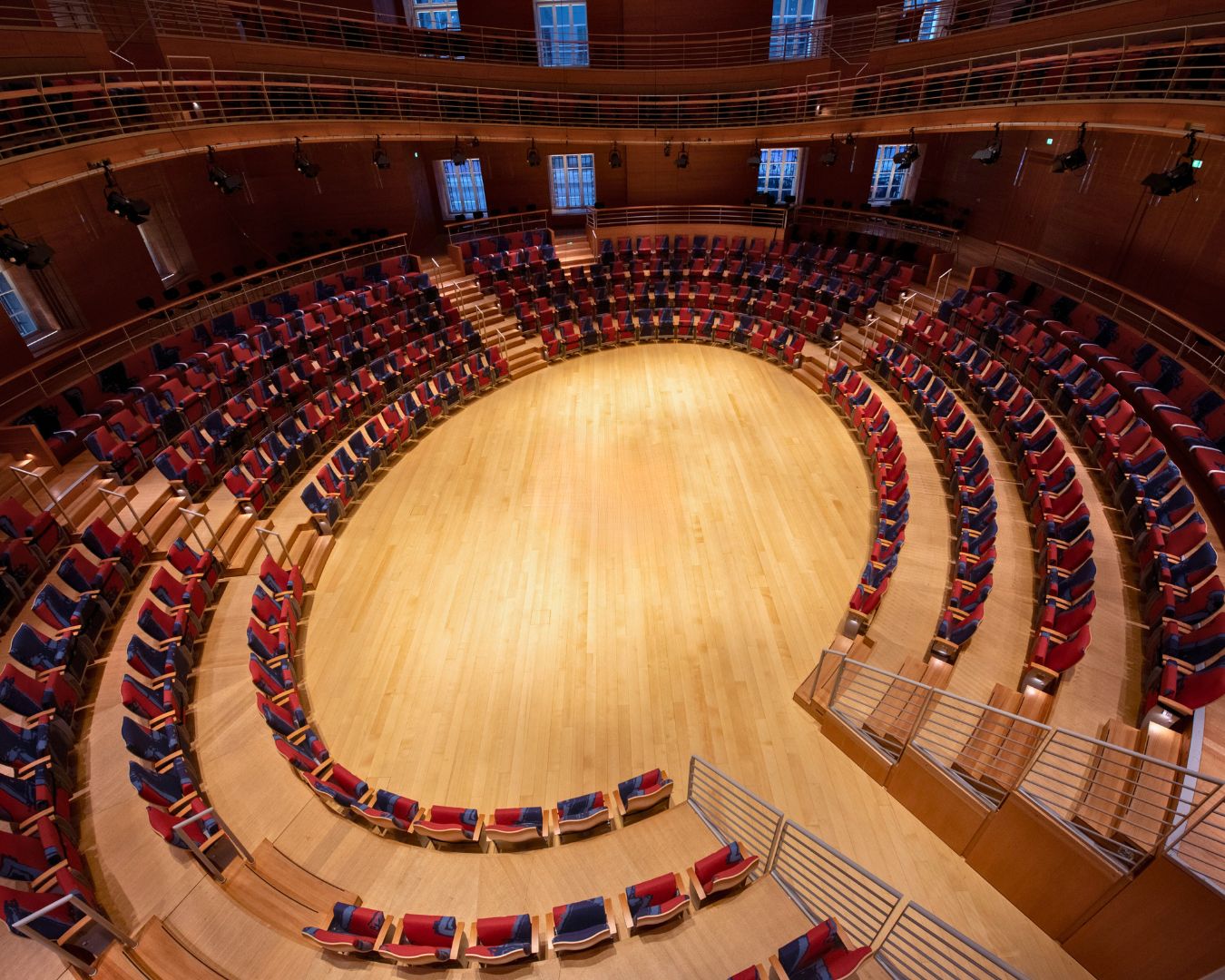
Mohamed Ben Hamida
Percussion
Tunisian musician and percussionist Mohamed Ben Hamida holds a master’s degree in Ethnomusicology. He has performed with international artists and across diverse musical traditions with particular expertise in composition and rhythmic analysis. He served as a professor of percussion at the Higher Institute of Music at the University of Sfax and subsequently worked for several years as a music educator in Oman and at the Ministry of Education in the United Arab Emirates. His musical experience spanning Gulf, Egyptian, Syrian, Tunisian, Moroccan, Iraqi, Western classical, and jazz traditions, he has collaborated with distinguished artists including Naseer Shamma, Saber Rebai, and Lotfi Bouchnak.
September 2026
Khadija El Afrit
Qanun
Born in Sousse, Tunisia, Khadija El Afrit is a Franco-Tunisian singer, qanun player, musicologist, and educator. She was introduced to music at an early age by her father, Azzam El Afrit, a master of Arabic music. After graduating in traditional Arabic music and qanun from the conservatory, she continued her studies at the Higher Institute of Music in Tunis and later at the Sorbonne in Paris, where she deepened her research into Arabic modal systems. She earned a PhD in Musicology in 2011 and has since developed an artistic practice at the intersection of research, creation, and education. A specialist in maqamat and improvisation, she performs around the world both as a solo artist and with various ensembles.
September 2026