Ahmad Shamma Oud
Oussa Sogoba Balafon, Voice, Percussion
Moussa Traore Kora
Kingsley Chinedu Piano, Percussion
Malai Maluak Deng Rau Adungu, Tanbur, Voice
Shibly Drums
Khalda Ibrahim Stage and Wardrobe Designer
Program
Maqam Lami (Iraq)
Tansania (traditional)
Mali (traditional)
Sudanese Heritage (traditional)
Mukashfi Al Qawm (traditional)
Inkovo (Inner Strength) (Ahmad Shamma)
Melody from Western Sudan (traditional)
Salam (Peace) (Ahmad Shamma)
Africa from North to South
Malaika (Fadhili William/Adam Salim?)
Abdel Kader (traditional)
Yèkè yèkè (Mory Kanté)
Intermission
Dance of Friends (Ahmad Shamma)
Mon Amour
Spain (Chick Corea)
We in Sudan (traditional)
You Are Not Alone (Ahmad Shamma)
The Blue Nile (traditional)
Hlangana (The Family Gathering) (Ahmad Shamma)
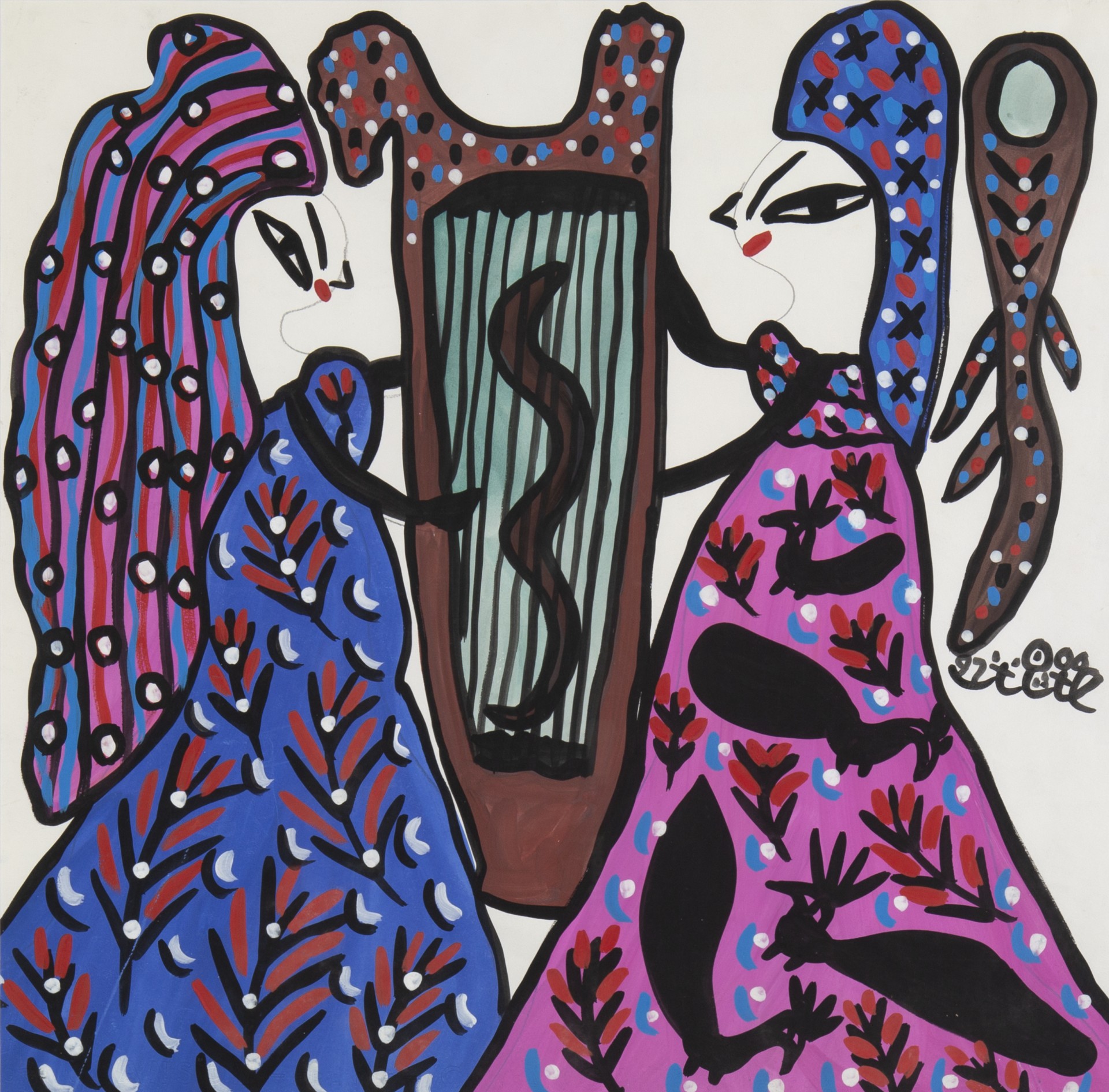
Baya, Untitled (Deux femmes à la harpe) (1997)
© Baya Estate, with kind permission by Baya Estate and Mennour, Paris
A Vast Cultural Landscape
When we speak of the “African-Arab world,” we are not referring to political borders or modern maps. We are describing a vast musical, cultural, and human landscape that has been shaped over thousands of years. Long before armies crossed deserts and merchants sailed the seas, sound had already made the journey. Music requires no translation and recognizes no borders. The relationship between Africa and the Arab world thus stands among the deepest and most enduring musical dialogues in history.
Essay by Naseer Shamma
A Vast Cultural Landscape
The Arabic Music Days explore African-Arab Dialogue
Naseer Shamma
When we speak of the “African-Arab world,” we are not referring to political borders or modern maps. We are describing a vast musical, cultural, and human landscape that has been shaped over thousands of years. Long before armies crossed deserts and merchants sailed the seas, sound had already made the journey. Before treaties were signed, rhythms had already traveled between communities, carrying memories, rituals, celebrations, and shared human experiences. Music is humanity’s oldest document of connection. It requires no translation and recognizes no borders. The relationship between Africa and the Arab world thus stands among the deepest and most enduring musical dialogues in history. It was never a one-way influence, but rather a continuous exchange that created a shared musical language that is still evolving today.
That is also why this African-Arab world has never believed in “cultural purity.” Every great city became a meeting place, every port a conservatory, and every caravan a moving school of music. It is often impossible to determine where a particular musical idea A began or where it ended, because music, by its very nature, refuses to recognize borders. Human movement played a decisive role in this exchange. Pilgrims, merchants, travelers, Sufi communities, scholars, and musicians all became cultural ambassadors. Songs often traveled more quickly than language itself, because melodies can settle into memory even when words change from one region to another.
If we were to draw a musical map instead of a political one, we would discover an immense network of routes stretching from the Red Sea to the Nile Valley, across the Sahara, through the Sahel and East Africa onward to the Atlantic coast. Along these paths traveled not only instruments, but also melodic systems, rhythmic ideas, vocal traditions, and entirely different ways of listening. The Arabic maqam tradition developed into one of the world’s most sophisticated melodic systems, while many regions of Africa cultivated their own distinctive musical languages, among them a rich variety of pentatonic scales. Wherever these musical worlds met, one never displaced the other. Instead, they entered into a dialogue that generated new forms of expression, traces of which can still be heard today in Sudan, Ethiopia, Eritrea, Somalia, Egypt, Morocco, Algeria, Tunisia, Mauritania, and throughout much of the African continent.
Rhythm might reveal this dialogue more clearly than any other musical element. In many African traditions, music is built upon layers of simultaneous rhythms that interact to create continuous movement rather than relying upon a single pulse. When these rhythmic concepts encountered the rhythmic vocabulary of Arab music, their meeting expanded the expressive possibilities of both traditions while preserving the identity of each.
No discussion of this shared world would be complete without acknowledging musical instruments. The oud, now one of the defining symbols of Arab music, did not remain confined to its original cultural environment. Throughout history it entered into dialogue with numerous African instruments, while African instrumental traditions influenced approaches to tone production, articulation, ornamentation, and musical color within Arab performance practice. Likewise, drums, frame drums, string instruments, and wind instruments traveled through trade routes, migration, and cultural exchange until they became part of a collective musical memory. Yet the deepest influence lies not in the instruments themselves but in the ways they are played. When a musician adopts an instrument from another culture, they do not simply inherit wood and strings; they inherit an entire philosophy of sound, silence, time, improvisation, and the relationship between performer and audience.
The central role of improvisation is one of the most remarkable characteristics shared by Arab and African musical traditions. Improvisation is not a departure from musical order; it is the highest expression of understanding that order. It allows the performer to recreate music in the present moment while remaining deeply rooted in tradition. In this sense, improvisation became one of the strongest bridges connecting musicians across this immense geographical and cultural landscape. Collective singing occupies an equally important place throughout many Arab and African societies. It is more than artistic performance; it is a social act that strengthens community and transforms music into a shared human experience rather than an individual product. This explains why music remains closely tied to everyday life: accompanying work, harvests, celebrations, worship, birth, mourning, and every significant transition in the human journey.
Looking at today’s musical landscape, many of the most innovative artistic projects are born from this shared heritage. A new generation of composers and performers increasingly views identity not as a boundary but as a point of departure for dialogue. This is precisely where the significance of these African-Arab connections lies. They are not merely a history to be celebrated, but a future waiting to be imagined. Our responsibility today extends beyond preserving tradition. We must continue to study it, document it, reinterpret it, and pass it on to future generations as a living human experience. Every maqam carries a story, every rhythm preserves a memory, and every instrument embodies centuries of cultural exchange.
A festival like this year’s Arabic Music Days, which brings together musicians from Africa and the Arab world, serves as a living laboratory for this dialogue. My hope is that it will do more than present concerts—it should create opportunities for artists to rediscover their common musical heritage while composing new chapters in a story that began centuries ago and continues today. The African-Arab world therefore is not simply a geographical expression. It is an ongoing sonic civilization where the Arab maqam meets the pentatonic scale, where complex African rhythms converse with Arab musical phrasing, where memory meets innovation, and where tradition becomes a source of creative renewal.
At a time when the world appears more divided than ever, music remains one of humanity’s most powerful reminders of what unites us. Music never asks for a passport. It never recognizes borders. It begins with, and always returns to, the human being. Perhaps this is why, whenever we truly listen to the music of Africa and the Arab world, we realize that we are not hearing two neighboring cultures, but one continuous human story told through many voices, one whose next chapter is still being written.
Naseer Shamma is among the world’s foremost players and teachers of the oud. Born in Kut, Iraq, he trained at the Music Academy in Baghdad with Iraqi grand master Munir Bashir, graduating in 1987, and subsequently completed a PhD in music philosophy. From 1993 to 1998 he taught at the Conservatory in Tunis, before founding the Arab Oud House in Cairo, a school dedicated entirely to his instrument. Other schools have since opened in Abu Dhabi, Riyadh, Baghdad, and Mosul. He has performed around the world with musicians from a wide range of artistic backgrounds, and in many of his projects combines traditions and instruments of classical Arabic music with those of Western music. Honored with more than 70 Iraqi and international awards, he received the Gusi Peace Prize in 2012, and in 2017 was named a UNESCO Artist for Peace for his humanitarian activities. He has been closely associated with the Pierre Boulez Saal since its inception as curator of the Arabic Music Days.
The Artists
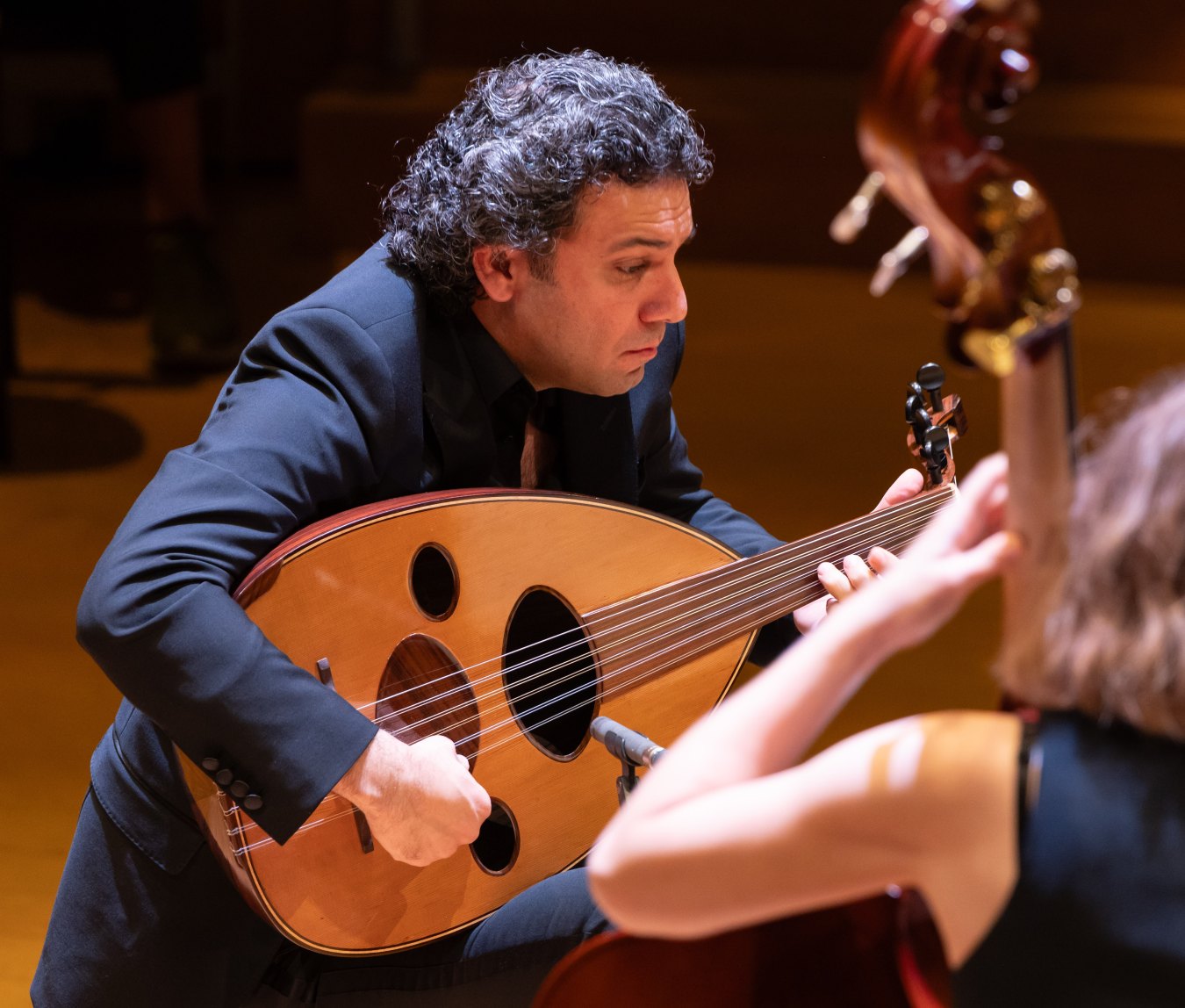
Ahmad Shamma
Oud and Composition
Born in Iraq, Ahmad Shamma is an oud player, composer, musical director, and leader of the Al Multaqa Orchestra and Ensemble, whose distinctive sound brings together Arabic and African musical traditions. He began his artistic journey at the College of Fine Arts of the University of Baghdad before relocating to Cairo to study at the Arab Oud House, founded by Naseer Shamma. He earned his oud soloist certificate with honors in 2007 and later taught at the institution. He subsequently moved to Abu Dhabi to teach oud and traditional music at the city’s Oud House and at the Sorbonne University Abu Dhabi. Throughout his career, he has performed internationally and developed a unique style blending Iraqi musical heritage with contemporary influences.
September 2026
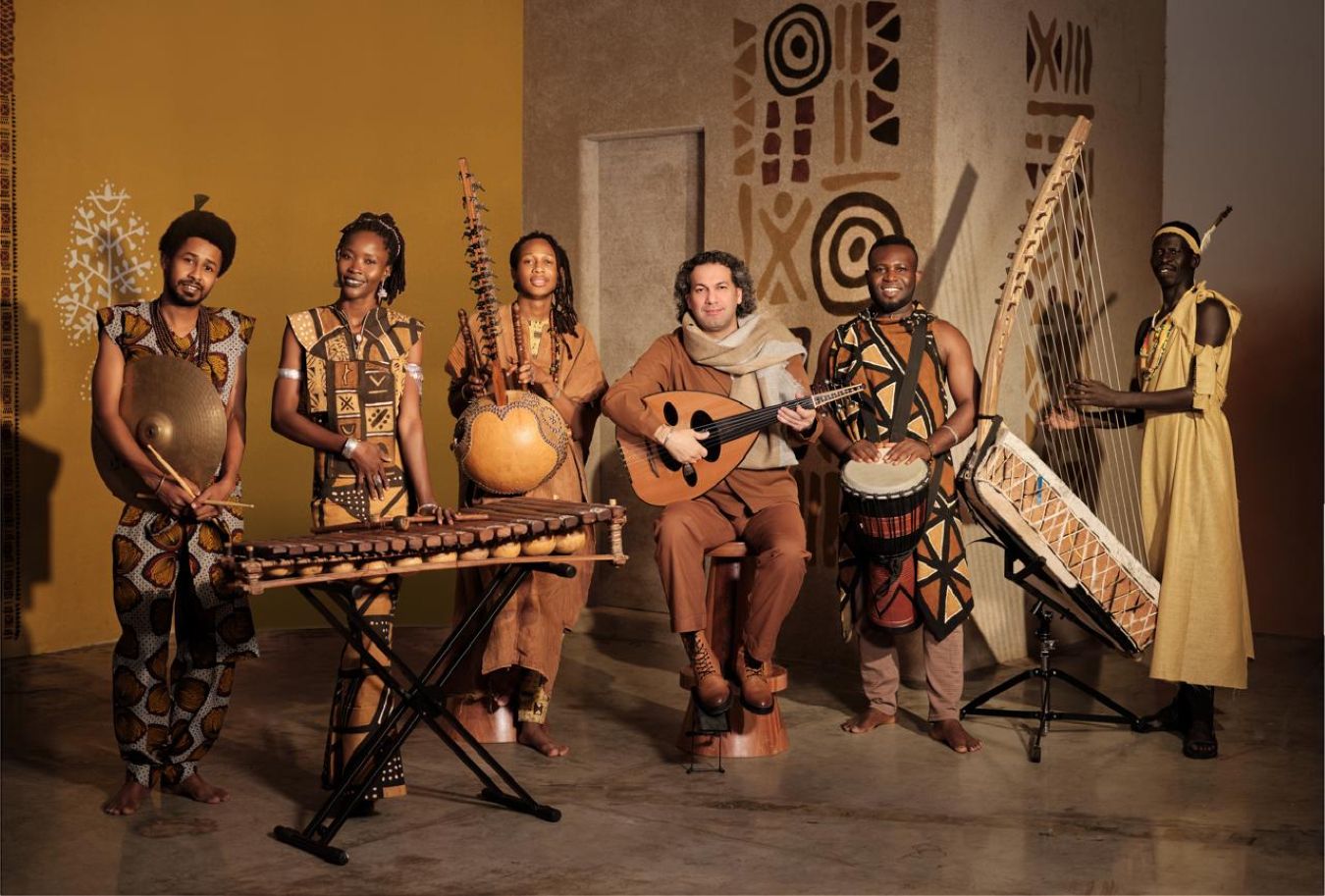
Al Multaqa Ensemble
Oussa Sogoba is a musician and interdisciplinary artist from Mali who performs on the balafon and other traditional percussion instruments. She holds a bachelor’s degree from the Balla Fasséké Kouyaté Conservatory of Arts and Multimedia in her home country’s capital Bamako and also trained in theater at Mali’s National Institute of Arts. She has performed at major festivals and cultural events across Mali and internationally and is recognized as the first female traditional balafon player in the country.
Moussa Traore hails from Mali and grew up with the rich artistic heritage of West Africa. As a performer on the kora, a traditional string instrument that combines elements of a lute and a harp, he has created a distinctive style by merging traditional West African rhythms with influences from jazz and reggae, while remaining deeply rooted in his Malian background. He has worked in recording studios across Mali. As a member of the Al Multaqa Ensemble, he preserves and introduces African musical traditions to diverse audiences.
Nigerian percussionist and pianist Kingsley Chinedu, born in Abia State and raised in Kaduna State as part of a musical family, began his artistic education at the age of seven and from the age of 12 studied with renowned Nigerian drummer Remi Kabaka. Since then, he has performed with numerous bands, ensembles, and artists both nationally and internationally.
A multi-instrumentalist and composer, Malai Maluak Deng Rau performs on the bow harp adungu and the bowl lyre tanbur, among other instruments. He has explored the rich tapestry of East African sounds, incorporating diverse textures and traditions into his works, which reflect a strong connection to heritage and culture. His versatility allows him to contribute across different musical styles, celebrating a variety of African musical traditions.
Sudanese percussionist and drummer Shibly began his musical education at the age of five and started his professional career in 2006 with the Zande Jazz Band from South Sudan. He was a founding member of the Sudan Roots Band and has performed with several prominent Sudanese groups, including Kush Band, Aslaf Band, and Sudan Resonator. He has also collaborated with international artists and cultural institutions such as British singer Natty, the British Council, and Germany’s Goethe-Institut.
September 2026