Alexander Gadjiev Piano
Program
Claude Debussy
La Terrasse des audiences du clair de lune
Ondine
Feux d’artifice
Maurice Ravel
Oiseaux tristes
Alborada del gracioso
La Vallée des cloches
Olivier Messiaen
Le Baiser d’enfant-Jésus
Andrea Miazzon
Postludio
Guillem Palomar
Drei Nachtstücke
Alexander Gadjiev
Improvisation
Joachim Carr
Pneuma
Modest Mussorgsky
Pictures at an Exhibition
Claude Debussy (1862–1918)
La Terrasse des audiences du clair de lune
Ondine
Feux d’artifice
from Préludes, Deuxième livre (1911–3)
Maurice Ravel (1875–1937)
Oiseaux tristes
Alborada del gracioso
La Vallée des cloches
from Miroirs (1904–5)
Olivier Messiaen (1908–1992)
XV. Le Baiser d’enfant-Jésus
from Vingt regards sur l’enfant-Jésus (1944)
Intermission
Andrea Miazzon (*1998)
Postludio (2025)
World Premiere
Guillem Palomar (*1997)
Drei Nachtstücke (2020)
Alexander Gadjiev (*1994)
Improvisation
Joachim Carr (*1988)
Pneuma (2025)
World Premiere
Modest Mussorgsky (1839–1881)
Pictures at an Exhibition (1874)
Promenade –
I. Gnomus
Promenade –
II. Il vecchio castello
Promenade –
III. Tuileries. Dispute d’enfants après jeux
IV. Bydło
Promenade –
V. Ballet of Unhatched Chicks –
VI. Samuel Goldenberg and Schmuyle
Promenade –
VII. Limoges. Le Marché –
VIII. Catacombae. Sepulcrum romanum –
Con mortuis in lingua mortua
IX. The Hut on Hen’s Legs (Baba Yaga) –
X. The Great Gate of Kiev
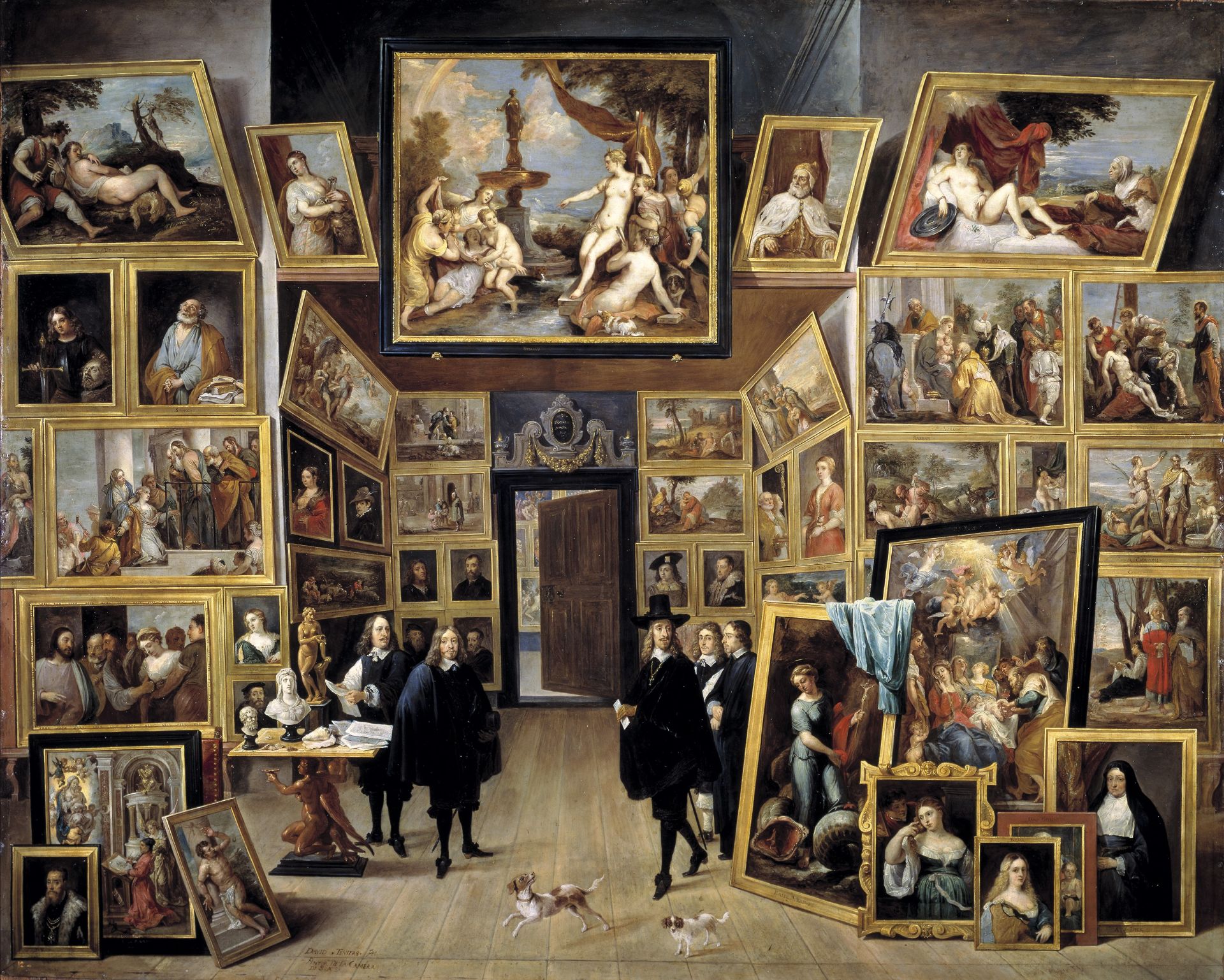
David Teniers the Younger, Archduke Leopold Wilhelm in his collection of paintings in Brussels, c. 1647
Pictures in Music
Although Franz Liszt is credited with coining the term “program music” in the late 1800s, the concept of instrumental music based on extramusical texts or images has a much longer history. In a sense, all pieces by Debussy, Ravel, Mussorgsky, and Messiaen that Alexander Gadjiev performs in tonight’s program are “pictures in music.”
Program Note by Harry Haskell
Pictures in Music
Piano Works by Debussy, Ravel, Messiaen, and Mussorgsky
Harry Haskell
Although Franz Liszt is credited with coining the term “program music” in the late 1800s, the concept of instrumental music based on extramusical texts or images has a much longer history. Whether music is capable of expressing, much less representing, anything outside itself remains a vexed question. When Mendelssohn was urged to attach descriptive titles to his “Songs without Words,” he famously declared: “What the music I love expresses to me, is not thought too indefinite to be put into words, but, on the contrary, too definite. If you ask me what my idea is, I say—just the song as it stands.” Berlioz, on the other hand, experienced the thunderstorm in Beethoven’s “Pastoral” Symphony as a congeries of vivid sound images; “it is no longer an orchestra that one hears,” he wrote, “it is no longer music, but rather the tumultuous voice of the heavenly torrents blended with the uproar of the earthly ones, with the furious claps of thunder, with the crashing of uprooted trees, with the gusts of an exterminating wind, with the frightened cries of men and the lowing of the herds.”
The pieces by Claude Debussy, Maurice Ravel, Modest Mussorgsky, and Olivier Messiaen that Alexander Gadjiev plays tonight are all, in a sense, “pictures in music.” Only Mussorgsky’s Pictures at an Exhibition, however, has a definite storyline, guiding the listener on an aural “promenade” through a (real-life) art show. Although the titles of Ravel’s pieces evoke pictorial imagery, he was less concerned with traditional tone painting than with capturing the flickering reflections of pianistic sonorities and textures in his musical “mirror.” Similarly, Debussy’s programmatic sobriquets are atmospherically evocative rather than concretely descriptive, while the rapturous contemplation induced by Messiaen’s vision of the baby Jesus has less to do with the ear or eye than with the spirit.
Impressionist Sketches
Debussy rose to prominence in the early 1890s with a group of boldly unconventional and quintessentially gallic works, including the String Quartet in G minor, La Damoiselle élue, and Prélude à l’après-midi d’un faune. By the time he published his first book of Images for solo piano in 1905, the composer and his aesthetic principles, loosely subsumed under the rubric “Debussyism,” were the object of both praise and censure. Together with the symbolist opera Pelléas et Mélisande, Debussy’s great piano and orchestral pieces came to define musical impressionism in the popular mind. Although critics associated him with Manet and other impressionist painters, he maintained that his music depicted not superficial “impressions” but essential “realities.” It was at least partly to counteract the distasteful label that he called his later piano works “preludes” and “etudes,” rather than using titles like Estampes and Images that evoked the visual arts.
In a further effort to discourage such associations, Debussy insisted on relegating programmatic titles to the end of his pieces—to no discernible effect, as the public remained stubbornly wedded to them. In any case, the two books of Préludes (published in 1910 and 1913, respectively) are programmatic only in the general sense of arising in response to extramusical stimuli; and those stimuli were as likely to be literary or theatrical as visual. The dozen preludes that comprise Book II are so texturally luxuriant that Debussy notated most of the music on three staves. La Terrasse des audiences du clair de lune (The Terrace of Moonlit Audiences) is notable for its spacious luminosity, Ondine (a water nymph) for its swirling, harp-like figurations and resonances. The last piece, Feux d’artifice (Fireworks), is a tour de force of kaleidoscopic colors, the individual notes almost dissolving in a glowing haze that is pierced, just before the end, by the distant clarion call of La Marseilleise.
Thirteen years younger than Debussy, Maurice Ravel was marked from an early age to succeed him as the poet laureate of French music. He made his mark at the turn of the 20th century with his masterful String Quartet and such brilliantly crafted piano pieces as the Pavane pour une infante défunte, Jeux d’eau, and Miroirs. Over the ensuing decades he refined his art, ruthlessly pruning away superfluous notes and gestures in search of the “definitive clarity” that was his declared ideal. Ravel’s repeated failure to win the Prix de Rome, a rite of passage for French composers seeking official approval, stiffened his determination to go his own way. Not until 1920 was he awarded the prestigious Légion d’Honneur, an accolade that he rebuffed with undisguised satisfaction. As a member of the Parisian artists’ circle known as the Apaches, the young Ravel aligned himself with the gadflies who rejected France’s hidebound cultural establishment. The five pieces that comprise Miroirs (Mirrors) are variously dedicated to a poet, a pianist, a painter, a music critic, and a composer, all known for their progressive stances in matters of taste.
According to Ravel, Miroirs marked “a considerable change in my harmonic evolution, one that disconcerted even those musicians who had been most familiar with my compositional style up to then.” (The work was premiered in Paris on January 6, 1906, by the Spanish pianist Ricardo Viñes.) Miroirs does indeed show Ravel cutting loose from traditional harmonic and structural moorings. In Oiseaux tristes (Sad Birds), a recurring motif of softly cooing repeated notes is interspersed with flighty arabesques; Ravel described the piece as “birds lost in the torpor of a very dark forest during the hottest hours of summer.” In Alborada del gracioso (Morning Song of the Court Jester), Ravel treats us to a high-stepping, Spanish-flavored dance, complete with rapidly repeated notes that evoke the strumming of a guitar. In the fifth and final piece, La Vallée des cloches (The Valley of the Bells), bright, bell-like peals are silhouetted against a subtly shifting tonal haze.
Sounding Images
Olivier Messiaen was the vital link in French music between the free, luminous harmonies of the impressionists and the tightly organized serialist procedures favored by the post–World War II avant garde. A devout Catholic, he served for more than six decades as organist of the Church of the Holy Trinity in Paris. The intensity of his spiritual life is reflected in the 1944 piano cycle Vingt regards sur l’enfant-Jésus (Twenty Aspects of the Baby Jesus). Couched in what Messiaen described as “a language of mystical love, at once varied, powerful, and tender,” Le Baiser de l’enfant-Jésus (The Kiss of the Baby Jesus) was inspired by an engraving of Jesus in Mary’s arms bending toward the French saint known as “Little Sister Theresa.” As if the music were not explicit enough, Messiaen helpfully provides a program: a soothing lullaby, incorporating a sequence of chords that is associated with God throughout the cycle, leads to the yearning strains of the infant’s “arms extended toward love,” the rapture of the holy kiss, and its tingling afterglow.
As one of the group of nationalist composers popularly known as the “Mighty Handful,” Modest Mussorgsky stood in the vanguard of the movement to create an identifiably Russian musical tradition in the mid-1800s. Neither by training nor by temperament was he fitted to join the ranks of the country’s musical establishment. A career civil servant, he gravitated instead toward men such as Alexander Borodin and Nikolai Rimsky-Korsakov, largely self-taught composers who drew inspiration and material from Russian folklore and history. Declaring that “my music must be an artistic reproduction of human speech in all its finest shades,” Mussorgsky forged a powerfully expressive, protomodernist musical language in works such as the orchestral tone poem Night on Bald Mountain and the opera Boris Godunov. Mussorgsky wrote Pictures at an Exhibition in June 1874, fresh from the hugely successful premiere of Boris Godunov at the Mariinsky Theater in St. Petersburg. A suite of miniature tone poems, it commemorates an exhibition of drawings and watercolors by the composer’s recently deceased friend (and fellow nationalist) Viktor Hartmann.
The piece is perhaps best known in the brilliant symphonic transcription that Ravel made in 1922, following the example of Rimsky-Korsakov, who had taken it upon himself to “correct” the supposed “mistakes” in many of Mussorgsky’s orchestrations before their publication. However, many pianists have championed the original keyboard version, including Vladimir Horowitz (who could not resist adding a few “improvements” of his own to the score). A majestically striding theme, which will recur throughout the work as both interlude and motif, ushers the listener/viewer into the exhibition hall. The air of nobility is soon spoiled by the grotesque antics of a clumsy gnome—the first of Mussorgsky’s incisive musical pen portraits. One by one the vivid images parade before our eyes: a gloomy medieval castle; children gamboling in Paris’s Tuileries Gardens; a lumbering Polish oxcart; a scherzo-like vignette of chicks pecking at their eggshells; two Jewish men animatedly arguing and gesticulating; a bustling French marketplace; a ponderously chordal descent into the French capitol’s subterranean catacombs; a witch’s hut transformed into a strutting hen; and, for a resplendent climax, the hymn-like strains inspired by Hartmann’s sketches for an imposing city gate at Kyiv.
A former performing arts editor for Yale University Press, Harry Haskell is a program annotator for Carnegie Hall in New York, the Brighton Festival in England, and other venues, and the author of several books, including The Early Music Revival: A History, winner of the 2014 Prix des Muses awarded by the Fondation Singer-Polignac.
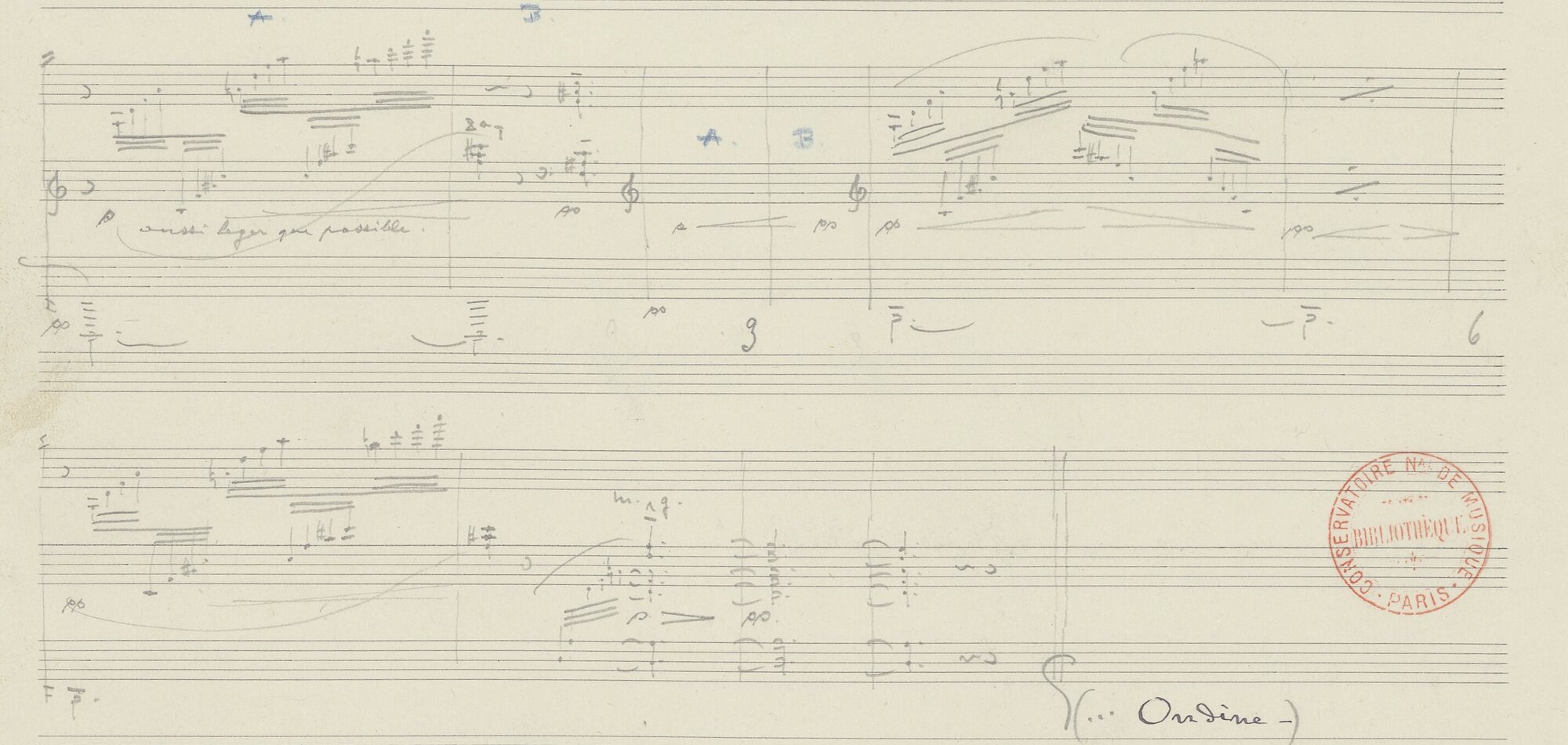
Claude Debussy’s Ondine from Préludes Book II in the composer’s manuscript (Bibliothèque nationale de France)
Tönende Bilder
Die Kontraste innerhalb des heutigen Programms könnten kaum größer sein: Steht der erste Teil ganz im Zeichen höchst artifizieller Klavierkunst französischer Provenienz von Debussy, Ravel und Messiaen, so bringt der zweite Teil mit Mussorgskys Bildern einer Ausstellung ein Werk, das sich in seiner schroffen, fast anti-pianistischen Ausformung jeder Einordnung entzieht.
Essay von Michael Horst
Tönende Bilder
Klavierwerke von Debussy, Ravel, Mussorgsky und Messiaen
Michael Horst
Die Kontraste innerhalb des heutigen Programms könnten kaum größer sein: Steht der erste Teil ganz im Zeichen höchst artifizieller Klavierkunst französischer Provenienz, die vor dem Ersten Weltkrieg in Claude Debussy und Maurice Ravel ihre bedeutendsten Repräsentanten und nach dem Zweiten Weltkrieg in Olivier Messiaen einen späten Nachfahren gefunden hat, so bringt der zweite Teil mit Modest Mussorgskys Zyklus Bilder einer Ausstellung ein Werk, das sich in seiner schroffen, fast anti-pianistischen Ausformung jeder Einordnung entzieht. Eine weitere Farbe steuern die zeitgenössischen Werke bei, die Alexander Gadjiev mit eigenen Improvisationen ergänzt.
Traumhafter Klangzauber
Claude Debussy und Maurice Ravel
Debussy hat mit seiner Klaviermusik das Tor zum 20. Jahrhundert weit aufgestoßen, und gerade seine 24 Préludes zählen in der Fülle ihrer Ideen und Stimmungen, Farben und Formen zu den bedeutendsten Sammlungen der Klaviermusik überhaupt. Nie zuvor war der Klavierklang so fantasievoll aufgefächert worden, nie waren die Möglichkeiten dieses Tasteninstruments, von den tiefsten Lagen bis in flirrende Höhen, so virtuos ausgereizt worden. Nicht zufällig hat Debussy viele der einzelnen Stücke auf drei Systemen notiert – die beiden Hände haben sich virtuos über die gesamte Klaviatur zu bewegen.
Schon die Titel der Préludes, die von Naturphänomenen über humoristische Portraits bis hin zu Postkartenidyllen reichen, geben einen Hinweis auf die Bandbreite des Zyklus, doch sie sollten keineswegs überinterpretiert werden – Debussy hat sie bewusst jeweils ans Ende der Kompositionen gesetzt. Die drei von Alexander Gadjiev ausgewählten Préludes entstammen dem 1914 publizierten zweiten Band; sie zeigen, anders als etwa populäre Titel aus dem ersten Teil wie La Cathédrale engloutie oder La Fille aux cheveux de lin, den verstärkten Willen des Komponisten, die Zusammenhänge von Melodie und Rhythmus aufzulösen und motivische Inseln quasi assoziativ aneinanderzufügen. Auch wenn Debussy durch die Lektüre eines indischen Reisebuchs zu dem Titel La Terrasse des audience du clair de lune (Die Terrasse der Audienzen bei Mondschein) angeregt worden sein soll: Dieses traumhafte Gebilde, das harmonisch entfernt noch an Wagners Tristan erinnert, ist in seiner Verbindung aus akkordischen Säulen und hingetupften Einwürfen eine pure Erfindung Debussys. Deutlich zersplitterter, zwischen bewegten Klangflächen und melodischen Fragmenten changierend, umreißt der Komponist in Ondine die sagenhafte Gestalt der märchenhaften Wasserfrau. Den glanzvollen Ausklang des gesamten Zyklus bildet Feux d’artifice, ein brillantes Spiel mit unablässig variierten musikalischen Ornamenten, das eher wie ein Wasserfall als das genannte Feuerwerk anmutet – wobei die plötzlichen Akzente wie kleine Raketen für einen besonderen Effekt sorgen.
Erstaunlich genug, dass in einer Stadt wie Paris zwischen 1900 und 1917 zwei so brillante wie gegensätzliche Komponisten lebten, die fast immer in einem Atemzug genannt werden. Der Kontrast zwischen Ravel und Debussy – ohne eine letztlich sinnlose Wertung – lässt sich gerade anhand ihres Klavierwerks gut nachvollziehen, umfasst es doch bei beiden etwa ein Drittel des gesamten Œuvres. 1905 komponierte Ravel seinen Zyklus Miroirs (Spiegel). Das erste Stück Oiseaux tristes (Traurige Vögel) wird in bewusster formaler Stringenz aus einem einzigen Motiv zu einem Vogelgezwitscher voller harmonischer Raffinessen entwickelt. Größte Popularität, vor allem in der späteren Orchesterfassung, hat Alborada del gracioso (Morgenständchen des Narren) erlangt: Ravel fängt hier spanische Gitarren- und Kastagnettenklänge in einem funkelnden, rhythmisch mitreißenden Stück von atemberaubender pianistischer Virtuosität ein. Äußerst schlicht dagegen erscheinen die musikalischen Mittel in La Vallée des cloches (Das Tal der Glocken): Aus imitierten Glockenklängen in verschiedensten Lagen und einem Spektrum von imaginierten Obertönen gestaltet der Komponist einen von herben Quartintervallen bestimmten Klangraum von großer Suggestivkraft.
Religiosität und Sinnlichkeit
Olivier Messiaen
Etwa 40 Jahre jünger als Debussy und Ravel war der 1908 geborene Olivier Messiaen. In seinem Werk vereinigen sich zwei völlig gegensätzliche Pole: eine tiefempfundene Religiosität, die den katholischen Glauben zum Zentrum allen Denkens und Fühlens machte, und eine Vorliebe für Klangsinnlichkeit, die Messiaen in seinen Orchester-, Orgel- und Klavierwerken gleichermaßen mit voller Hingabe ausgelebt hat. Ein besonders wichtiges Dokument dafür ist der zweistündige Klavierzyklus Vingt regards sur l’enfant-Jésus (Zwanzig Blicke auf das Jesuskind), komponiert 1944 und von Messiaens Ehefrau Yvonne Loriod ein Jahr später zur Uraufführung gebracht. Seine 20 Teile bleiben in ihrer Betrachtung der Kindheit Jesu durchaus nicht auf abstrakt-spirituelle Sphären beschränkt, sondern verbinden himmlische und irdische Liebe in einem Personalstil, der Elemente aus alter und neuer Zeit, Europäisches und Außereuropäisches, Zartes und Bombastisches in gewaltigen pianistischen Klanggemälden zusammenfügt. Ein freies Metrum ist für Messiaens Stil ebenso typisch wie die fast hypnotische Abfolge von Akkordtrauben, die zu schweben scheinen.
Le Baiser de l’enfant-Jésus (Der Kuss des Jesuskindes), die Nr. 15 des Zyklus, kann ihre Verbindung zu Franz Liszt, seinen religiösen Tongemälden und seinem überbordenden Klavierstil, kaum verleugnen. Das Stück folgt einem klaren geistigen Ablauf, wie er zu Beginn von Messiaen notiert wird: Zart glitzernde Akkorde in strenger Anordnung, die mehr und mehr von Tongirlanden umspielt werden, findet der Komponist für das Wiegenlied Jesu, überschrieben „Le sommeil“ (Der Schlaf). Die Geste, mit der das Jesuskind schließlich seine Arme „in Richtung Liebe“ ausstreckt („Les bras tendues vers l’amour“) spiegelt sich in einer leidenschaftlichen Verdichtung der Klänge, die immer stärker aufwärtsstreben. Sie münden in den „Kuss“, eine von rauschenden Arpeggien begleitete Melodie, die sich für den Abschluss, „L’ombre du baiser“ (Der Schatten des Kusses), in ein zärtliches Klanggespinst auflöst, das in ätherischen Fis-Dur-Akkorden verklingt.
Schroffe Tongemälde
Modest Mussorgsky
Mussorgskys Bilder einer Ausstellung stehen wie ein wuchtiger Solitär im Klavierwerk des Komponisten wie überhaupt im russischen Klavierrepertoire des 19. Jahrhunderts. Oper und Lied waren Mussorgskys wichtigste Betätigungsfelder, repräsentiert insbesondere durch Boris Godunow und die Liederzyklen Ohne Sonne und Lieder und Tänze des Todes. Erst der Tod seines guten Freundes, des Malers Viktor Hartmann, gab den Impuls für eine großformatige, anspruchsvolle Klavierkomposition. Hartmann war 1873 gestorben, und im folgenden Jahr fand in Moskau eine Gedenkausstellung aus, die von Wladimir W. Stassow, einem gemeinsamen Freund, organisiert wurde.
Insgesamt zehn höchst unterschiedliche Bilder wählte Mussorgsky für seine musikalischen Portraits. Darunter finden sich Personen, Straßenszenen, Stimmungsbilder, sagenhafte Erzählungen – und mit dem Großen Tor von Kiew eine gewaltige Apotheose als krönender Abschluss. Den gesamten Lebenszyklus scheint Mussorgsky mit seiner Auswahl einfangen zu wollen: Kindergeschrei ist ebenso zu hören wie ein Liebeslied, und der Tod ist mit den römischen Katakomben in besonders suggestiver Weise vertreten. Mögen die Bilder und Zeichnungen Hartmanns, die im Nachhinein nur noch teilweise ausfindig gemacht werden konnten, kaum über die künstlerischen Konvention der Zeit hinausgegangen sein, so tun dies die Vertonungen in jedem Takt. Sie verweigern sich dem traditionellen Klavierstil, wie er in den Werken von Mussorgskys russischen Zeitgenossen Pjotr Tschaikowsky, Mili Balakirew oder Anatol Ljadow zum Ausdruck kommt. Die Partitur spiegelt eher die Intention des Komponisten, seine radikalen Klangvorstellungen dem Klavier quasi überzustülpen.
Schon die Promenade, die nach der wuchtigen Eröffnung weitere fünf Male in veränderter Gestalt erklingt, fällt durch ihren ungewöhnlichen 11/4-Takt – gegliedert in fünf plus sechs Viertel – auf. Hinzu kommt Mussorgskys Vorliebe, Themen nicht im klassischen Sinn zu verarbeiten, sondern immer wieder zu repetieren und dabei ohne Zäsur hart gegeneinander zu stellen. In Gnomus zeigt er mit gleichsam verbogenen Tonfolgen und chromatisch sich windenden Oktavgängen die Physiognomie dieses Wesens, dessen schleichender Gang mit schwer fassbaren Trillerketten im Bass eingefangen wird. In eine italienische Szenerie entführt dagegen Il vecchio castello (Das alte Schloss) – mit einem traurigen Gesang über einem Barcarolen-Rhythmus, welchem der ostinate Basston Gis ein Gefühl bleierner Monotonie verleiht.
Von größter Plastizität sind die stampfenden Bässe, die Mussorgsky für den schwergängigen Ochsenkarren Bydło findet. Hier reicht dem Komponisten nicht allein die Vortragsbezeichnung „pesante“ (gewichtig), sondern er verdoppelt die Bassnoten, obwohl sie nur einmal angeschlagen werden können – eine sinnfällige Notierung, die vor allem die Imagination des Interpreten im Auge hat. Als in höchstem Maße „sprechende“ Bilder präsentieren sich auch das Ballett der unausgeschlüpften Küken mit den tschilpenden Vorschlägen und Trillern in hoher Lage sowie das Portrait von Samuel Goldenberg und Schmuyle. Hier setzt der Komponist auf grobe Kontraste zwischen zwei jüdischen Archetypen: auf der einen Seite der selbstgefällige Reiche mit einem energischen einstimmigen Thema, auf der anderen der flehentlich winselnde Arme mit hektischen Tonrepetitionen.
Fahle, dissonante Akkorde, durch Fermaten zum musikalischen Stillstand gebracht, prägen die Catacombae; hier hatte sich der Maler selbst mit einer Lampe in den Katakomben dargestellt. Eine letzte gespenstische Promenade (lateinisch überschrieben als „Mit den Toten in einer toten Sprache“) schließt sich an, bevor der Zyklus seinem Abschluss und Höhepunkt entgegenstrebt. Ein Abbild ungezügelter Wild- und Rohheit ist Die Hütte auf Hühnerfüßen, inspiriert von dem russischen Märchen von der Hexe Baba Jaga und in Musik gesetzt mit schroffen Akzenten und Rhythmen, wie man sie später erst wieder bei Béla Bartók findet. Danach bleibt nur noch die letzte Steigerung, wenn sich mit viel Pathos die feierliche Prozession durch Das große Tor von Kiew (als Hauptstadt der alten Rus) bewegt und die imaginierten Glocken mit festlichem Geläute für weihevolle Stimmung sorgen.
Der Berliner Musikjournalist Michael Horst arbeitet als Autor und Kritiker für Zeitungen, Radio und Fachmagazine. Außerdem gibt er Konzerteinführungen. Er publizierte Opernführer über Puccinis Tosca und Turandot und übersetzte Bücher von Riccardo Muti und Riccardo Chailly aus dem Italienischen.
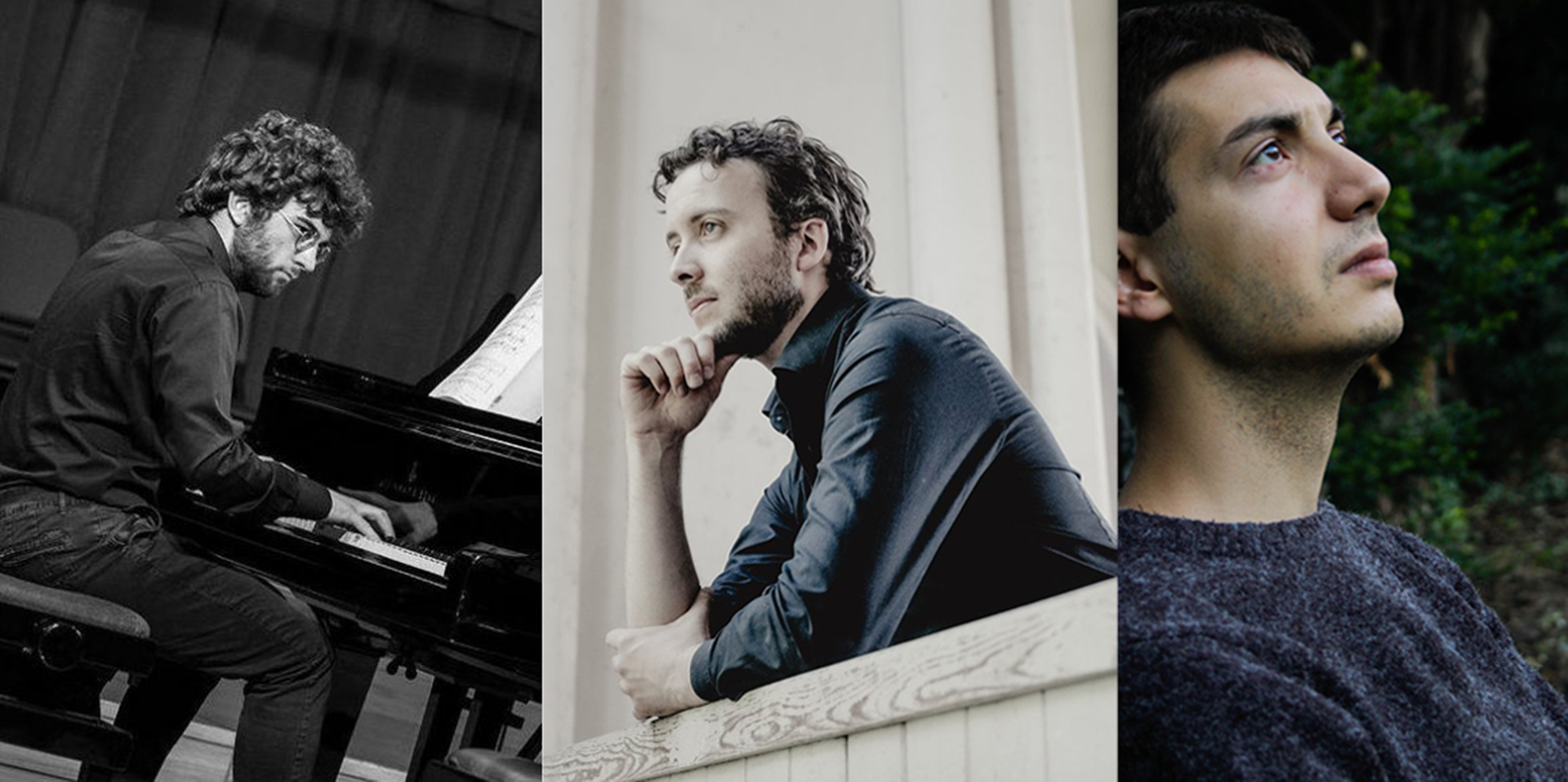
Andrea Miazzon, Joachim Carr, and Guillem Palomar
Notes from the Composers
Andrea Miazzon, Guillem Palomar, and Joachim Carr introduce their pieces, two of which receive their world premieres tonight.
Postludio
So-called “pure” instrumental music is governed by its own forms of signification, different from those on which the other arts are based. Unable to refer directly to objects, images, or narratives, music articulates meaning through internal relationships, tensions, directions, and gestures unfolding in time.
I have always been fascinated by a dialogue with extramusical subtexts, which I nevertheless choose not to make explicit—not to deny their existence, but to avoid steering or constraining listening in a specific direction. In this sense, music becomes for me a kind of refracting prism: it does not convey a determinate content, nor the original source of inspiration, but may awaken something in the listener—something unpredictable and deeply personal, which nonetheless, in a distant and unconscious way, arises from that initial idea.
To introduce the spirit of Postludio, I quote a verse by Sandro Penna:
Forse la lenta tua malinconia si perde
se nella notte ad un veloce
treno l’affidi.
Perhaps your slow melancholy fades
if in the night to a speeding
train you entrust it.
—Andrea Miazzon
Drei Nachtstücke
Drei Nachtstücke originated from research into material for a song cycle—which I ultimately never wrote—setting texts by the Classical poets Ovid and Pindar, as well as by the Sephardi writer Yehudah Halevi. These three piano pieces explore the poems’ prosodic possibilities through the different ratios that can be applied to long and short syllables within the metrical feet. The meters of the texts are reflected in the music of the Nachtstücke through form, bar structure, and note durations, so that the pieces may be described as “fantasies on an elegiac couplet, on bacchic rhythm, or on a dactylic clausula,” respectively.
This work is representative of my years of study at the Barenboim-Said Akademie under the guidance of Jörg Widmann and was premiered at the Pierre Boulez Saal by Nathalia Milstein as part of her graduation recital in October 2020.
—Guillem Palomar
Pneuma
The undulating flow of Gregorian melodies is characterized by a rhythm that is not quantifiable and measurable, but that is rather felt as an interaction between rhythmic movements: the energetic impulse of arsis—the upward movement as the melody rises, typically at the beginning of a phrase, and at important words and syllables—and thesis—the “falling” gesture that follows, as the word or the phrase comes to a close, to momentary stillness.
These elemental movements are deeply rooted in our embodied beings, most prominently in our breathing, to which the title Pneuma refers, but they also permeate the world “out there”: as waves, wind, and other oscillating forces, and furthermore, in religious terms, as the spirit as a life-giving force.
For this piece, I have taken a Gregorian chant (an Alleluia sung, in the Roman rite, on the sixth Sunday after Pentecost) as a departure point: its melodic outlines and shapes become extended both in space, with wider intervals—painted with a broad brush, so to speak, and with an extended palette of tonal colors—and prolonged in time, the melodic motifs of the chant underlying the texture (cantus firmus–like) or weaved into it at important points of the melodic arches. The original melody remains concealed for most of the time, except in moments towards the end of the piece, where it becomes quite perceptible, “hidden” in plain sight.
The so-called neumes—the ancient notation with which the chants were preserved—have also acted as a stimulus to the conception of the piece. The neumes had no information about the exact pitches to be sung but were visual representations of the melodic shapes and inflections, written above the text of the song, to aid the memory of melodies that were often very long and would be passed on orally. However, since they exist in a vast variety of very precise shapes, it is highly likely that they also contained much information about rhythm, flow, and even color and expression—information that is forever lost to us.
Inspired by all of this, in Pneuma there are two main pairs of rhythmic contrast, or of opposing forces. The first is the interplay between arsis and thesis, and whereas in the first part, the energetic arsis movements dominate, in the following section there are long, suspended falling gestures. The other main opposition is between time that is absolutely measured, proportional, and “rhythmic,” and time of freely flowing movements and gestures. These points of interest reflect a broader question of how one relates to time—in terms of quality, whether as urgency or restfulness, or in measurable, quantitative terms?
—Joachim Carr
The Artist

Alexander Gadjiev
Piano
Alexander Gadjiev was born in Gorizia on the border between Italy and Slovenia, a city whose cultural and linguistic crossroads have had a significant impact on his career. The son of a musical family, he received his first piano lessons from his father and later studied with Pavel Gililov at Salzburg’s Mozarteum and with Eldar Nebolsin at the Hanns Eisler School of Music in Berlin. He is a prizewinner of the Sydney International Piano Competition and the International Chopin Competition, among others, and in 2022 was awarded the Premio Abbiati; the following year, he received the Prešeren Prize, the highest artistic honor in Slovenia, from the Slovenian president. He has performed at major venues including London’s Wigmore Hall, the Maggio Musicale in Florence, the Vienna Musikverein, Moscow Conservatory, Teatro La Fenice in Venice, Bunka Kaikan in Tokyo, Salle Cortot in Paris, and at the festivals of Salzburg, La Roque d’Anthéron, Aldeburgh, Ludwigsburg, and Ruhr. In the summer of 2024, the first edition of the cross-border “Prečkanja – Sconfinamenti” Festival was held in his hometown under his artistic direction. In 2025, Alexander Gadjiev served as cultural ambassador for the European Capital of Culture Gorizia-Nova Gorica. His discography includes solo works by Schumann, Liszt, Prokofiev, Scriabin, Mussorgsky as well as Nikolai and Alexander Tcherepnin, among others.
February 2026