Domen Marinčič Viola da gamba
Program
Works by
Jean Lacquement Dubuisson
Monsieur de Sainte-Colombe le père
Monsieur de Sainte-Colombe le fils
Monsieur de Machy
Johannes Schenk
Carl Friedrich Abel
Jean Lacquement dit Dubuisson (1622/23–1680/81)
Suite in E minor (c. 1680)
Prélude – Allemande – Courante – Sarabande
Monsieur de Sainte-Colombe le père (fl. 1658–1687)
Suite in D major (c. 1680)
Allemande – Courante – Sarabande – Gigue à la manière du Vieux Gautier – Gigue – Vielle
Monsieur de Sainte-Colombe le fils (c. 1660–c. 1720)
Tombeau pour Monsieur de Sainte-Colombe le père (1701?)
[Without indication] – Passage du Styx – Fort lentement – Dernier adieu – Désespoir – Fort lentement – Gay
Monsieur de Machy (fl. 1685)
Suite in G major (1685)
Prélude – Allemande – Courante – Sarabande – Gigue – Gavotte en rondeau – Chaconne
Intermission
Johannes Schenk (1660–1710)
Sonata No. 6 in A minor from L’Écho du Danube Op. 9 (c. 1710)
Adagio – Presto – Adagio – Aria. Largo – Vivace – Aria. Largo – Allegro – Largo – Aria. Largo – Aria. Adagio – Giga
Anonymus
Allemanda, Courante, and Variatio in A major
(from Ein neu reformirt und kinstlich abgerechneter Raitknecht, University Library Ljubljana Ms 272, 1692)
Carl Friedrich Abel (1723–1787)
Two Pieces in D minor AbelWV A:27 and A:30 (c. 1775)
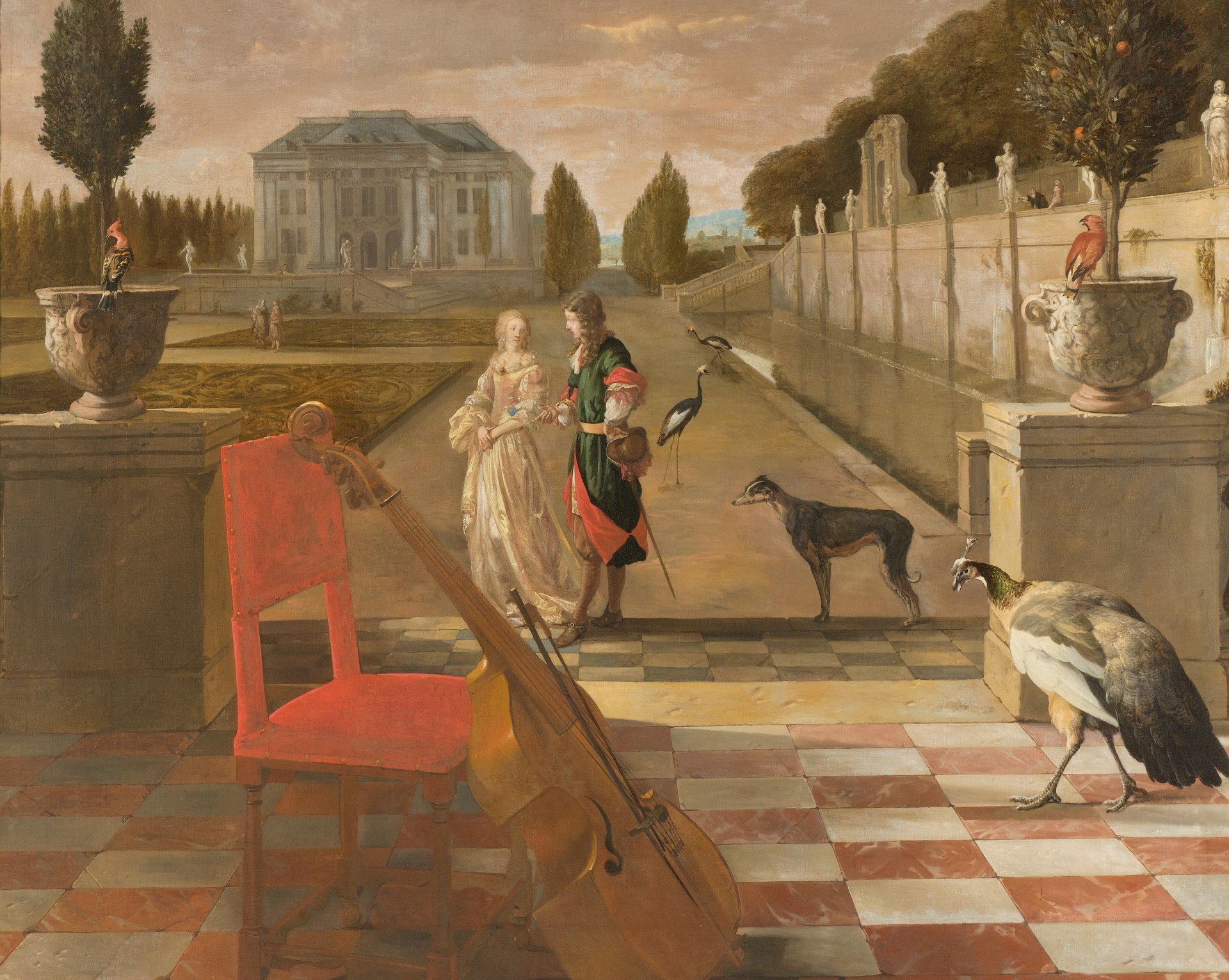
Painting by Jan Weenix, c. 1700 (Rijksmuseum Amsterdam)
“The Sweetest Air”
Solo bowed string instruments, played without accompaniment, hold a unique magic—through their intimate expression, a sense of storytelling, or as a common choice in dance music with which they were associated since the Middle Ages. These qualities are all evident in the 17th- and 18th-century repertoire for unaccompanied bass viol.
Program Note by Domen Marinčič
“The Sweetest Air”
Music for Solo Viol
Domen Marinčič
Solo bowed string instruments, played without accompaniment, hold a unique magic—through their intimate expression, a sense of storytelling, or as a common choice in dance music with which they were associated since the Middle Ages. These qualities are all evident in the 17th- and 18th-century repertoire for unaccompanied bass viol.
Born sometime before 1614, Nicolas Hotman is the author of the earliest solo works that have survived from France. He was highly regarded as both a viol player and lutenist, taught both Sainte-Colombe and de Machy, and was said to have introduced the theorbo to France. The influence of the lute tradition permeates all French music for solo viol from Hotman on, and both repertoires share common forms and musical gestures in a varied texture of melodies, chords, and arpeggiated polyphony. Another obvious similarity, or borrowing, is the notation itself: most viol players up to de Machy made at least occasional use of the French lute tablature, a form of notation indicating the position of fingers on the frets rather than pitches.
The earliest sources of French music for solo viol include, alongside Hotman’s works, compositions by Jean Laquement, who became known as Dubuisson. His short suites, with their abundance of chords and idiomatically organized polyphony, were very popular among viol players. Well over 100 of his solo pieces survive in manuscripts from France, England, Germany, and the Netherlands. In 1680, Dubuisson was listed among Parisian viol virtuosos, together with Sainte-Colombe and Marin Marais. Some years later, Jean Rousseau criticized “the playing of the late old Du Buisson” in his viol method, but de Machy preferred it to that of Sainte-Colombe.
***
Information about Sainte-Colombe’s life is very fragmentary, and even his first name is lost to history. His contemporaries praised him as a sensitive musician and important innovator. Newly invented wound strings with an outer layer of metal wire enabled him to add a seventh string to the bass viol, extending its range in the lowest register. As a respected teacher, Sainte-Colombe taught not only his own children but also Danoville, Meliton, Jean Rousseau, and the young Marin Marais. He is said to have sent the latter away after just six months claiming he had nothing new to teach him, provoking speculations that he saw Marais as a potentially dangerous rival. In addition to a number of solo pieces, around 70% of which are in D minor and were likely used in teaching, Sainte-Colombe left 67 “Concerts” for two bass viols, which abound with unusual passages and questionable dissonances, yet are regarded as jewels of 17th-century chamber music due to their originality and dark poetic quality.
The mysterious melancholy of Sainte-Colombe’s duos and the fragmentary biographical information inspired the French writer Pascal Quignard’s novel Tous les matins du monde, published in 1991. (A film adaptation starring Gérard Depardieu as the ageing Marais was released that same year.) Quignard describes two contrasting views of music: the eccentric Sainte-Colombe shuns the empty splendor of the court and prefers to practice in the solitude of his garden shed. In particularly poignant moments his music takes on Orphic power and causes his deceased wife to appear. The young Marais, a fiery, ambitious virtuoso, is fascinated by such uncompromising devotion to art. Following disputes with his teacher, he opts for a glittering career at the court of the Sun King, only to realize eventually that fame has brought him no happiness. Ironically, Quignard’s central idea seemed somewhat compromised by the unexpected commercial success of the film’s soundtrack and its real-life performer, Jordi Savall.
Some of Sainte-Colombe’s movements on tonight’s program, the Allemande and both Gigues, feature no chords at all. The Gigue à la manière du Vieux Gautier is a tribute to the legendary lutenist Ennemond Gaultier (1575–1651), whom Sainte-Colombe may have known personally. Like the majority of gigues by French lutenists of the older generation, this movement is notated in duple meter and resembles the final section of Sainte-Colombe’s famous Tombeau for two viols, depicting the joy of the Elysium fields. The short Vielle at the end of tonight’s suite requires the player to tune the third string lower in order to better imitate the sounds of a hurdy-gurdy.
***
Among Sainte-Colombe’s children was a son, whose name is equally unknown and who, judging from the technical demands of his music, must likewise have been an outstanding viol player. In 1707 he spent at least six months in Edinburgh, teaching and making use of his father’s works. A few years later, he gave a charity concert in London. A manuscript in the Durham Cathedral Library contains several of his suites as well as music by Marais, Christopher Simpson, Johann Schenk, and others. The unique Tombeau in F minor composed by the younger Sainte-Colombe on the death of his father features programmatic titles such as “Crossing the Styx,” “Last Farewell,” and “Despair.” Some passages seem highly theatrical and, unlike any other tombeau, perhaps even operatic in expression. This extraordinary piece is the longest known single-movement composition for an unaccompanied string instrument prior to Johann Sebastian Bach’s beloved Ciconna for solo violin.
Sieur de Machy was the first French composer to publish pieces for unaccompanied viol in print. His collection of 1685 contains eight suites, four of which are notated in French tablature. De Machy established a tradition that eventually became typical of French viol players by specifying details such as bowing, ornamentation (including vibrato), and fingering with the utmost precision. In a lengthy preface, he described two ways of positioning the thumb of the left hand, provoking protests from Jean Rousseau and Danoville—both were convinced that the thumb must always be held opposite the middle finger. Such details require clarification, and fortunately de Machy promised to be available at his home every Saturday between three and six in the afternoon to answer any potential questions.
***
“The enchanting manner of bowing with which the great Schenk caressed his viol, which I, listening rapturously, was privileged to experience several years ago, encouraged me to likewise take this soul-moving instrument (when it is touched by such masterful fingers) into my own hand.” This appreciation of Johann Schenk stems from a preface to a collection of viol music by the Dutch organist Johan Snep. Schenk’s playing was extolled in numerous poems, and his fame eventually secured him a post at the Düsseldorf court of the Elector Palatine Johann Wilhelm II, himself an amateur viol player. Schenk’s viol music culminated in the collections Le Nymphe di Rheno and L’Echo du Danube, both of which were printed in Amsterdam at the beginning of the 18th century. The latter publication shows a strong influence of modern Italian string sonatas, but the unusually varied opening movement of the sixth sonata suggests some programmatic idea, resembling the rhetoric in the Tombeau by the younger Sainte-Colombe. Schenk derived inspiration from English viol players, German violinists, Dutch string players, and, last but not least, French musicians. A portrait of the young Marin Marais, standing and holding the viol on a chair, was long thought to represent Schenk.
***
The National and University Library in Ljubljana holds a small manuscript of unknown provenance, dated 1692 and titled Ein neu reformiert und künstlich abgerechneter Raitknecht. The title page bears the initials J. M. J., and on one of the pages containing musical notation, the name of a Slovenian priest is noted, perhaps merely as marginalia. The volume contains eight short pieces for a keyboard instrument and compositions for one or two violins with or without a bass, including dance movements from one of Arcangelo Corelli’s trios. Three of the solo violin pieces—an Allemanda, Courant, and Variatio in A major, all of which required scordatura—are part of tonight’s program.
***
Carl Friedrich Abel was born in Köthen, where his father played in the court orchestra under the direction of Johann Sebastian Bach. Carl Friedrich remained close to members of the Bach family throughout his life. After his father’s death, he went to study in Leipzig and later joined the Dresden court orchestra, where Johann Sebastian Bach held the title of court composer while his eldest son, Wilhelm Friedemann, was the court organist. Abel left Dresden around 1757, when Frederick II attacked the city due to disputes over the Austrian succession. He visited the Goethe family home in Frankfurt, may have stopped in Mannheim and Paris, and finally made his way to London. There he spent the last three decades of his life. From 1763 onward, he worked closely with Bach’s youngest son, Johann Christian. Together, they organized a successful concert series for more than 15 years.
Abel’s performing career was closely associated with the bass viol. His obituary in the Morning Post remarked that his favorite instrument was not in general use and would probably die with him. Johann Wolfgang von Goethe remembered him as the last person to play the viol with success and universal acclaim. The New York Public library holds an autograph manuscript containing Abel’s 29 pieces for unaccompanied viol, which are relatively demanding and could have been composed for his own use. The collection once belonged to the English painter Thomas Gainsborough, who was an amateur viol player and painted a magnificent portrait of Abel. On the day of Abel’s death, Gainsborough wrote that he would never stop looking up at the sky in the hope of seeing his friend again. In the same entry, he mentions “the sweetest air I have in my collection of his happiest thoughts.” This is possibly the Adagio in D minor, which stands out for its expressiveness and resembles a complex monologue.
The Artist
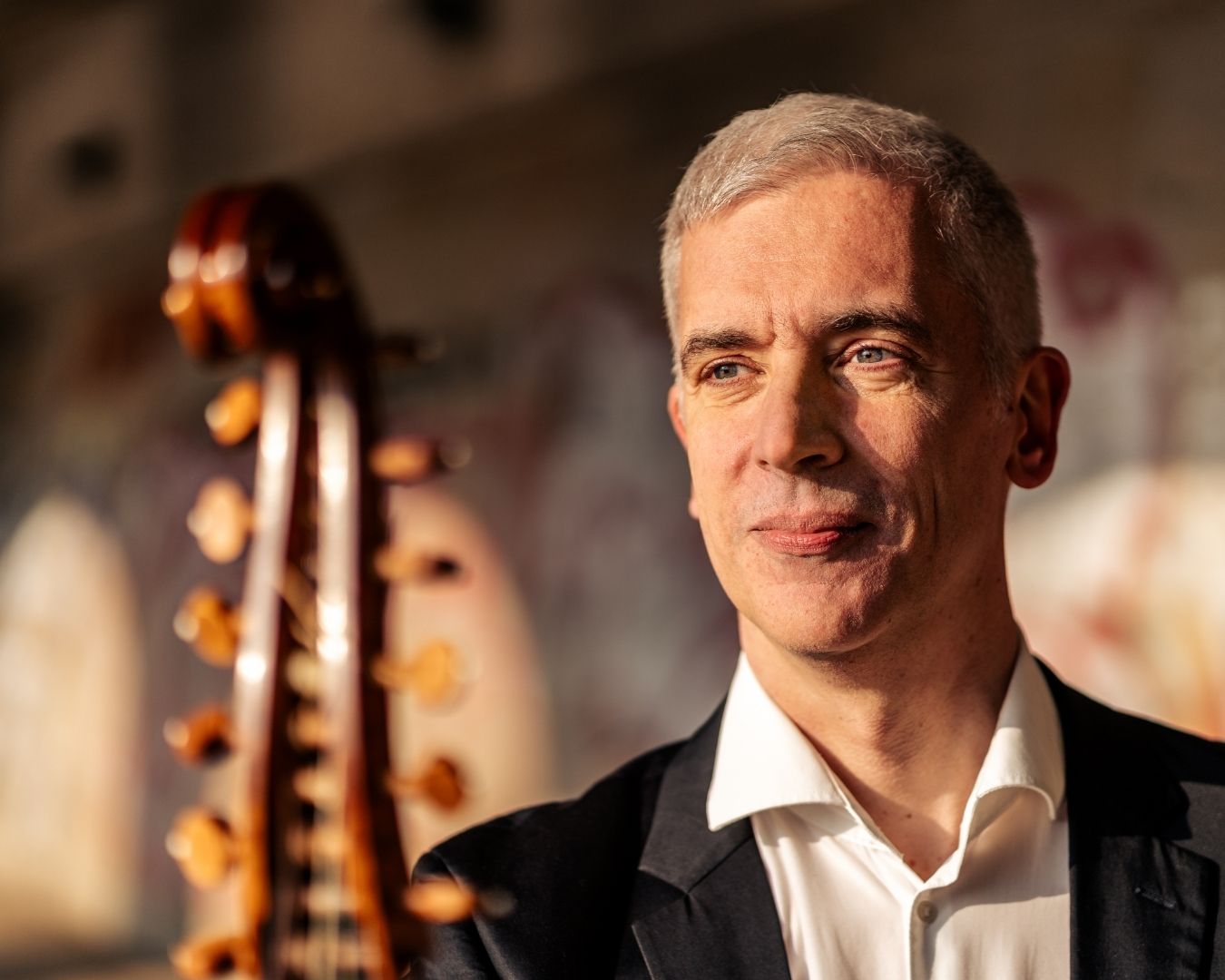
Domen Marinčič
Viola da gamba
Domen Marinčič was born in Ljubljana and began his musical training on the cello. He later studied viola da gamba in Nuremberg and with Philippe Pierlot in Trossingen, as well as harpsichord with Carsten Lohff and basso continuo with Alberto Rinaldi. As a chamber musician, he performs throughout Europe, the United States, Canada, and Asia, and has participated in some 40 CD pductions, collaborating with artists such as Emma Kirkby, María Cristina Kiehr, Pino De Vittorio, Edoardo Torbianelli, and Dan Laurin. He is the founder of the Slovenian ensemble musica cubicularis and longtime artistic director of the Radovlijca Festival. In recent years, he has also led orchestral projects in Slovenia, Finland, and Croatia, performing oratorios by Scarlatti, Stradella, and Pasquini, as well as Jean Gilles’s Requiem, among other works. He has presented his research on music history and performance practice in numerous lectures at international symposia. From 2021 to 2025, he was professor of historical performance practice at the University of Music and Drama in Hanover; in 2025, he was appointed to the Mozarteum Salzburg as successor to Reinhard Goebel.
April 2026