Michele Pasotti Lute and Musical Direction
Alena Dantcheva, Francesca Cassinari Soprano
Elena Carzaniga, Bernd Oliver Fröhlich Alto
Massimo Altieri, Gianluca Ferrarini Tenor
Alessandro Ravasio Bass
Giulia Genini Dulcian and Flute
Claire McIntyre, Ermes Giussani Sackbut
Efix Puleo Viella da braccio
Teodoro Baù Viella da gamba
Program
Works by
B. de Cluny
F. Andrieu
Guillaume Dufay
Gilles Binchois
Johannes Ockeghem
Alexander Agricola
Antoine Busnoys
Josquin des Prez
Nicolas Gombert
William Byrd
Jean Richafort
B. de Cluny
Pantheon abluitur / Apollinis eclipsatur / Zodiacum signis (c. 1350)
F. Andrieu (fl. 1370–1380)
Armes, amours / O flour des flours (1377)
Codex Faenza (15th century)
Viver ne puis (instrumental)
Guillaume Dufay (1397–1474)
He, compaignons, resvelons nous
Guillaume Dufay
Ave regina caelorum
Buxheim Organ Book (c. 1460–70) / Gilles Binchois (c. 1400–1460)
Dulongesux (instrumental)
Johannes Ockeghem (c. 1420–1497)
Mort tu as navré / Miserere (1460)
Intermission
Alexander Agricola (1446–1506)
De tous biens plaine II (instrumental)
Antoine Busnoys (c. 1435–1492)
In hydraulis (1467)
Alexander Agricola
D’ung aultre amer I (instrumental)
Josquin des Prez (c. 1450–1521)
Nymphes des bois (1495)
Nicolas Gombert (c. 1495–c. 1560)
Musae Jovis
William Byrd (1539–1623)
Ye sacred Muses
Jean Richafort (c. 1480–c. 1550)
Introitus
from the Requiem "in memoriam Josquin des Prez" (1532)
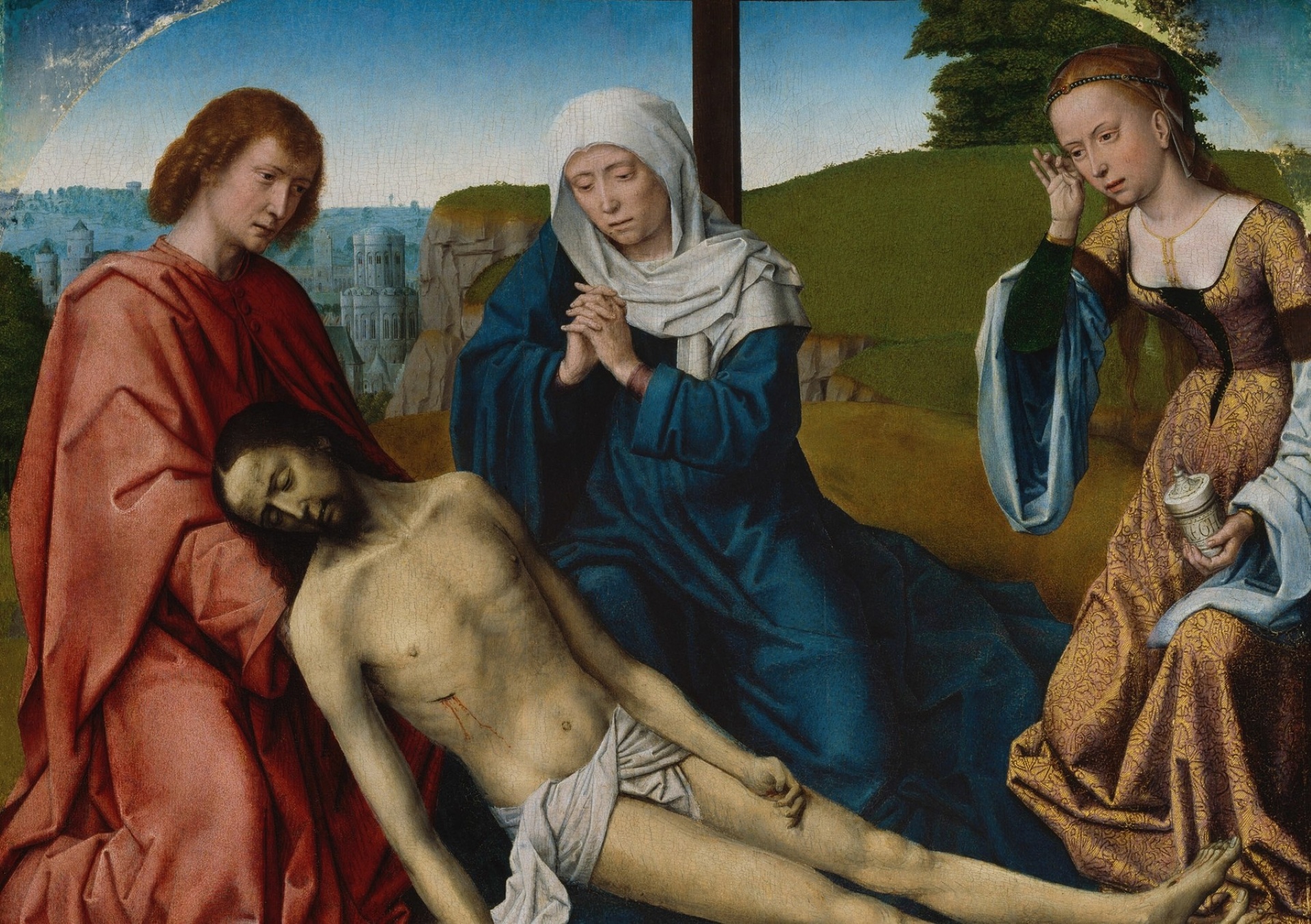
Gerard David, The Lamentation of Christ (c. 1500)
Musical Memorials
The history of classical music is replete with laments, homages, and other memorials addressed by one admiring musician to another. Michele Pasotti and La fonte musica make this tradition the starting point of their concert.
Program Note by Harry Haskell
Musical Memorials
Remembering Composers from the 14th to the 16th Centuries
Harry Haskell
The history of classical music is replete with laments, homages, and other memorials addressed by one admiring musician to another. By the 17th century, these typically posthumous tributes had become so popular that the French invented a name for them: tombeaux. The genre took root in the Renaissance and Baroque eras, when composers openly acknowledged their stylistic debts and borrowed freely from one another without fear of being accused of plagiarism or lack of originality. This form of commemoration was revived in the 20th century in works such as Ravel’s Tombeau de Couperin and György Kurtág’s Officium breve, which invoke the spirits of their honorees by imitating their compositional styles or incorporating snatches of their music. Even during the Romantic era, which made a fetish of individualism and originality, the practice survived in works like Tchaikovsky’s Piano Trio in A Minor, an elegy for the pianist Anton Rubinstein, and Liszt’s Lugubre gondola, a funereal meditation on the boat that carried Richard Wagner’s body to the railway station after his death in Venice in 1883. Implicit in such musical testimonials is the philosophy that imitation, or even outright theft, is often the sincerest form of flattery. As Stravinsky once said, “I like Mozart very much, so much that I steal the music of Mozart. And I feel that I have the right to steal because I love it.”
A kindred impulse lies behind the older music on tonight’s program by La fonte musica and its leader, Michele Pasotti, which celebrates “the will to remember and to be remembered.” Taken together, Pasotti writes, these laments and homages “give a strong idea of the community of musicians” in the medieval and renaissance periods. In “remembering each other,” these eulogizing musicians allowed “a much wider community to remember them all, as we are still doing.”
A “New Art”
The 14th century witnessed a sea change in music theory and practice. What contemporaries dubbed Ars Nova, “the New Art,” was based on an innovative system of notation that made it possible to write music of unprecedented rhythmic and textural complexity. At the same time, composers began to shed their traditional anonymity: Guillaume de Machaut, the greatest master of the Trecento, meticulously anthologized all of his music and poetry in what was effectively the first such complete-works edition. The composer of Pantheon abluitur / Apollinis eclipsatur / Zodiacum signis, one B. de Cluny, proudly “commends himself to all” in the bottommost of the motet’s three texted parts, while a dozen other leading composers and theorists of the day (including Machaut) are called out by name in the upper voice as members of a far-flung “collegium of musicians” linked to signs of the Zodiac as the sun crosses the firmament. Machaut’s death in 1377 moved the otherwise unknown F. Andrieu to write a bitextual tribute in the form of a four-voice double ballade (a genre closely associated with Machaut): Armes, amours / O Flour des flours is at once a poignant déploration, or lament, for the “noble rhetorician” and a joyous celebration of “the gentle art of music.”
A more international style of composition emerged in the 15th century, as increasing numbers of musicians traversed the Alps in both directions. The Codex Faenza, from which the anonymous two-part instrumental chanson Viver ne puis is taken, contains keyboard versions of dozens of French and Italian vocal works, many of them in the quintessentially Gallic genres of ballade, rondeau, and virelai. No composer exemplified the new cosmopolitan spirit better than Guillaume Dufay. Born near Brussels, he worked and traveled widely throughout France, Italy, and the Low Countries over a period of six decades. In the early 1420s, while he was employed by the powerful military leader Carlo Malatesta in Rimini, Dufay saluted a handful of his musical associates in the lighthearted rondeau Hé, compaignons, resvelons nous. Some four decades later, he adapted the text of the Marian plainsong Ave regina caelorum in a prayer for the Holy Mother’s intercession sung on his own deathbed: “Hail, queen of heaven, hail, mistress of the angels, have mercy on your dying Dufay, may he not burn in the fire of sinners.”
Ockeghem, Busnoys, and Agricola
Foremost among Dufay’s successors were Johannes (or Jean de) Ockeghem and Antoine Busnoys, whom a contemporary writer described as “the most outstanding and most famous professors of the art of music.” That these three preeminent musicians were personally acquainted attests to the increasing mobility and interconnectedness of European musical culture in the 1400s. Mors, tu as navré / Miserere laments the death of their Franco-Flemish colleague Binchois in 1460. The upper voice of Ockeghem’s heartfelt déploration features a French-texted melody whose three eight-line stanzas are laid out in ballade form, punctuated by the refrain “Prier pour l’âme” (Pray for his soul), to which the bottom three voices respond by intoning a Latin prayer for the dead. Binchois himself is represented on tonight’s program by an anonymous intabulation, or keyboard transcription, from the mid-15th century Buxheimer Orgelbuch (Buxheim Organ Book). The work’s unusual title, Dulongesux, is a corruption of Deuil angoisseus rage demeseurée, one of Binchois’s most popular ballades.
Ockeghem was still very much alive when Busnoys—who may have studied with him during their time together in Tours in the 1460s—wrote In hydraulis in honor of his esteemed elder. The Latin text of Busnoys’s motet combines praise for Ockeghem with recondite allusions to Pythagorean music theory and the ancient water-powered pipe organ known as the hydraulis. (Ockeghem apparently returned the compliment by writing an equally abstruse tribute to Busnoys.) A generation younger than Ockeghem, Alexander Agricola was chiefly known for his secular instrumental and vocal music, much of it based on preexisting material. In De tous biens plaine and D’ung aultre amer, he recycles the tunes of two popular rondeaux—by Hayne van Ghizeghem and Ockeghem, respectively—as the foundational cantus firmi for instrumental polyphony. A native of Ghent, Agricola plied his trade throughout western and southern Europe; following in the footsteps of Dufay, Ockeghem, and Busnoys, he ended his life in the service of the Burgundian court.
The Age of Josquin
Ockeghem’s death in 1497 prompted Josquin des Prez, the greatest Franco-Flemish musician of his time, to write a bilingual motet modeled on the older composer’s lament for Binchois. Like Mors, tu a navré / Miserere, Nymphes des bois juxtaposes a contemporary French lyric—in this case eulogizing Ockeghem as the “good father” of the younger generation and a “true treasurer of music”—with a Latin plainsong from the Roman Catholic Requiem Mass. By adding a fifth voice to the four-part texture of Ockeghem’s déploration, Josquin deepens and darkens the music’s mournful intensity. Even before he died, Josquin became a byword for compositional rectitude, his music held up as a model for legions of composers, teachers, and theorists. Martin Luther’s oft-cited encomium—“Josquin is the master of the notes, he made them do what he wanted; the other composers had to do what the notes wanted”—reflects his time-honored image as an autonomous, almost godlike genius. Musae Jovis, a memorial by his disciple Nicholas Gombert, uses a traditional chant melody as a cantus firmus, just as Josquin had done in Nymphes des bois.
William Byrd enjoyed a privileged status at the courts of Queen Elizabeth and her successor, King James I. Thanks partly to the monopoly on music publishing that Elizabeth granted to him and his teacher, Thomas Tallis, in 1575, Byrd was by the close of the 16th century the most influential figure in English music. Like Tallis, he was a gentleman of the Chapel Royal and supplied music for both the Anglican and Catholic liturgies, while remaining discretely devoted to the Church of Rome. Tallis’s death in 1585 inspired Byrd’s eloquent anthem Ye sacred muses for five voices (in tonight’s performance, instruments); the textual allusion to “race of Jove” harks back to Gombert’s Musae Jovis. Jean Richafort, a follower if not an actual pupil of Josquin, eulogized his departed maître in a full-length Requiem Mass, of which only the first movement will be sung tonight. So successfully did Richafort incorporate music from one of Josquin’s chansons into the mass that it was attributed to the venerable “master of the notes” in more than one manuscript source.
A former performing arts editor for Yale University Press, Harry Haskell is a program annotator for Carnegie Hall in New York, the Brighton Festival in England, and other venues, and the author of several books, including The Early Music Revival: A History, winner of the 2014 Prix des Muses awarded by the Fondation Singer-Polignac.