Moslem Rahal Ney and Musical Direction
Yurdal Tokcan Oud
Hakan Güngör Qanun
Hussain Atfah Voice
Youssef Hbeisch Percussion
Program
Sama’i Nahawand
Lamuny
Longa Riad
Aalawf
Mahboub Qalbak
Koniali
Kavoki
Beyad Dari
Doush Doush
Seeboni
Tale’a
Sama’i Nahawand
A slow piece designed to soothe the nerves, opening the concert with elegance and depth. Composed by the Iraqi musician Rouhi Al-Khamash.
Lamuny
“They criticized me and asked: What do you see in her? I replied: How can you understand? You need to see her through my eyes, not yours.” A popular piece from the Arabic tradition.
Longa Riad
A lively and rhythmic piece by the Egyptian composer Riad Al-Sonbaty, showcasing dynamic melodies and intricate transitions.
Aalawf
A heartfelt song reflecting nostalgia and cultural identity, inspired by Palestinian heritage.
Mahboub Qalbak
A love song filled with emotion, rooted in the Druze traditions of Mount Arab.
Koniali
A traditional dance from Greece, Turkey, and Asia Minor. Performers use wooden spoons, two in each hand, giving this dance its alternative name, “The Spoon Dance.”
Kavoki
A Kurdish folkloric song, full of energy and movement, celebrating cultural vibrancy.
Beyad Dari
A classic Persian song blending traditional lyrics with rich melodies, evoking timeless beauty.
Doush Doush
A classical piece in the Afshari mode, attributed either to an unknown composer or the renowned Persian poet and musician Ali Akbar Sheyda.
Seeboni
A romantic and touching song by the Egyptian composer Sayed Darwish, exploring themes of love and longing.
Tale’a
A love song from the Iraqi tradition, expressing deep emotions of passion and desire.
The takht: Notes on the Program
The takht is a traditional Arabic musical ensemble with profound historical and cultural significance. The word takht in Arabic means “bed” or “a place of rest”; in the realm of music, it represents a platform for creativity, relaxation, and collaboration among skilled musicians. Traditionally, the takht ensemble features instruments such as the ney, oud, qanun, kamancheh, and riq.
Despite the challenges of the 21st century, the takht continues to thrive, offering a repertoire ranging from mystical and meditative pieces to vibrant and joyful melodies. It remains a timeless form of musical expression, able to evoke a wide range of emotions and to adapt to diverse musical settings. More than just a musical ensemble, it is a cultural phenomenon representing centuries of artistic expression and cross-cultural influences. This program seeks to honor the legacy of the takht while breathing new life into it, presenting it as a universal art form to contemporary audiences.
The Artist
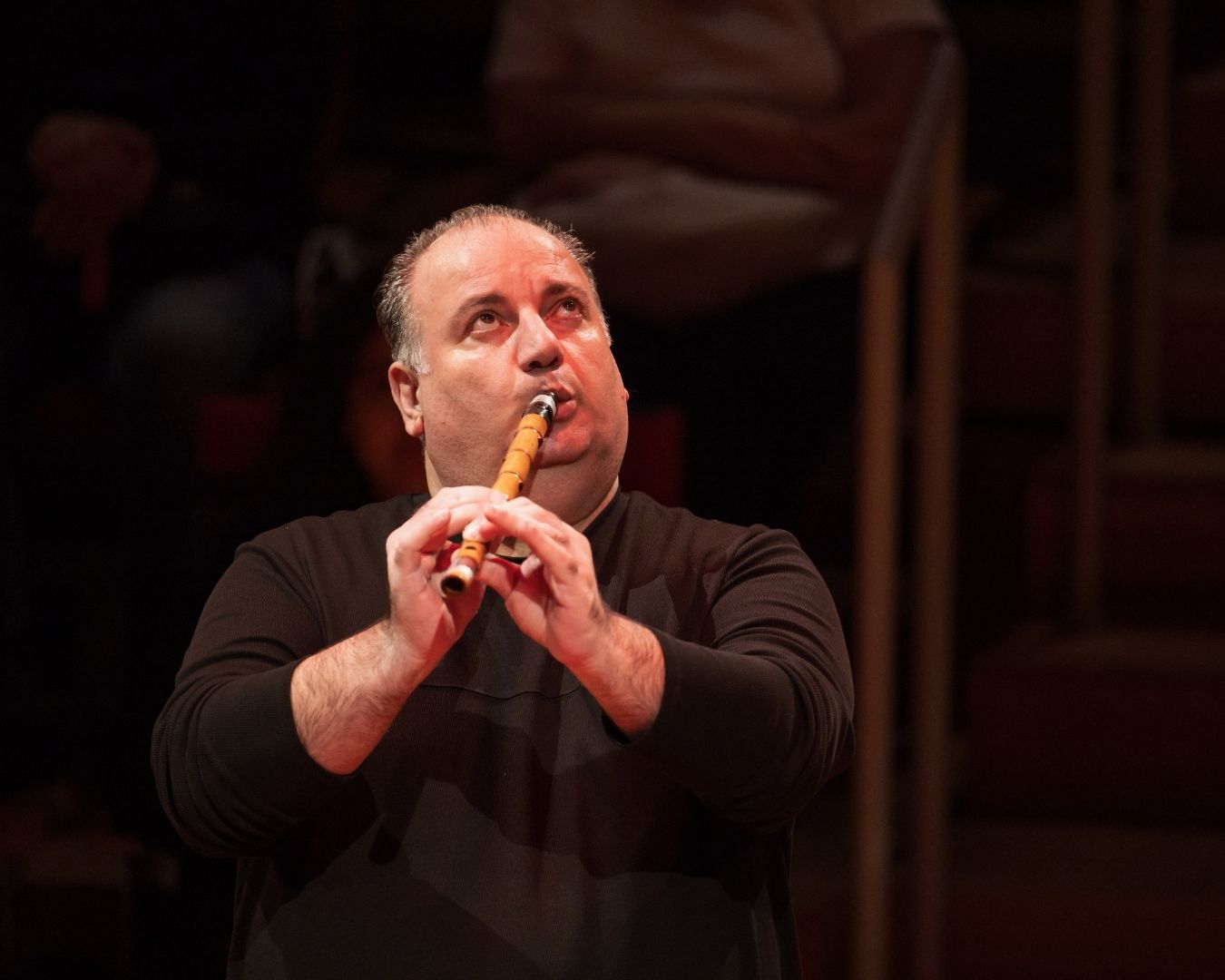
Moslem Rahal
Ney and Musical Direction
Moslem Rahal studied at the Damascus Conservatory and specializes in performing on the ney, a flute instrument that originated in central Asia and is widely used in Arabic music. He teaches as a professor at the conservatories of Damascus and Homs. As a soloist, he has been heard with the National Ensemble for Arabic Music and the Syrian National Symphony Orchestra and has appeared frequently under the direction of Solhi al-Wadi and Misak Bagboderian. The founder and artistic director of the Shams Ensemble Group, he was invited to perform at the Jerash Festival in Jordan. He has contributed significantly to the development of his instrument, publishing a number of scholarly articles. Together with Waed Bouhassoun, he serves as artistic director of Jordi Savall’s Orpheus 21 project. In addition to his concert activities, Moslem Rahal is also an instrument maker for ney and kaval, another flute instrument used in music from the Balkans, Turkey, Armenia, and Egypt.