Ibrahim Alshaikh Clarinet
Michael Barenboim Violin
Hisham Khoury Violin
Katia Abdel Kader Viola
Genwa Khazen Cello
Fadwa Qamhia Double Bass
Program
Salvador Arnita
Andante meditativo for Strings
Wolfgang Amadeus Mozart
Clarinet Quintet in A major K. 581
Giovanni Bottesini
String Quintet in C minor "Gran Quintetto"
Kareem Roustom
Palestinian Songs & Dances
for Clarinet and String Quartet
Salvador Arnita (1914–1984)
Andante meditativo for Strings
Wolfgang Amadeus Mozart (1756–1791)
Clarinet Quintet in A major K. 581 (1789)
I. Allegro
II. Larghetto
III. Menuetto – Trio I – Trio II
IV. Allegretto con variazioni
Intermission
Giovanni Bottesini (1821–1889)
String Quintet in C minor “Gran Quintetto” (1850?)
I. Allegro moderato
II. Scherzo. Allegro ma non troppo – Trio
III. Adagio
IV. Finale. Allegro con brio
Kareem Roustom (*1971)
Palestinian Songs & Dances
for Clarinet and String Quartet (2024)
I. Oh, You on the Mountain
II. Blessed Are Your Wedding Garments
III. Dance of the Mijwiz
IV. Three Village Wedding Songs:
1. The Chiming Bracelet –
2. Register the Bride’s Name, Oh Judge –
3. God Bless the Henna Painter
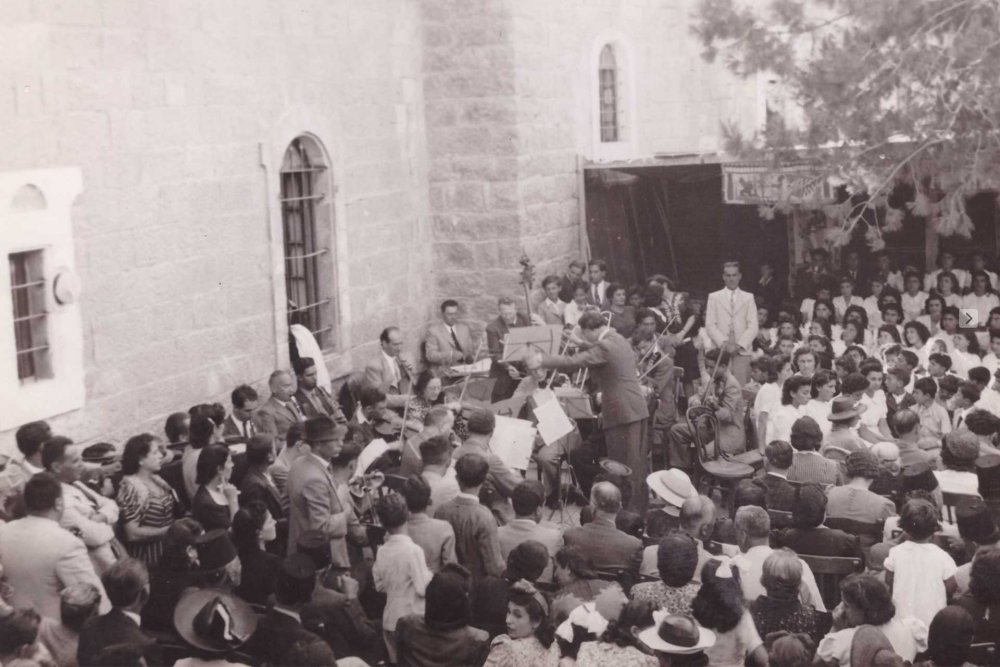
Salvador Arnita (center) conducts the orchestra and choir of Birzeit College, c. 1941
Cultural Crosscurrents
Since time immemorial, the historical region of Palestine has been a cultural crossroads, a fault line where eastern and western civilizations and religions meet, mingle, and clash. As both a physical locale and an aspirational homeland, it has represented various things to the four composers of tonight’s concert.
Program Note by Harry Haskell
Cultural Crosscurrents
Music by Mozart, Bottesini, Arnita, and Roustom
Harry Haskell
Since time immemorial, the historical region of Palestine has been a cultural crossroads, a fault line where eastern and western civilizations and religions meet, mingle, and clash. As both a physical locale and an aspirational homeland, it has represented various things to the four composers whose music makes up tonight’s program. The 18th-century Palestine of Mozart’s time was an “exotic” outpost of the Ottoman Empire that held scant interest for most Europeans. By Giovanni Bottesini’s heyday in the late 1800s, the area between the Mediterranean Sea and the Syrian desert had gained geopolitical significance as regional and world powers jockeyed for influence in the Holy Land. The lives of Salvador Arnita and Kareem Roustom were decisively shaped by the 1917 Balfour Declaration, which envisioned a “national home for the Jewish people” in the lands long populated by Arab Muslims and Christians. In juxtaposing chamber works by these composers, the Nasmé Ensemble invites us to ponder the politically fraught but artistically fruitful history of this long-contested region.
A Palestinian Symphonist
By the time he died in Amman in 1985, Salvador Arnita was revered throughout the Arab world as the “father” of modern Palestinian music. He and his wife, the musicologist Yusra Jawhariyyeh, had retired to Jordan five years earlier after three decades on the faculty of the American University of Beirut. Born in Jerusalem in 1915, Arnita grew up in British-administered Mandatory Palestine and cut his musical teeth as an organist at Catholic churches there and in Egypt, where Western art music and music education had long been integral to the government’s modernizing agenda. Further studies in Rome and London, together with sporadic performances in Europe and the United States, broadened his outlook and solidified his versatile compositional technique. The music Arnita wrote during and after his 12-year tenure as music director of Jerusalem’s YMCA (1936–48) reflects a synthesis of European and Arabic styles, traditions, and instruments. Although never a political activist, he gave voice to his people’s aspirations in works like the choral-orchestral cantata Identity, set to a canonic text by the Palestinian “national” poet Mahmoud Darwish, which incorporates several of the indigenous folksongs that Yusra Jawhariyyeh collected under the aegis of the Palestine Liberation Organization. The Andante meditativo for strings—the slow movement from the first of Arnita’s three symphonies—is a richly harmonized and characteristically refined essay in a conservative late-Romantic idiom. It stands as an eloquent testament to the cosmopolitan culture that nourished Arnita’s art.
A Pair of European Quintets
Wolfgang Amadeus Mozart was acclaimed in his lifetime as both a creative and a re-creative artist: in addition to being a top-notch pianist, he was a highly accomplished violinist and violist. At age six he impressed his domineering father, Leopold, by teaching himself to play the violin, and within a mere seven years he was appointed concertmaster of the court orchestra in his native Salzburg. In his youth, Mozart frequently appeared in public as a violin soloist in his own works; on one occasion he boasted of having “played as though I were the greatest fiddler in all of Europe.” Later in life, however, he focused on the keyboard and confined his violin playing to private chamber music sessions. Among them was an informal reading of the newly composed Quintet for Clarinet and Strings at a salon party in Vienna in 1790, a few months after the work’s premiere at a public benefit concert. Like Mozart’s Trio for Clarinet, Viola, and Piano of 1786 and Clarinet Concerto of 1791, the Quintet was inspired by the artistry of the renowned clarinetist Anton Stadler, a member of the Vienna court orchestra. The two men met shortly after Mozart’s arrival in the imperial capital in 1781 and struck up a friendship that was cemented by their bond as fellow Masons.
Both the Quintet and the Concerto show off the clarinet’s low, or chalumeau, register to good advantage, having been conceived for Stadler’s recently invented basset clarinet, which had two (later four) more keys than the standard model. Contemporaries praised Stadler’s velvety tone and nimble changes of register. The Clarinet Quintet—sometimes known as the “Stadler” Quintet—is notable for its sunny, upbeat mood (notwithstanding the fact it was written at a time of considerable stress and unhappiness in Mozart’s life) and for its broad palette of colorist effects. The concertante-style clarinet part is sufficiently soloistic to stand out above, and occasionally below, the four string instruments, but seldom calls attention to itself in an exhibitionistic fashion. The opening Allegretto strikes a relaxed, conversational tone, with the thematic material shared more or less equally by clarinet and strings. In the richly luminous Larghetto, the clarinet and muted first violin take turns in the spotlight, while the two trio sections of the graceful minuet feature them in music of a more vigorously athletic character. The jovial theme-and-variations finale gives all five players an opportunity to shine.
Giovanni Bottesini owes his status as one of the greatest double bassists in history to a quirk of fate: as an aspiring 14-year-old student from a family of modest means, he traded in his childhood violin for a violone in order to secure a scholarship to the Milan Conservatory. In addition to his prominent solo and orchestral career on the international circuit, Bottesini went on to achieve a measure of fame as a composer and conductor; in the latter capacity, he led the world premiere of Verdi’s Aida in Cairo in 1871. Although Bottesini’s own operas were notably less successful, his many concertos, fantasias, and other works for double bass set a high bar for virtuosity that has never been surpassed; contemporaries dubbed him the “Paganini of the double bass.” Of Bottesini’s eight string quartets and four quintets, by far the most enduringly popular is the “Gran Quintetto” in C minor, which was first performed in Venice in 1858. Like his friend Saverio Mercadante, to whom the work is dedicated, Bottesini combined the florid melodies of Italian bel canto opera with a sophisticated harmonic palette and a sure grasp of string-instrument technique. (He was also a dab hand at the violin, viola, cello, and piano.) The fact that the first violinist at the premiere was the celebrated virtuoso Antonio Bazzini may explain why the double-bass plays an uncharacteristically self-effacing role in the Quintet. Much of Bottesini’s violin writing is markedly soloistic, starting with the lengthy, often cadenza-like introduction to the opening Allegro moderato. Although the Quintet begins in brooding C minor, Bottesini quickly shifts tonal gears to the sunnier major mode. The remaining three movements pass through a series of contrasting keys, culminating in a brisk, march-like fughetto in C major.
Reimagining the Palestinian Tradition
Born in Damascus, Kareem Roustom emigrated to the United States with his family at age 13 and settled near Cape Cod. He describes himself as a “musically bilingual composer” who blends elements of Western art and vernacular music with the sounds and traditions of the Arab Middle East. His eclectic catalogue features works written for Michael Barenboim, members of the West-Eastern Divan Orchestra, the Kronos Quartet, and other boundary-crossing performers. In recent years, the 55-year-old composer, long cut off from Syria by the civil war, has eulogized his homeland in works bearing titles like Aleppo Songs, A Muffled Scream, and Letters Home. The idea of home is central to Palestinian Songs & Dances (2024), which was inspired by a summer chamber-music program in New Hampshire dedicated to “cultivating connection and understanding among people of diverse backgrounds.” Roustom’s experience as an immigrant prompted him to explore his own roots via recordings by Rim Banna, Dalal Abu Amneh, Sabah Fakri, and other Arab musicians. In Palestinian Songs & Dances, he sought to “reimagine” these folk sources “in a new setting so as to be able to hear, experience, and understand them, and the culture which produced them, in a different light.” In the first movement, “Oh, You on the Mountain,” ululating timbral trills evoke the songs of resistance fighters during the British occupation of Palestine. “Blessed Are Your Wedding Garments” is an extended dialogue between the clarinet and first violin in a steady, subdued rhythm. “Dance of the Mijwiz” simulates the “forceful and rasping tone” of a double-piped wind instrument popular in Syria, Lebanon, and Palestine, in part by means of “tin foil mutes” attached to the bridges of the string instruments and the bell of the clarinet. The last movement, based on Palestinian wedding songs, includes an optional playback of a recording made in 1987 at a real-life wedding near the Israeli city of Haifa. The fluid interplay of traditional Arabic and Western avant-garde elements is typical of Roustom’s work. As he explained in a recent interview, “The emphasis is not on hybridity, which tends to cast both sides in a light of ‘otherness,’ but on recognizing a holistic view of these two musical traditions.”
A former performing arts editor for Yale University Press, Harry Haskell is a program annotator for Carnegie Hall in New York, the Brighton Festival in England, and other venues, and the author of several books, including The Early Music Revival: A History, winner of the 2014 Prix des Muses awarded by the Fondation Singer-Polignac.
The Ensemble
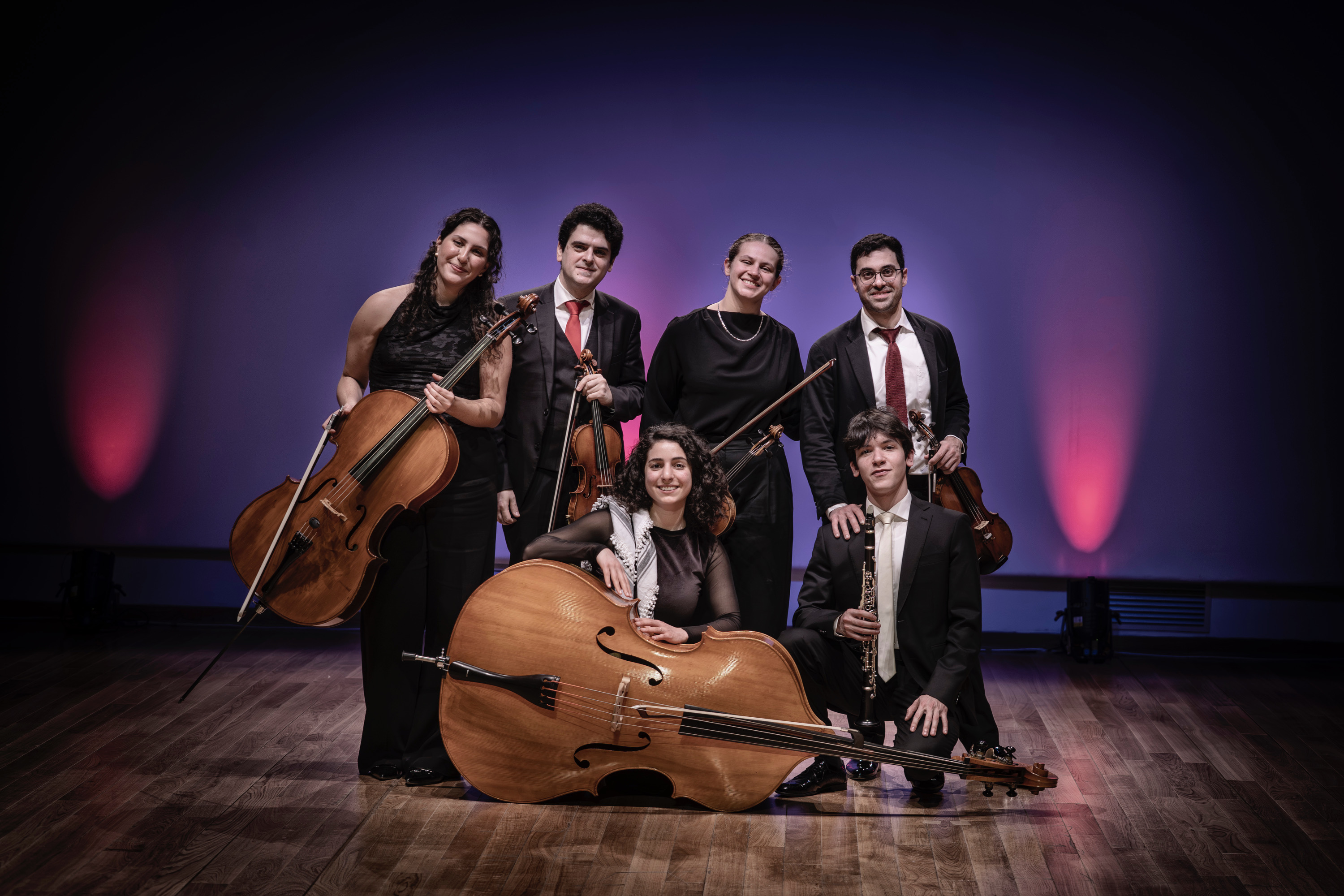
Nasmé Ensemble
In Arabic, nasmé means a breeze of air—the young ensemble that bears this name brings together five exceptional musicians from different regions of historic Palestine. Representing a symbol of unity and harmony in the face of adversity, they have achieved a collaboration as artists that often seems unattainable due to political barriers. Together, they perform classical European chamber music and repertoire from their homeland. In January 2025, the ensemble gave five concerts in the Canary Islands, where they also built connections with the local Palestinian community. The group also regularly performs at benefit concerts for the people of Palestine. This year, the Nasmé Ensemble will be heard at the Ludwigsburg Festival, the Palau de la Música in Valencia, and the Beethovenfest Bonn, among other venues.
February 2026