Hisham Errish Oud and Composition
Majed Al-Dahmani Bass
Shokri Jomaa Khalifa Khazam Piano and Keyboard
Mohamed Al-Ghazal Percussion
Program
When the Desert Sings (Touareg)
One Song of Libya
Alkaska Dance
Dammet Gasha
Infatuation (Loving Benghazi)
Libyan Panorama
Nights of Cyrenaica
Barefoot (Dancing on Blazing Coal)
Alhambra
Intermission
Memory
Asmariya
Nawa
Warda (Libyan Lullabies)
Generalife (A Garden in Andalusia)
Ojla, the Oasis of the South
Taghriba (A Journey of Exile)
Falah (Ahmed Fakroun)
Alam wa Amal (Pain and Hope)
All works by Hisham Errish
When the Desert Sings (Touareg)
An embodiment of Touareg art, rooted in African musical traditions and the origins of blues
One Song of Libya
A piece about the beauty of Libya, based on the maqam Ajam, which corresponds to the European major scale and is also known in Libya as maqam Maqsum
Alkaska Dance
North Africa's oldest dance in the style of the Amazigh
Dammet Gasha
An evocation of Bedouin music, in which a leader sings a simple melody and various groups respond
Infatuation (Loving Benghazi)
A blend of Oriental and local Atbi rhythms inspired by the Libyan city of Benghazi
Libyan Panorama
Various maqamat from different areas in Libya performed in the raqqas rhythm
Nights of Cyrenaica
A hommage to traditional Bedouin musical froms such as Tobilah and Majruda
Barefoot (Dancing on Blazing Coal)
Libyan serenade blending Eastern music and blues
Alhambra
A journey to the roots of flamenco, dedicated to Paco de Lucía
Intermission
Memory
Dedicated to the memory of the late artist and friend Tamer Alwani
Asmariya
An evocation of the spiritual and musical traditions of Sufism
Nawa
Melody in the maqam Nawa which is particlarly popular in Tripoli
Warda (Libyan Lullabies)
"Warda" describes approaching a water well in a desert. The rhythm imitates the sound of empty water barrels banging on camel backs.
Generalife (A Garden in Andalusia)
The Generalife is a Nasrid palace garden in Granada, Spain. Libya also has one of these "gardens of paradise" (from Arabic gannat al-arif). The rhythm of the piece evokes the Spanish bulería and the culture of Andalusia.
Ojla, the Oasis of the South
Inspired by the Ojla rhythm in southern Amazigh style
Taghriba (A Journey of Exile)
The feeling of longing for your homeland while you already are in your homeland
Falah (Ahmed Fakroun)
Arrangement of Ahmed Fakroun's famous song with a touch of African reggea
Alam wa Amal (Pain and Hope)
A rebirth for the city of Darna, the Libyan city that was hit by a catastrophic flood in 2023. It is hard to embody pain; here, the focus is on hope for a better future
All compositions by Hisham Errish
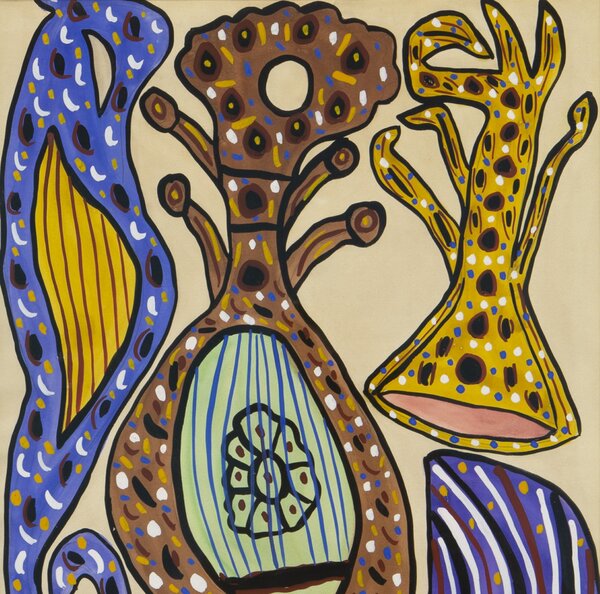
Baya, Untitled (Instruments de musique) (detail, 1974)
© Baya Estate, with kind permission by Baya Estate and Mennour, Paris
A Vast Cultural Landscape
When we speak of the “African-Arab world,” we are not referring to political borders or modern maps. We are describing a vast musical, cultural, and human landscape that has been shaped over thousands of years. Long before armies crossed deserts and merchants sailed the seas, sound had already made the journey. Music requires no translation and recognizes no borders. The relationship between Africa and the Arab world thus stands among the deepest and most enduring musical dialogues in history.
Essay by Naseer Shamma
A Vast Cultural Landscape
The Arabic Music Days explore African-Arab Dialogue
Naseer Shamma
When we speak of the “African-Arab world,” we are not referring to political borders or modern maps. We are describing a vast musical, cultural, and human landscape that has been shaped over thousands of years. Long before armies crossed deserts and merchants sailed the seas, sound had already made the journey. Before treaties were signed, rhythms had already traveled between communities, carrying memories, rituals, celebrations, and shared human experiences. Music is humanity’s oldest document of connection. It requires no translation and recognizes no borders. The relationship between Africa and the Arab world thus stands among the deepest and most enduring musical dialogues in history. It was never a one-way influence, but rather a continuous exchange that created a shared musical language that is still evolving today.
That is also why this African-Arab world has never believed in “cultural purity.” Every great city became a meeting place, every port a conservatory, and every caravan a moving school of music. It is often impossible to determine where a particular musical idea A began or where it ended, because music, by its very nature, refuses to recognize borders. Human movement played a decisive role in this exchange. Pilgrims, merchants, travelers, Sufi communities, scholars, and musicians all became cultural ambassadors. Songs often traveled more quickly than language itself, because melodies can settle into memory even when words change from one region to another.
If we were to draw a musical map instead of a political one, we would discover an immense network of routes stretching from the Red Sea to the Nile Valley, across the Sahara, through the Sahel and East Africa onward to the Atlantic coast. Along these paths traveled not only instruments, but also melodic systems, rhythmic ideas, vocal traditions, and entirely different ways of listening. The Arabic maqam tradition developed into one of the world’s most sophisticated melodic systems, while many regions of Africa cultivated their own distinctive musical languages, among them a rich variety of pentatonic scales. Wherever these musical worlds met, one never displaced the other. Instead, they entered into a dialogue that generated new forms of expression, traces of which can still be heard today in Sudan, Ethiopia, Eritrea, Somalia, Egypt, Morocco, Algeria, Tunisia, Mauritania, and throughout much of the African continent.
Rhythm might reveal this dialogue more clearly than any other musical element. In many African traditions, music is built upon layers of simultaneous rhythms that interact to create continuous movement rather than relying upon a single pulse. When these rhythmic concepts encountered the rhythmic vocabulary of Arab music, their meeting expanded the expressive possibilities of both traditions while preserving the identity of each.
No discussion of this shared world would be complete without acknowledging musical instruments. The oud, now one of the defining symbols of Arab music, did not remain confined to its original cultural environment. Throughout history it entered into dialogue with numerous African instruments, while African instrumental traditions influenced approaches to tone production, articulation, ornamentation, and musical color within Arab performance practice. Likewise, drums, frame drums, string instruments, and wind instruments traveled through trade routes, migration, and cultural exchange until they became part of a collective musical memory. Yet the deepest influence lies not in the instruments themselves but in the ways they are played. When a musician adopts an instrument from another culture, they do not simply inherit wood and strings; they inherit an entire philosophy of sound, silence, time, improvisation, and the relationship between performer and audience.
The central role of improvisation is one of the most remarkable characteristics shared by Arab and African musical traditions. Improvisation is not a departure from musical order; it is the highest expression of understanding that order. It allows the performer to recreate music in the present moment while remaining deeply rooted in tradition. In this sense, improvisation became one of the strongest bridges connecting musicians across this immense geographical and cultural landscape. Collective singing occupies an equally important place throughout many Arab and African societies. It is more than artistic performance; it is a social act that strengthens community and transforms music into a shared human experience rather than an individual product. This explains why music remains closely tied to everyday life: accompanying work, harvests, celebrations, worship, birth, mourning, and every significant transition in the human journey.
Looking at today’s musical landscape, many of the most innovative artistic projects are born from this shared heritage. A new generation of composers and performers increasingly views identity not as a boundary but as a point of departure for dialogue. This is precisely where the significance of these African-Arab connections lies. They are not merely a history to be celebrated, but a future waiting to be imagined. Our responsibility today extends beyond preserving tradition. We must continue to study it, document it, reinterpret it, and pass it on to future generations as a living human experience. Every maqam carries a story, every rhythm preserves a memory, and every instrument embodies centuries of cultural exchange.
A festival like this year’s Arabic Music Days, which brings together musicians from Africa and the Arab world, serves as a living laboratory for this dialogue. My hope is that it will do more than present concerts—it should create opportunities for artists to rediscover their common musical heritage while composing new chapters in a story that began centuries ago and continues today. The African-Arab world therefore is not simply a geographical expression. It is an ongoing sonic civilization where the Arab maqam meets the pentatonic scale, where complex African rhythms converse with Arab musical phrasing, where memory meets innovation, and where tradition becomes a source of creative renewal.
At a time when the world appears more divided than ever, music remains one of humanity’s most powerful reminders of what unites us. Music never asks for a passport. It never recognizes borders. It begins with, and always returns to, the human being. Perhaps this is why, whenever we truly listen to the music of Africa and the Arab world, we realize that we are not hearing two neighboring cultures, but one continuous human story told through many voices, one whose next chapter is still being written.
Naseer Shamma is among the world’s foremost players and teachers of the oud. Born in Kut, Iraq, he trained at the Music Academy in Baghdad with Iraqi grand master Munir Bashir, graduating in 1987, and subsequently completed a PhD in music philosophy. From 1993 to 1998 he taught at the Conservatory in Tunis, before founding the Arab Oud House in Cairo, a school dedicated entirely to his instrument. Other schools have since opened in Abu Dhabi, Riyadh, Baghdad, and Mosul. He has performed around the world with musicians from a wide range of artistic backgrounds, and in many of his projects combines traditions and instruments of classical Arabic music with those of Western music. Honored with more than 70 Iraqi and international awards, he received the Gusi Peace Prize in 2012, and in 2017 was named a UNESCO Artist for Peace for his humanitarian activities. He has been closely associated with the Pierre Boulez Saal since its inception as curator of the Arabic Music Days.
A Note from the Ensemble
Libyan music is rich and diverse, shaped by multiple civilizations, cultures, and historical experiences across the many regions of Libya, a country spanning more than 1.6 million square kilometers. From the desert to the coast, and from east to west and south, we encounter a remarkable diversity of maqamat, or scales, and rhythms, instruments and performance styles, and even in the ways musical phrases are constructed and melodies are performed.
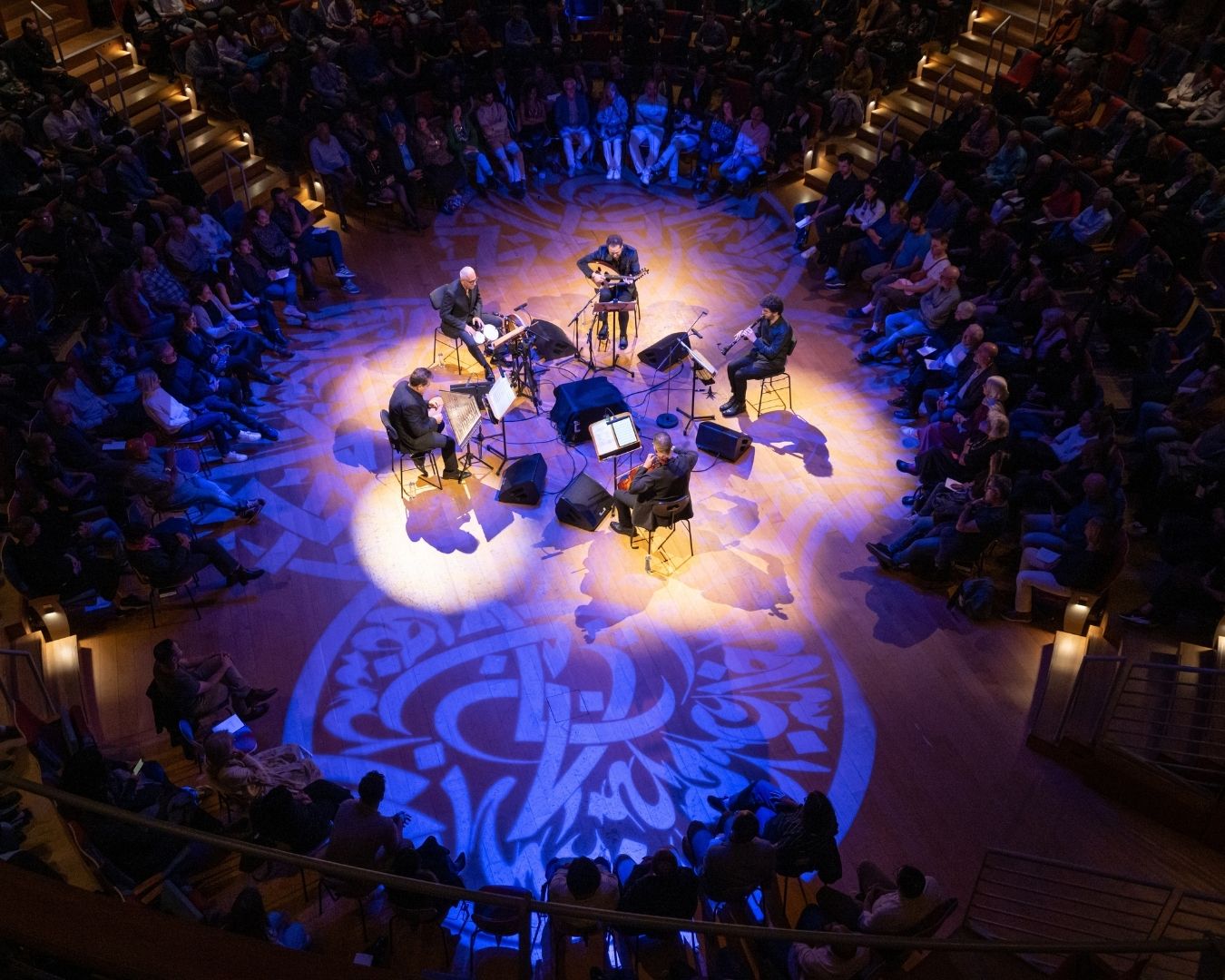
It is a pleasure for us, the musicians of the ensemble Nuqoosh, to welcome you to the Pierre Boulez Saal for our program Libya Sings.
Libyan music is rich and diverse, shaped by multiple civilizations, cultures, and historical experiences across the many regions of Libya, a country spanning more than 1.6 million square kilometers. From the desert to the coast, and from east to west and south, we encounter a remarkable diversity of maqamat, or scales, and rhythms, instruments and performance styles, and even in the ways musical phrases are constructed and melodies are performed. Libyan traditional instruments, including wind, string, and percussion instruments, have contributed to the formation of a distinctive local musical language, with its own nuances and characteristics. But this music also carries within it the traces of a long history of cultural diversity, with Amazigh, Tuareg, Bedouin, African, and Andalusian influences, alongside other musical traditions of a more spiritual character that have become part of Libya’s musical memory. This is where Libya Sings begins.
The pieces you will hear tonight are not simply performances of traditional music in its original form. They are contemporary musical interpretations inspired by its details and distinctive characteristics. Through these works, we seek to reflect the language of Libyan musical phrasing by listening closely to its maqamat, rhythms, and performance practices, and then reinterpreting these elements through a contemporary musical language that brings the oud, bass guitar, percussion, and keyboard together.
This project is an extension of the approach developed by the Libyan House for Oud Studies, the institution behind these works. Its approach is grounded in research, study, and analysis, transforming insights drawn from this music into new works inspired by it, while incorporating contemporary techniques of composition, performance, and music production. At the same time, it remains committed to respecting the authenticity and distinctive character of the traditional source material.
The name Nuqoosh, meaning “engravings” or “imprints,” was chosen for the ensemble because these melodies and rhythms can be seen as traces engraved by places, people, and memory across Libya. Each of these imprints carries its own story, its own musical dialect, and its own rhythm.
Tonight, we will take you on a journey through a number of musical landscapes: from the music of the Tuareg, the Amazigh, and the desert, to the Bedouin traditions of Cyrenaica; from the rhythms of Benghazi, Tripoli, and southern Libya to Sufi musical traditions; and onward to the Andalusian and wider North African dimensions of Libya’s musical heritage. Libyan heritage will be presented not as something that belongs only to the past, but as a living language, one that can be listened to, learned from, and used as a foundation upon which new music can be created.
Thank you for joining Nuqoosh for our first encounter with an audience here in Berlin. May this music take you on a journey through some of Libya’s diversity, memory, and voices.
—Hisham Errish
The Artists
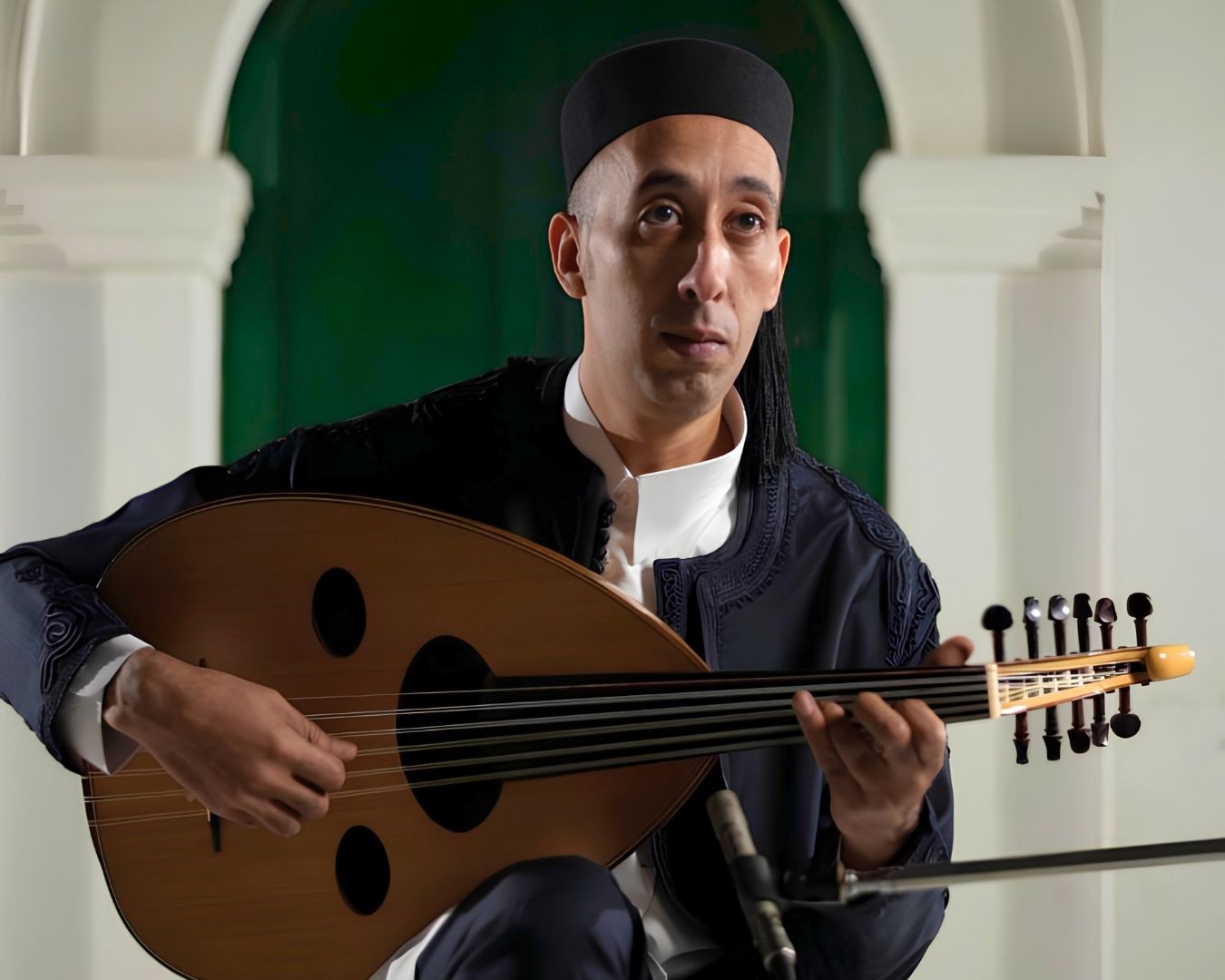
Hisham Errish
Oud and Composition
Hisham Errish is a Libyan oud player born in 1980. His music and performance style are rooted in North African, Arab, and Saharan traditions, blending diverse cultural influences from Libya while researching and developing new techniques to expand the expressive range of the oud. A graduate of the Arab Oud House, which was created by Naseer Shamma, he is also a founding member of the Libyan House for Oud Research, where he works to create opportunities for musicians to develop their skills, gain experience, and deepen their technical knowledge, while promoting Libyan musical heritage on regional and international stages.
September 2026
Majed Al-Dahmani
Bass
Born in Tripoli in 1968, Majed Al-Dahmani holds a diploma in music from his hometown’s Jamal Al-Din Al-Miladi Institute and a bachelor’s degree from the Faculty of Arts and Design at the University of Tripoli. A composer, arranger, and multi-instrumentalist, he performs on guitar, bass guitar, violin, viola, and oud. He participated four times in the Libyan Song Festival, receiving the Jury Award for Best Work in 2002, and also took part in two editions of the Arab Song Festival in Cairo. He has written original music for several theatrical productions, television dramas such as Zahret Al-Yasmeen and Misk Al-Layl, and for radio works. He has been teaching at the Jamal Al-Din Al-Miladi Institute since 1989.
September 2026
Shokri Jomaa Khalifa Khazam
Piano and Keyboard
A Libyan academic holding a PhD in Music, Shokri Jomaa Khalifa Khazam is a lecturer in the Department of Musical Arts at the Faculty of Arts and Design at the University of Tripoli, where he also coordinates academic studies and examinations. His academic research focuses on Libyan folk musical rhythms, percussion instruments, and traditional musical heritage, with published studies addressing rhythmic traditions in Libyan Malouf and Tripoli songs. Alongside his academic career, he has served on the Libyan Ministry of Culture’s song committee and works as a keyboard player and music arranger with the Libyan National Radio Ensemble. He has also participated in numerous concerts and festivals in Libya and internationally.
September 2026
Mohamed Al-Ghazal
Percussion
Libyan percussionist Mohamed Al-Ghazal has performed and recorded for more than 35 years and since 1990 has been a member of the Libyan National Radio Ensemble, contributing to numerous musical, radio, and television productions. He specializes in rhythm studies and in developing traditional and contemporary Libyan and Arabic rhythmic structures. Throughout his career, he has performed at concerts and music festivals across Libya and internationally, working closely with ensembles and artists in both stage and studio settings. He holds a diploma in Music and a bachelor’s degree in Arts and Media.
September 2026