Sabine Devieilhe Soprano
Mathieu Pordoy Piano
Program
Works by
Franz Liszt
Yosef Hadar
Jacqueline Mani
Franz Schubert
Richard Strauss
Edvard Grieg
Lili Boulanger
Cécile Chaminade
Germaine Tailleferre
Francis Poulenc
Darius Milhaud
Marguerite Monnot & Édith Piaf
Franz Liszt (1811–1886)
Der Fischerknabe S 292/1 (Schiller)
Yosef Hadar (1926–2006)
Erev shel shoshanim (Dor)
Jacqueline Mani (1931–2016)
Le Petit chat triste
Franz Schubert (1797–1828)
Du bist Ruh D 776 (Rückert)
Anonymous
Berceuse cosaque
Franz Schubert
Nacht und Träume D 827 (Collin)
Franz Liszt
En rêve for Piano S 207 (1885)
Richard Strauss (1864–1949)
Meinem Kinde Op. 37 No. 3 (Falke)
Die Nacht Op. 10 No. 3 (Gilm)
Franz Liszt
Oh! quand je dors S 282 (Hugo)
Edvard Grieg (1843–1907)
Ein Traum Op. 48 No. 6 (Bodenstedt)
Intermission
Richard Strauss
Kornblumen
from Mädchenblumen Op. 22 (1888) (Dahn)
Lili Boulanger (1893–1918)
Elle était descendue
Elle est gravement gaie
from Clairières dans le ciel (1914) (Jammes)
Richard Strauss
Mohnblumen
from Mädchenblumen
Lili Boulanger
Un poète disait
from Clairières dans le ciel
Richard Strauss
Efeu
from Mädchenblumen
Cécile Chaminade (1857–1944)
Ma première lettre (Gérard)
Germaine Tailleferre (1892–1983)
Non, la fidélité (Lattaignant)
Mon mari m’a diffamée (15th century)
Les Trois présents (Sarasin)
from Six Chansons françaises (1929)
Francis Poulenc (1899–1963)
Improvisation No. 15 for Piano "Hommage à Édith Piaf" (1959)
Darius Milhaud (1892–1974)
Tay toy, babillarde arondelle Op. 223 No. 3 (1941) (Ronsard)
Marguerite Monnot (1903–1961) & Édith Piaf (1915–1963)
Hymne à l’amour
Encores
Gabriel Fauré
Au bord de l'eau Op. 8 No. 1
Barbara
Gare de Lyon
Guy Lafarge
Une Nuit au poulailler (from the operetta Schnock)
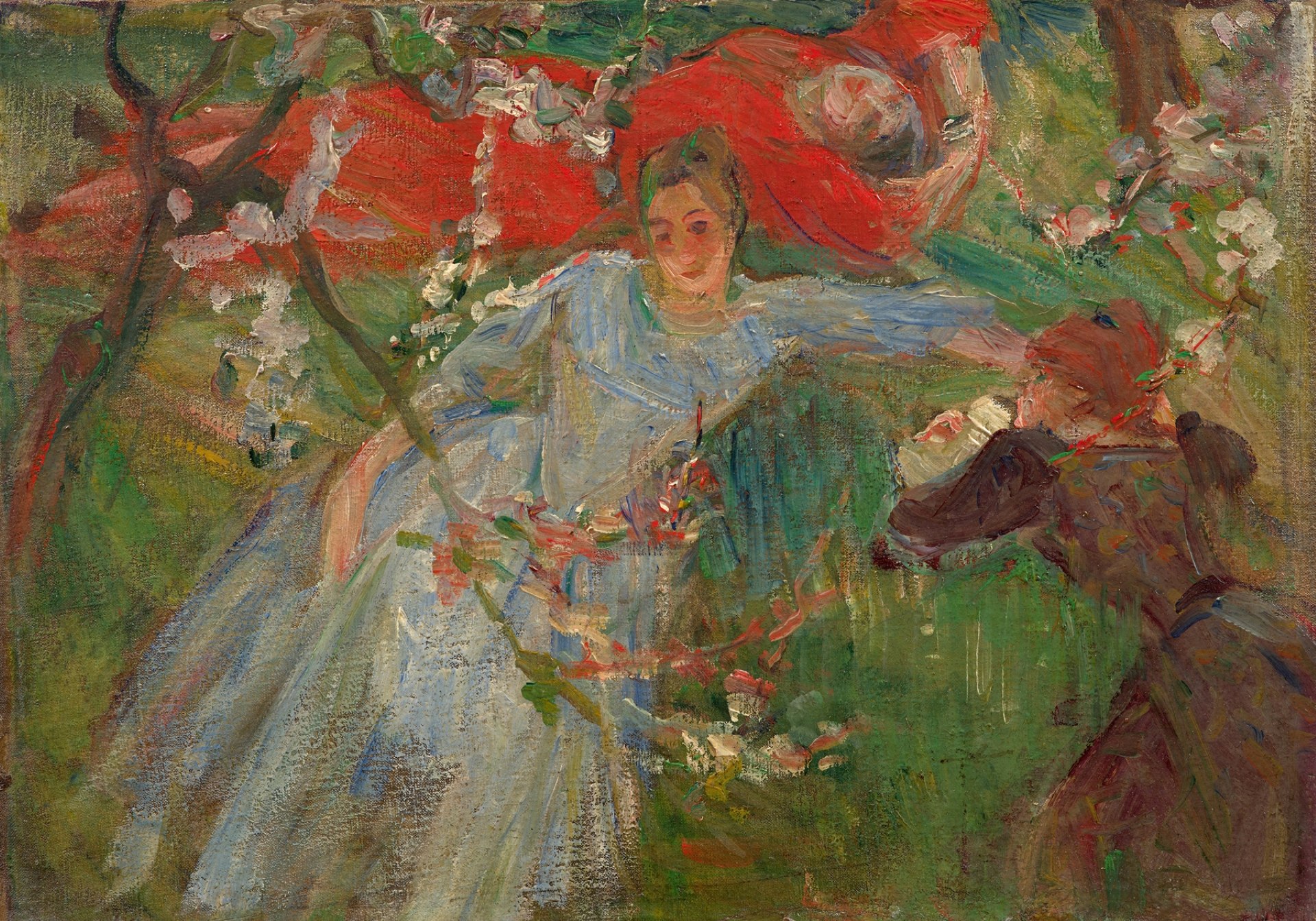
Marie Bracquemond (1840-1916), Three Women Lying on the Lawn
Love Songs and Lullabies
Song has been used, for thousands of years, to bring people together and express feelings and ideas that are shared across the globe: ceremony, prayer, celebration, mourning—and above all, love. Tonight’s concert assembles a rich harvest of love songs, whether romantic, sacred, or familial.
Essay by Katy Hamilton
Love Songs and Lullabies
On Sabine Devieilhe and Mathieu Pordoy’s Recital Program
Katy Hamilton
Song has been used, for thousands of years, to bring people together and express feelings and ideas that are shared across the globe: ceremony, prayer, celebration, mourning—and above all, love. Tonight’s concert assembles a rich harvest of love songs, whether romantic, sacred, or familial.
The program opens with a song in which love is truly dangerous: Franz Liszt’s Der Fischerknabe sets a text taken from Schiller’s Wilhelm Tell and depicts a young man falling asleep by a lake, only to be woken by a water sprite who pulls him down below. The sprite’s music is radiant, irresistible—and fatal.
The remainder of the evening’s first half is dedicated to songs that, in one way or another, may be called lullabies. The Hebrew Erev shel shoshanim (usually translated as “Evening of Roses”) was written by the Israeli composer, teacher, and conductor Yosef Hadar in the mid-1950s. With its heartfelt, memorable melody, it has become a popular favorite and is often performed for Jewish weddings. Le Petit chat triste, by another important 20th-century educator, the Swiss singer and pedagogue Jacqueline Mani, is a sweet little song for young children, full of mournful meowing before the kitten is reassured that her mother will come back to comfort her.
According to the pianist Graham Johnson, Schubert’s Du bist die Ruh, to a text by Friedrich Rückert, is “one of the most famous songs in the world, and also one of the most difficult to sing.” Schubert colors its almost hymn-like solemnity with delicate melodic decorations, allowing singer and pianist to breathe and build through the song’s long phrases, plumbing the depths of love the poet feels. A gently rocking paean to sweet dreams and “holy night,” the slightly later Nacht und Träume sets a poem by Matthäus von Collin. Between these two Schubertian lullabies, a parent tenderly sings a baby to sleep in the anonymous Berceuse cosaque.
***
Written in 1885, the year before his death, Franz Liszt’s En rêve dates from a time when the composer’s piano writing was becoming increasingly sparse, questing, and sometimes forlorn. But this is a miniature of exquisite, radiant calm—a tiny nocturne that seems almost to hover in mid-air, twinkling and lyrical. Richard Strauss composed the floating Die Nacht, one of his first published songs, just around the same time. Meinem Kinde dates from 1898, the year after Strauss’s son Franz was born, and Gustav Falke’s text is draped in hypnotic, circling piano figurations to coax a beloved child to sleep. Liszt’s Oh! quand je dors, one of his most famous songs, takes us from Strauss’s cradle to the bedside of an ardent lover desperate to dream of the angelic object of his affection. The piece was written for Marie d’Agoult, the mother of his three children and a talented author.
Liszt is hardly alone among composers in having created songs for his own lovers. Many of Strauss’s earlier lieder were written with the voice of his wife, the opera singer Pauline de Ahna, in mind. The same is true of Edvard Grieg, whose wife Nina Hagerup was a brilliant advocate of his many songs in public and private performance. Ein Traum is one of Grieg’s relatively few German-language lyrics—and a glorious example of wish fulfilment as the young man’s dream of finding a lover in the springtime becomes reality. In the same year that Grieg finished the group of six songs that includes Ein Traum, Richard Strauss put the finishing touches to a bouquet of four Mädchenblumen. The poems are by Felix Dahn, a high-profile writer of the time and a frequent contributor to Die Gartenlaube, Germany’s most popular family magazine. The serenity of Kornblumen (Cornflowers) is contrasted with the dizzy, passionate Mohnblumen (Poppies) and the soulful, deep feeling of Efeu (Ivy) which, Dahn tells us, “are among the rare flowers that bloom only once.”
***
From flowers we turn to the heavens with Lili Boulanger’s Clairières dans le ciel of 1914. Having won the coveted Prix de Rome in 1913, Boulanger set off for Italy in early 1914 to stay at the Villa Medici for the required two years’ study of classical and Italian art. She broke her journey in Nice, where a friend introduced her to the writing of contemporary Basque poet Francis Jammes, prompting the inspiration for a song cycle. It consists of 13 numbers, and Boulanger instructs the performer that “all of these songs should be sung with the feeling of evoking a past that is still fresh in the mind.” The opening piece (Elle était descendue au bas de la prairie) conjures an image of a girl picking flowers in a water meadow with all the tenderness of a recent, treasured memory. It is followed by the picture of a couple together, the meeting of gazes and the solemn cheerfulness of the young woman sending the pianist’s hands to the extremes of the keyboard, and the singer soaring up the stave (Elle est gravement gaie). The fourth song, Un poète disait, bubbles with the joy and devotion of a young lover utterly bewitched.
Almost 40 years Boulanger’s senior, Cécile Chaminade was one of the most successful composers of song and piano music of late-19th century France. Ma première lettre sets a poem by the composer’s friend Rosemonde Gérard, the wife of playwright Edmond Rostand (of Cyrano de Bergerac fame) and a writer whose texts Chaminade returned to on several occasions. It is a sweetly heartbroken song, the singer wistful at rediscovering the first letter she penned as a child. Chaminade takes us through her unfolding reactions to reading it, as well as evoking the naïve simplicity of the contents of that childish first attempt.
With Germaine Tailleferre, we arrive in 20th-century Paris. A prodigious pianist and composer, Tailleferre is now most often remembered as the only female member of Les Six, the group of composers that included Poulenc and Milhaud, among others—but she was also a friend of Ravel, a duet partner of Charlie Chaplin, and by the 1930s a successful composer of film music. The Six Chansons françaises date from 1929, the end of the decade that had begun with the formation of Les Six, and were premiered in 1930 to considerable acclaim. Tailleferre looked to past centuries for her poetry: the busy, archly pointed Non, la fidélité is by the 18th-century writer Gabriel-Charles de Lattaignant, while Mon mari m’a diffamée sets an anonymous 15th-century text that weighs up, in the most humane terms, the benefits and disadvantages of cheating on one’s husband for the chance of real love. The delightful closing number, Les Trois présents (this time by the 17th-century poet Jean-François Sarasin), makes a gift of three gracious greetings—we have only to choose which we would prefer.
***
Between 1932 and 1959, Francis Poulenc composed 15 Improvisations for solo piano—some using material heard in other pieces, others free and easy in their exploration of tiny thematic fragments. Two were offered in homage to treasured musical figures: Schubert, in 1941, and in 1959 (the last of the set), Édith Piaf, whose Improvisation provides the second instrumental interlude in tonight’s program. It is a charmingly lilting pianistic song in the best Piaf style, all swooning chords and elegance, effortlessly woven into an idiom that is unmistakably Poulenc.
Darius Milhaud’s Tay toy, babillarde arondelle comes from a collection of four Pierre de Ronsard settings published in 1940. Milhaud composed the set for the French-born American soprano Lily Pons, and they were premiered at the Waldorf Astoria in New York in December 1941, sung by Pons and conducted by her husband, André Kostelanetz. It is Pons’s dazzling soprano that inspired the high-flying chatter of the swallow in this virtuosic little song: a coloratura aria in less than ninety seconds.
There is no more fitting conclusion to this panoply of love songs than Édith Piaf ’s 1950 Hymne à l’amour, in which Piaf ’s text is paired with music by her regular collaborator Marguerite Monnot (who had studied, coincidentally, with Nadia Boulanger and Alfred Cortot). Piaf probably wrote it in memory of her lover Marcel Cerdan, a world-champion boxer who had died in a plane crash in late 1949 on his way back from New York to Paris. The world could fall to pieces, and all other cares and allegiances be renounced, Piaf tells us, as long as her beloved is true to her. And even after death, “We’ll have eternity to ourselves… God reunites those who love each other.”
Katy Hamilton is a writer and presenter on music, specializing in 19th-century German repertoire. She has published on the music of Brahms and on 20th-century British concert life and appears as a speaker at concerts and festivals in the UK, in Europe, and on BBC Radio.
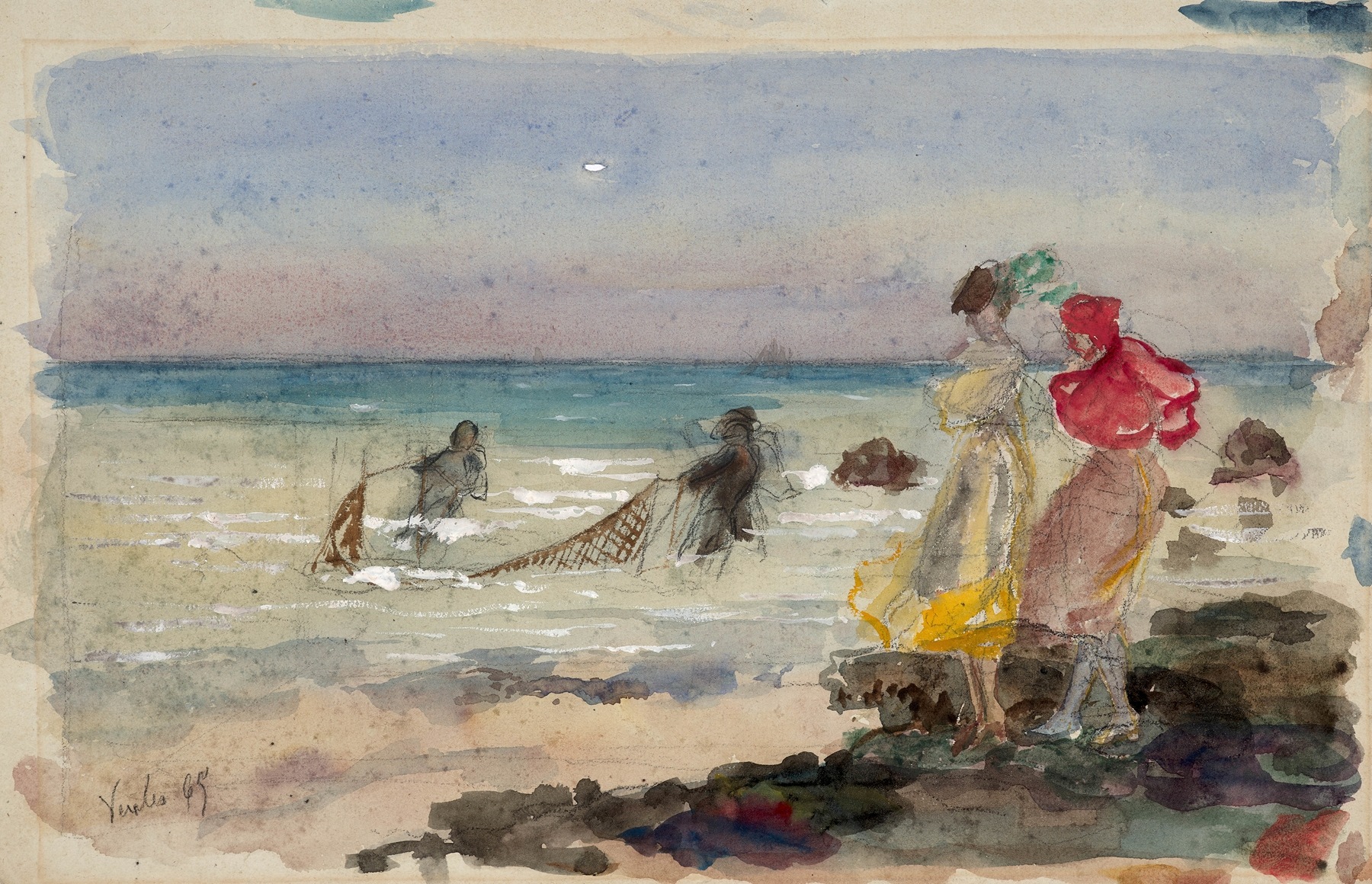
Marie Bracquemond, Beach at Veules-les-Roses (1865?)
Triumph der Liebe
Voller Leichtigkeit und Humor konfrontieren Sabine Devieilhe und Mathieu Pordoy in Liedern von Schubert bis Piaf lang überwundene Geschlechterklischees mit musikalischen Frauenbildern, die Stärke und Souveränität vermitteln – sei es weibliche, mütterliche, feministische oder künstlerische.
Werkeinführung von Meike Pfister
Triumph der Liebe
Musikalische Frauenbilder von Schubert bis Piaf
Meike Pfister
Moderne Texte finden sich eher selten in Liederabendprogrammen. Das macht allerdings kaum einen Unterschied, wenn darin urmenschliche Phänomene wie Liebe, Tod oder Heimweh verhandelt werden oder die Texte von so hoher literarischer Qualität sind, dass sie immer neue Sichtweisen zulassen. Im Fall der vier Mädchenblumen von Felix Dahn ist weder das eine noch das andere wirklich gegeben. Dahns Charakterisierung verschiedener Frauentypen – symbolisiert durch „milde Kornblumen“, „immer froh gelaunte Mohnblumen“, „schmucklosen“ Efeu „mit verborgner Blüte“ und die „märchenhafte, sagengefeierte Wasserrose“ – bedient nicht nur lange überwundene Geschlechterklischees, sondern mag schon Ende des 19. Jahrhunderts auf manch eine oder einen allzu stereotyp gewirkt haben. Auch die zeitlose Schönheit und Meisterschaft der Vertonung von Richard Strauss konnte nicht gänzlich verhindern, dass sich inzwischen Diskussionen um eine zeitgemäße Aufführung dieser Lieder entspinnen.
Eine solche aber gelingt Sabine Devieilhe und Mathieu Pordoy in ihrem heutigen Programm – und zwar ganz ohne moralische Fingerzeige. Voller Leichtigkeit und Humor werden die Mädchenblumen mit konträren Frauenbildern konfrontiert, die Stärke und Souveränität vermitteln – sei es weibliche, mütterliche, feministische oder künstlerische. Der erste Teil des Konzerts widmet sich Wiegen- und Schlafliedern im weitesten Sinn. Daneben erklingen aber auch Liebeslieder, in denen – wie etwa bei Franz Liszt – die verzehrende oder gar zerstörerische Liebe zu einer Frau besungen wird. Im zweiten Teil stehen dann vor allem Lieder französischer Komponistinnen des Fin de siècle und der 1920er Jahre im Zentrum.
Triumphieren darf am Ende aber weder eine Frau noch ein Mann, sondern einzig und allein die Liebe selbst. In Marguerite Monnots und Édith Piafs Hymne à l’amour – dem einzigen Stück des heutigen Konzerts, dessen Text von einer Frau stammt –, heißt es: „Der blaue Himmel über uns mag einstürzen / Und die Erde sich auftun, / Das ist nicht wichtig, wenn du mich liebst, / Dann ist mir die ganze Welt egal.“
Herz und Verstand
Auch den Fischerknaben in Franz Liszts 1845 veröffentlichtem gleichnamigen Lied kümmert es nicht, wenn er den engelsgleichen Stimmen in die Tiefen des Wassers folgt und damit sein Leben verspielt. „In Liebessachen muss man sich glücklich preisen, wenn sie ein schönes Ende nehmen“, war Liszt überzeugt, dessen Liebesleben es niemals an Dramatik mangelte. Auch die eindringlichen Worte, die Liszts Vater an den damals 16-Jährigen richtete, konnten den Lauf der Dinge nicht aufhalten: „Auf seinem Totenbette in Boulogne sagte mir mein Vater, dass ich ein gutes Herz und Verstand besäße, aber dass er fürchte, dass die Frauen mein Leben verwirren und mich beherrschen würden“, erinnerte sich der Komponist.
Wer von wem beherrscht wird, ist in Liszts Leben stets eine Frage der Perspektive – in Schillers Fischerknaben aus Wilhelm Tell ist die Antwort eindeutig. Im Kontext des 1804 entstandenen Dramas stellt das Gedicht eigentlich nur einen unschuldigen Gesang zur „Melodie des Kuhreihens“ dar. Franz Liszt macht daraus – wie könnte es anders sein? – einen virtuosen und leidenschaftlichen Rausch. Nicht minder emotionsgeladen ist seine Vertonung von Victor Hugos Oh! quand je dors, das am Ende der Gruppe aus Schlaf- und Traumliedern vom wonnevollen Erwachen einer im Schlaf geküssten Seele spricht.
Nacht und Blumen
Auch Richard Strauss hatte offenbar eine Schwäche für starke Frauen. Nicht nur die Protagonistinnen seiner Opern – allen voran Salome, Elektra oder die Marschallin im Rosenkavalier – legen diese Vermutung nahe, sondern gleichermaßen seine Ehefrau Pauline. Stets auf der Hut sein vor etwaigen Taktlosigkeiten musste man bei ihr laut Alma Mahler-Werfel – selbst als Femme fatale erster Güte bekannt –, denn „sie sagte alles heraus, was und wie sie es dachte“. Für Strauss, so überliefert es Alma, offenbar die ideale Partie: „Mei’ Frau ist oft arg ruppig, aber wissen S’, i brauch des.“
Ausgesprochen taktvoll aber und alles andere als ruppig war sie als Sopranistin. Für Strauss’ Liedschaffen wurde sie zu einer wichtigen Inspirationsquelle, und es ist sicher kein Zufall, dass die Anzahl seiner Liedkompositionen nach der Heirat im Jahr 1894 markant anstieg und 1906 mit dem Ende von Paulines aktiver Karriere wieder sank. (Die Mädchenblumen schrieb er – vielleicht bezeichnenderweise? – bereits zwischen 1886 und 1888). Das Wiegenlied Meinem Kinde entstand nicht nur für die Sängerin Pauline, sondern auch für die Mutter: Strauss schenkte es ihr zur Geburt des gemeinsamen Sohnes Franz am 12. April 1897.
Tatsächlich eignet sich das überaus anspruchsvolle Stück eher für den Konzertsaal als zum Einschlafen – ganz im Gegensatz zu den beiden traditionellen Liedern Le Petit chat triste und Berceuse cosaque. Auch das hebräische Erev shel shoshanim zählt nicht zur Gattung des Kunstlieds im klassischen Sinn. Die schlichte Melodie, die zu den berühmtesten des in Tel Aviv geborenen Komponisten Yosef Hadar gehört und häufig bei Hochzeiten erklingt, ist mittlerweile so bekannt geworden, dass manch eine:r sie für ein Volkslied halten mag.
Traum und Wirklichkeit
Den Worten Friedrich Rückerts nach ist Du bist die Ruh ein inniges Liebeslied. Doch die in sanften Wellenbewegungen fließende Klavierbegleitung in der Vertonung Franz Schuberts hüllt das Gedicht in das Gewand eines Wiegenliedes. Eine wiegende Bewegung durch zieht auch das zweite Werk des Komponisten im heutigen Programm. In seinem Gedicht Nacht und Träume beschreibt Matthäus von Collin die für die Romantik und für Schubert so typische Sehnsucht nach einer Traumwelt, die der harschen Wirklichkeit vorgezogen wird. Ganz anders geht es zu in Edvard Griegs Ein Traum aus dem Jahr 1889: „Und schöner noch als einst der Traum / Begab es sich in Wirklichkeit“, heißt es in dem leidenschaftlichen Liebeslied, das uns zum Ende der ersten Konzerthälfte in die Realität zurückholt.
Komponist und Komponistin
Im Wechsel mit Strauss’ Mädchenblumen präsentieren Sabine Devieilhe und Mathieu Pordoy drei Lieder aus Lili Boulangers Zyklus Clairières dans le ciel (Lichtungen im Himmel). Auch hier, in den teils symbolistischen Gedichten von Francis Jammes, dienen Blumen immer wieder zur poetischen Beschreibung der Geliebten, allerdings nicht systematisch wie bei Dahn, sondern als ein Stilmittel unter vielen: „Elle avait le regard qu’ont les fleurs de lavande“ (Sie hatte Augen wie Lavendelblüten), wie es am Ende des ersten Liedes heißt.
Der Zyklus entstand 1914 während Boulangers Aufenthalt in Rom in der Villa Medici. Als erste Frau hatte Lili, die jüngere Schwester der später berühmten Kompositionslehrerin Nadia Boulanger, den renommierten Prix de Rome erhalten, der vor ihr bereits Komponisten wie Debussy, Bizet oder Massenet als Ausgangspunkt für ihre Laufbahn gedient hatte. Nicht nur der Ausbruch des ersten Weltkriegs, sondern auch ihre stets anfällige physische Konstitution zwangen sie jedoch zum Abbruch ihres Stipendiums. Die Arbeit an der Orchesterversion der 13 impressionistischen Lieder blieb unvollendet. Lili Boulanger starb 1918 mit nur 24 Jahren an Tuberkulose.
In einer Zeitungskritik aus dem Jahr 1914 wird ihre „starke gestalterische Kraft“ hervorgehoben, „die sich nicht in belanglose oder nebensächliche Einzelheiten verliert, was sofort verraten hätte, dass eine Frau die Musik komponierte“. Trotz der fragwürdigen Perspektive deckt sich diese Aussage doch in etwa mit den Worten von Ambroise Thomas (selbst Prix de Rome-Preisträger) über Cécile Chaminade: „Dies ist keine komponierende Frau, sondern ein Komponist, der eine Frau ist.“ In ihrem Heimatland wurde Chaminade als erste Komponistin überhaupt in die Légion d’Honneur aufgenommen. Außerhalb Frankreichs genoss sie noch größeren Ruhm: In England zählte Queen Victoria zu ihren Bewunderern, und in Amerika gründeten sich gar sogenannte „Chaminade Clubs“ – musikalische Gesellschaften mit überwiegend weiblichen Mitgliedern, die ihre Werke zur Aufführung brachten.
Ehe und Liebe
Dem musikalischen Impressionismus und Symbolismus der Vorkriegszeit hielt die Groupe des Six mit Beginn der 1920er Jahre Pragmatismus, Humor und neoklassizistische Klarheit entgegen. Neben Georges Auric, Louis Durey und Arthur Honegger gehörten auch Germaine Tailleferre, Francis Poulenc und Darius Milhaud zu dieser eher lose verbundenen Gemeinschaft. Die Verwendung und Montage verschiedenster Genres und Stile, auch der Unterhaltungsmusik, war ein wesentliches Merkmal ihrer Ästhetik, die auf Eric Satie und Jean Cocteau zurückging.
Tailleferres Six Chansons françaises aus dem Jahr 1929 repräsentieren diesen Ansatz – und möglicherweise auch ihre eigenen Erfahrungen mit Männern: Die zweimal geschiedene Komponistin wählte für ihre Lieder Texte aus dem 15. bis 18. Jahrhundert, in denen mit Treue und Ehemännern eiskalt abgerechnet wird. Mon mari m’a diffamée widmete sie der Frau des Malers Bernard Boutet de Monvel, der 20 Jahre später im Oktober 1949 bei einem Flugzeugabsturz ums Leben kam. Mit in der Maschine saß Marcel Cerdan, Boxweltmeister und Geliebter von Édith Piaf. Wie Delphine Boutet de Monvel mit dem Verlust ihres Mannes umging und ob Tailleferres Widmung einst als Anspielung auf eheliche Schwierigkeiten gemeint war, wissen wir nicht. Bekannt ist aber, dass Édith Piaf noch am selben Abend nach dem Unglück die Hymne à l’amour sang – das Lied, das erst wenige Monate zuvor als große Liebeserklärung an Marcel entstanden war.
Meike Pfister lebt als Pianistin, Musikwissenschaftlerin und Moderatorin in Berlin und ist hauptsächlich an der Universität der Künste und der Philharmonie Berlin sowie an der Elbphilharmonie in Hamburg tätig.
The Artists

Sabine Devieilhe
Soprano
Born in Normandy, soprano Sabine Devieilhe studied cello and musicology before completing her vocal training at the Conservatoire in Paris. Soon after, she received invitations to the Festival d’Aix-en-Provence and made debuts in the title role of Délibes’s Lakmé at the Opéra de Montpellier and as the Queen of the Night in Die Zauberflöte in Lyon. Since then, she has appeared at all major opera houses across Europe, including the Opéra national, Théâtre des Champs-Élysées, and Opéra comique in Paris, the Théâtre de la Monnaie in Brussels, the Zurich Opera House, the Vienna and Munich state operas, Milan’s La Scala, London’s Royal Opera House, and the Glyndebourne and Salzburg festivals. In the 2022–23 season, she made her debut at the Metropolitan Opera in New York as Constance in Poulenc’s Dialogues des Carmélites. Her repertoire also includes roles such as Handel’s Cleopatra, Mozart’s Susanna and Ilia, Strauss’s Sophie and Zdenka, Debussy’s Mélisande, and Ophélie in Ambroise Thomas’s Hamlet. Among Sabine Devieilhe’s performances this current season are the title role of Donizetti’s Lucie de Lammermoor (in the French version) in Paris and a tour with countertenor Jakub Józef Orliński and the ensemble Il Pomo d’Oro. She also gives recitals at London’s Wigmore Hall, the Philharmonie de Luxembourg, in Compiègne, Bordeaux, Lyon, and Strasbourg.
January 2026

Mathieu Pordoy
Piano
French pianist Mathieu Pordoy performs internationally as a collaborative pianist and repetiteur. Together with Sabine Devieilhe, he has appeared at Carnegie Hall in New York, the Vienna Musikverein, London’s Wigmore Hall, the Concertgebouw in Amsterdam, and the Berlin Philharmonie, among other venues. In 2023, they released their first duo album with songs by Mozart and Strauss. Mathieu Pordoy has also collaborated with Michael Spyres, Marina Rebeka, Diana Damrau, Pene Pati, and Benjamin Bernheim, with whom he made his debut at the Salzburg Festival in 2021. Concerts have taken him to the Dortmund Konzerthaus, Vienna Konzerthaus, and Hamburg’s Elbphilharmonie. As a vocal coach and expert on French opera, he regularly works at major European theaters such as the Opéra national and the Théâtre des Champs-Élysées in Paris, the Vienna State Opera, and the Zurich Opera House. He is the artistic coordinator of the Académie de l’Opéra Comique Paris and has been a coach at the Académie du Festival d’Aix-en-Provence since 2008.
January 2026