Stefan Temmingh Recorder
Elisabeth Seitz Salterio
Michael Dücker Lute
Johanna Seitz Harp
Peter Kuhnsch Percussion
Stefan Maass Guitar, Cittern
Adrian Rovatkay Bassoon, Dulcian, Recorder
Hartmut Becker Cello
Walewein Witten Harpsichord
Mathis Wolfer Recorder
Program
Works by
Michael Nyman
Henry Purcell
Thomas Preston
Chick Corea
Johann Sebastian Bach
Johann Heinrich Schmelzer
Antonio Vivaldi
Tarquinio Merula
Jean-Baptiste Lully
and others
Michael Nyman (*1944)
An Eye for Optical Theory
from the score to The Draughtsman’s Contract (1992)
Henry Purcell (1659–1695)
Ground in C minor ZD 221
Thomas Preston (?) (?–after 1559)
Uppon la mi re
Henry Purcell
May Her Blest Example Chase
from Love’s Goddess Sure Was Blind Z 331 (1692)
Chick Corea (1941–2021)
Children’s Song No. 1 (1971–4)
Johann Sebastian Bach (1685–1750)
Fourteen Canons BWV 1087 (1748–9) (Selection)
Johann Heinrich Schmelzer (um 1623–1680)
Sonata secunda in F major
from Sonatae unarum fidium (1664)
Antonio Vivaldi (1678–1741)
Sonata in D minor RV 63 Op. 1 No. 12 "La Follia"
Intermission
Tarquinio Merula (1594–1665)
Canzonetta spirituale sopra alla nanna “Hor ch’è tempo di dormire” (1636)
Anonymus
Follias
from Roswallen Lute Book (1620)
Corne Yairds
aus The Division Flute (1706)
Greensleeves
from Playford’s English Dancing Master (1651)
Black and Grey
Chick Corea
Children’s Song No. 4
Anonymus
Durham Ground
on a theme by Arcangelo Corelli
Jean-Baptiste Lully (1632–1687)
Chaconne
from the Tragédie lyrique Phaëton LWV 61 (1683)
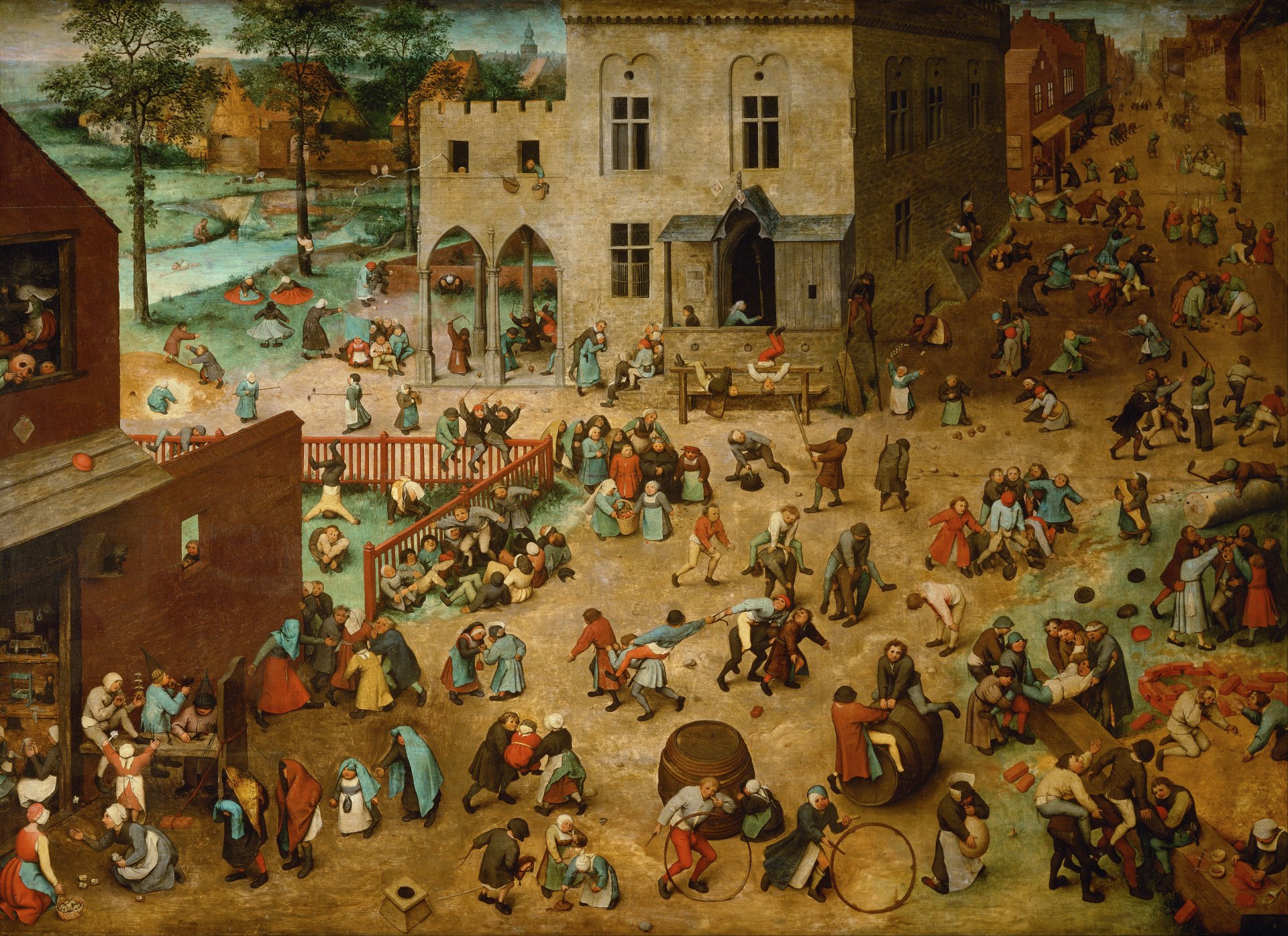
Pieter Brueghel the Elder, Children's Games (1560)
Playing the Ground
At first glance, tonight’s program seems somewhat heterogeneous: music from England, a bit of Bach, some Italians, the Frenchman Lully—and then there’s Chick Corea, grandmaster of jazz. The key to this selection lies in the title Stefan Temmingh and the ensemble Nuovo Aspetto have chosen for their project: Playgrounds.
Program Note by Michael Horst
Playing the Ground
On the Program by Stefan Temmingh and Nuovo Aspetto
Michael Horst
At first glance, tonight’s program seems somewhat heterogeneous: music from England, a bit of Bach, some Italians, the Frenchman Lully—and then there’s Chick Corea, grandmaster of jazz. The key to this selection lies in the title Stefan Temmingh and the ensemble Nuovo Aspetto have chosen for their project: Playgrounds. A playground, then, for experiments in interpretation? Far more: the basis of this program—quite literally—is the ground, the musical foundation from which the individual pieces grow.
In England during the early Baroque age, “ground” or “ground bass” became a specific musical term: it describes a sequence of bass notes, an ostinato, or, in more modern parlance, a pattern that is repeated throughout, lending a piece its harmonic structure. Musical tension, therefore, is created by the upper voices, which are richly ornamented, often improvised, above this bass foundation. While in England composers would sometimes incorporate the word ground into the titles of works, in Italy terms such as passacaglia, follia, ciacona, or pavana were used. In Germany, Johann Pachelbel employed the principle of a continuous bass in his famous Canon. The concept still survives in contemporary popular music—known variously as a loop, riff, vamp, or walking bass.
England—United States
Henry Purcell marks the point of departure for today’s journey—in the original and as an arrangement. For that is what An Eye for Optical Theory, an instrumental piece written by Michael Nyman for Peter Greenaway’s 1982 film The Draughtsman’s Contract, essentially is. In keeping with the story, which is set at an English country estate in the late 17th century, Nyman used Purcell’s music, including the Ground in C minor, which is subsequently heard in its original version. But the labels of original or arrangement easily become misleading here, as Stefan Temmingh explains: “At the time, no one gave much thought to which instrument would play a piece. For us too, an essential aspect of this program is the playful, improvisational element. Sometimes the recorder takes the melody, sometimes the lute—we don’t necessarily determine all the details in advance.” In that sense, Nyman’s arrangement, which hews close to its model harmonically, is simply arranged again.
Nor were there rules how extensive such a ground had to be. The shortest is ascribed to William Byrd, Purcell’s contemporary, who used only two notes in The Bells. Other grounds stretch over several measures, while the anonymous composition Uppon la mi re names the three Italian tone syllables (A, E, and D in English notation) upon which it is based. The striking ground Purcell invented for “May Her Blest Example Chase,” the fifth section of Love’s Goddess Sure Was Blind, one of his Birthday Odes for Queen Mary, goes on for a full eight measures.
A leap from Purcell to the end of the 20th century provides a musical “dab of color” (Stefan Temmingh) in the form of Chick Corea’s Children’s Songs. The pianist and multiple Grammy winner, who passed away in 2021 at the age of almost 80, was a well-known wanderer between the realms of jazz and classical music. On the one hand, he performed with Miles Davis and Stan Getz, Herbie Hancock and John McLaughlin. His collaboration with the Viennese pianist Friedrich Gulda, on the other hand, was the stuff of legend as well, resulting in their joint recording of Mozart’s Concerto for Two Pianos. As a composer, Corea wrote many works for “his” instrument, including these 20 Children’s Songs, which he released as an album in 1984. He said he created these miniatures “to convey simplicity as beauty, as represented in the spirit of a child”. They are consciously inspired by Béla Bartók’s piano anthology Microcosm; their simplicity results in part from the repetitive bass figures that function like a ground.
Germany—Austria
Johann Sebastian Bach’s Fourteen Canons BWV 1087 were only discovered in 1973, in Bach’s own copy of the first printing of the “Goldberg” Variations. These short pieces are collected there in the composer’s hand, titled—in reference to the larger work—“Various canones on the first eight fundamental notes of the previous aria.” The familiar bass sequence is transformed according to all the artful rules of counterpoint: now in unison, now in two voices, now as inversion and retrograde, sometimes even with the “fundamental voice” in the middle instead of as a bass line. “It was important to me to include Bach in our program, as a resting point, so to speak,” says Stefan Temmingh. Ultimately, he claims, Bach did nothing here but write a bass that keeps repeating itself—a ground, in other words. But the extremely complex design of these Canones (a selection of which is performed tonight) did force the ensemble to compromise, as the musician explains: “In this case we forego improvisation. Instead, I decided upon a clear structure, with two voices plus bass, and that’s what it will be in the concert.”
From Leipzig, the musical journey continues to Vienna, from the high Baroque of the early 18th century to the time around 1660, when Johann Heinrich Schmelzer served as kapellmeister to the art-loving Emperor Leopold I. “We really wanted to play some early Baroque music,” Temmingh says about the pieces he selected together with the members of Nuovo Aspetto, “and these sonatas are an absolute classic”. Schmelzer was not only a virtuoso violinist, he also composed a great number of sonatas, among which the Sonatae unarum fidium, seu a violino solo, six works for solo violin (with bass accompaniment) stand out. Printed in Nuremberg in 1664, these pieces not only pose remarkable technical challenges, they are also remarkable for their great harmonic expressivity. As part of today’s program, the Sonata secunda will be heard because it maintains its harmonic foundation throughout, while the solo voice conjures a highly virtuosic, seemingly infinite wealth of ornamentation, growing ever more playful as the piece progresses. Schmelzer’s sonatas may have been composed for the violin—but in keeping with the spirit of the time, of course they can also be performed on a recorder.
Italy
The following excursion to Northern Italy again combines two works from the high and the early Baroque periods. Antonio Vivaldi is known chiefly for the enormous number of his instrumental concertos, most notably the omnipresent Four Seasons. His Sonata for Two Violins and Basso continuo in D minor—also heard today in a version for recorder—is a series of variations on La Follia, a theme in the saraband rhythm that originated in Portugal and spread via Spain throughout Europe, attaining such fame that it attracted and inspired generations of composers, from Corelli to Scarlatti, Carl Philipp Emanuel Bach and even Franz Liszt. From its simple harmonic structure, Vivaldi develops an opulent series of variations featuring dramatic, lively, and elegiac moments alike.
The piece by Tarquinio Merula has a completely different character. Born in Cremona, Merula became an important force in Baroque instrumental music, not least because he kept seeking new solutions for the basso continuo. One example of this is the Canzonetta spirituale sopra alla nanna “Hor ch’è tempo di dormire,” a sacred song based on the lullaby “Now It Is Time to Sleep.” In fact, the text goes far beyond a simple lullaby, turning into a vision of Mary in which she sees the future and her son’s death on the cross: “Amor mio, sia questo petto / Hor per te morbido letto / Pria che rendi ad alta voce / L’alma al Padre su la croce” (My beloved child, may this breast be a soft bed for you, before you commend your spirit loudly to our Father on the cross). Stefan Temmingh is aware of the challenge implicit in performing such a highly expressive work entirely without words: “We will try to make the context come alive through music. It is astonishing enough to see how Merula builds his piece on just two chords.”
England—France
Toward the end of the evening, Temmingh and Nuovo Aspetto once again train their gaze upon England, with three traditional, folklike pieces that have come down to us from anonymous sources and also employ the principle of the ground. “Absolutely one of a kind” is Temmingh’s description of the “Durham Ground” from the high Baroque period of the mid-18th century. The piece is based on a sarabande theme of eight measures written by Arcangelo Corelli, who was long dead at the time—far more than 100 years after the first publication of his Violin Sonatas Op. 5, this work obviously continued to be highly popular. The theme is followed by the obligatory set of variations, which then suddenly leads into a highly virtuosic and precisely notated harpsichord part. Finally, this “Durham Grand” ends with a fugue—amazingly, the authorship of this composition has not been ascertained to this day.
The concert concludes in brilliant fashion with the Chaconne from Phaéton, a tragédie en musique by Jean-Baptiste Lully. We seem to be transported back to the court at Versailles, where the opera, which tells the tragic story of the son of the sun god, premiered in 1683. Once again, Temmingh and his ensemble have chosen a very special arrangement: the source was a publication from London, The Division Flute, which includes Lully’s Chaconne in a version for recorder. This, in turn, was “re-arranged” by the musicians for their instruments to make it sounds orchestral—a final musical game on the “playgrounds” of tonight’s program.
Translation: Alexa Nieschlag
Michael Horst is a freelance music journalist based in Berlin who writes for newspapers, radio stations, and magazines, in addition to giving pre-concert talks. He has published opera guides on Puccini’s Tosca and Turandot and translated books by Riccardo Muti and Riccardo Chailly from Italian to German.
The Artists
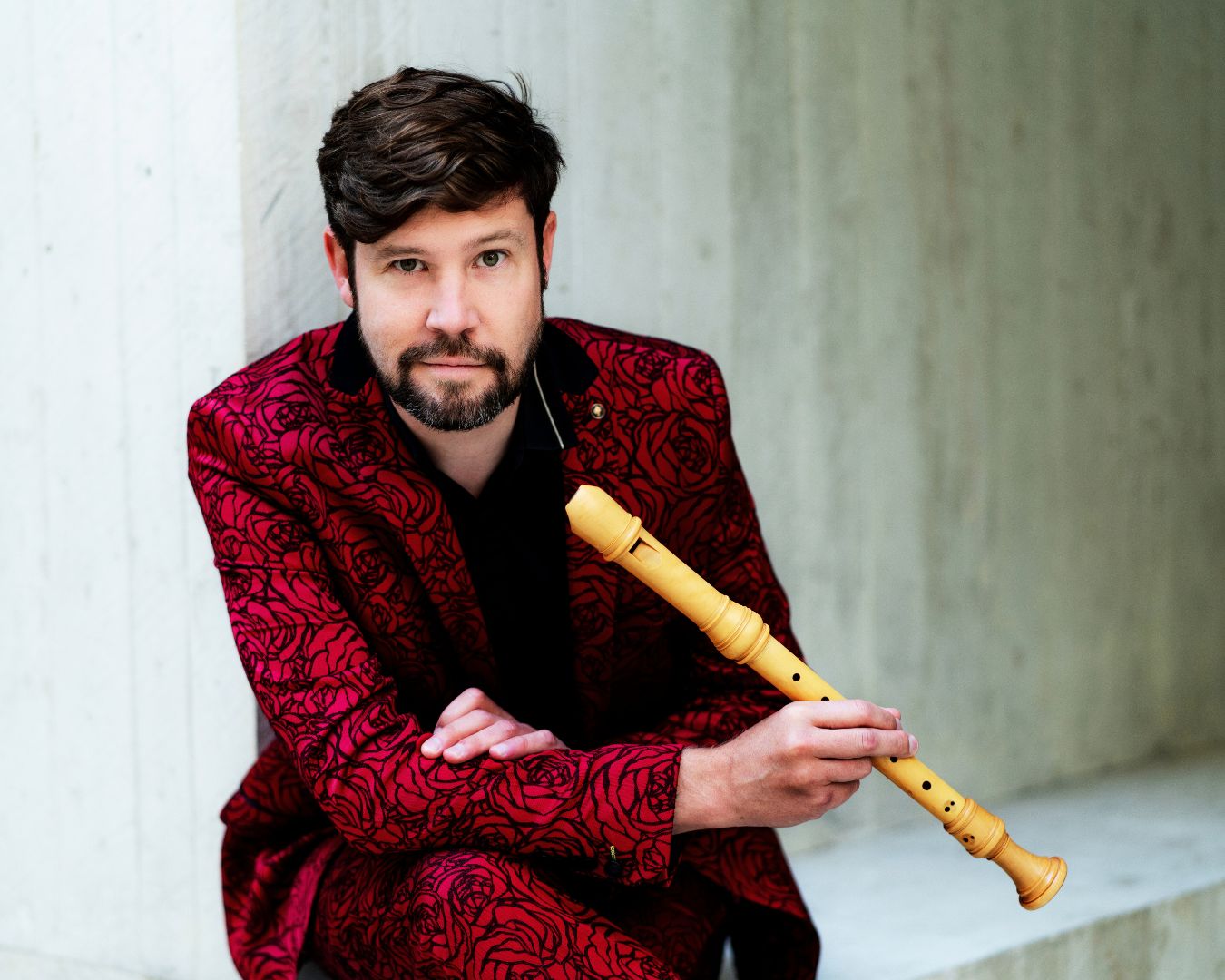
Stefan Temmingh
Recorder
Stefan Temmingh was born in South Africa and studied recorder with Markus Zahnhausen in Munich and with Michael Schneider at the Frankfurt Musikhochschule. One of today’s leading soloists on his instrument, he appears regularly at Bachfest Leipzig, the Handel Festivals of Halle and Göttingen, the Utrecht Early Music Festival, Boston Early Music Festival, and at festivals in Asia and Africa. He has performed as a soloist with Deutsche Radio Philharmonie, Estonian National Symphony Orchestra, Bochum Symphony, Cologne’s WDR Funkhausorchester, and the Hong Kong Sinfonietta, among many others. His repertoire includes music for recorder from the Baroque era to works of the present day. He regularly commissions and premieres new recorder concertos from contemporary composers. His recording of concertos by Bach, Fasch, Graupner, and Telemann with the Capricornus Consort Basel, a close artistic partner since 2017, was awarded a OPUS Klassik Award in 2022. He has also received an ECHO Klassik, International Classical Music Award, and Diapason d’Or. Stefan Temmingh has been a professor at the Freiburg Musikhochschule since 2019.
October 2025
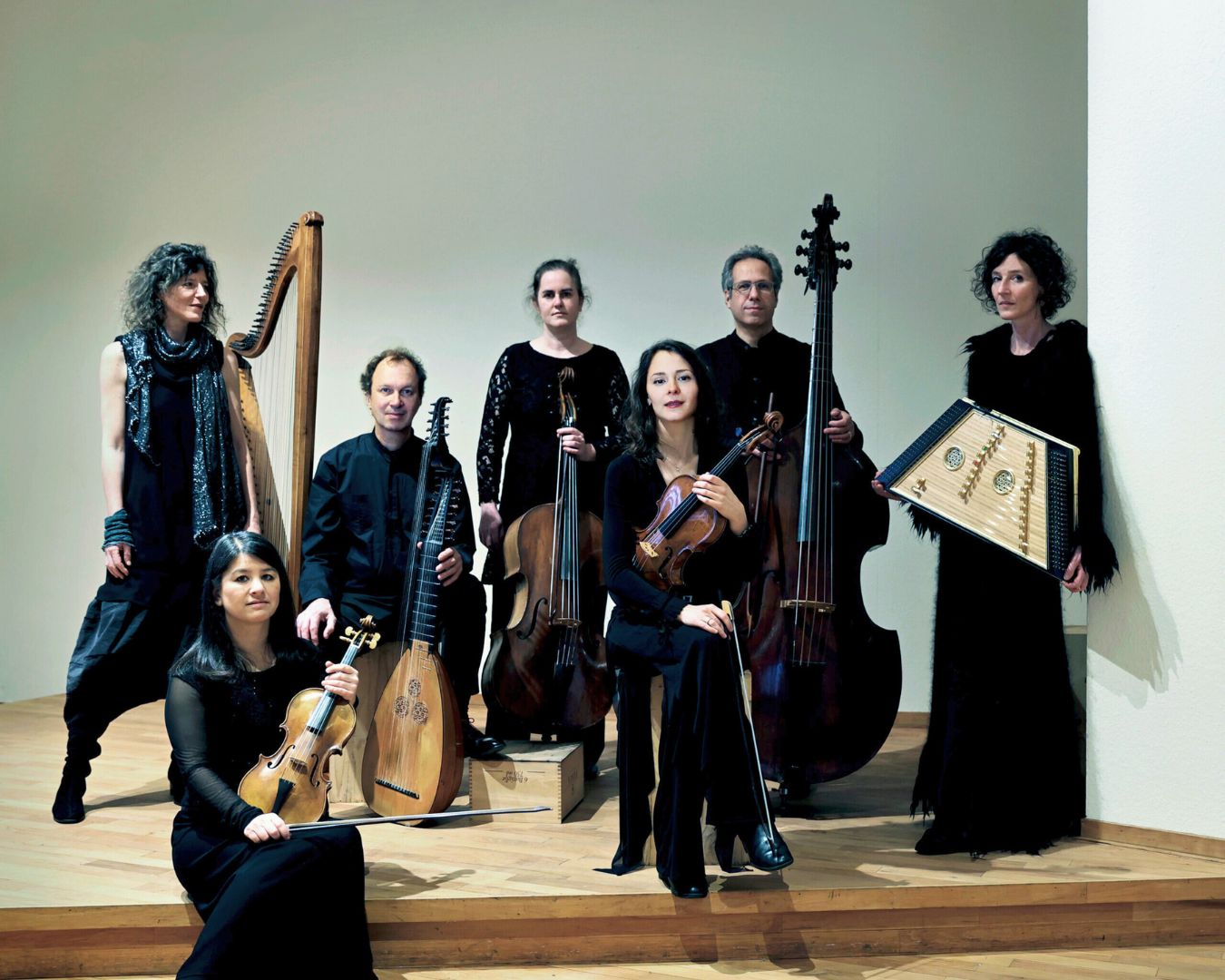
Nuovo Aspetto
Nuovo Aspetto was founded by Michael Dücker, Johanna Seitz, and Elisabeth Seitz and specializes in rediscovering Baroque and early Classical works for unusual combinations of instruments. Previous projects and CD recordings have been dedicated to Johann Georg Reutter, Francesco Ratis, Antonio Caldara, and Joseph Haydn, whose orchestral works the ensemble has recorded in chamber music arrangements by his contemporaries. Most recent releases include arias and instrumental works by Francesco Bartolomeo Conti and the album Il gondoliere Veneziano with baritone Holger Falk. Nuovo Aspetto has appeared at venues including the Vienna Konzerthaus, Elbphilharmonie and Laeiszhalle in Hamburg, the Prinzregententheater in Munich, the Schubertiade Schwarzenberg-Hohenems, the Innsbruck Festival of Early Music, the Handel Festival in Karlsruhe, the Musikfest Bremen, and most recently on a U.S. tour.
October 2025