Ben Goldscheider Horn
Philip Dawson Live Electronics
Program
Works by
Zoë Martlew
Alex Groves
Thea Musgrave
Hildegard Westerkamp
Mark Simpson
German Premieres
Zoë Martlew (b. 1968)
Nibiru for Horn and Live Electrnonics (2024)
Alex Groves (b. 1991)
Single Form (Dawn) for Horn and Live Electrnonics (2022)
Thea Musgrave (b. 1928)
The Golden Echo III for Horn and Live Electrnonics (2024)
Hildegard Westerkamp (b. 1946)
Fantasie for Horns II for Horn und Tape (1979)
Mark Simpson (b. 1988)
Darkness Moves II for Horn and Live Electrnonics (2024)
There will be no intermission.
All five works receive their German premieres as part of tonight’s program.
“Out of Silence, Song Rises”
Read more about the composers and their works.
Composers’ Notes
Zoë Martlew (b. 1968)
A composer, cellist, cabaret artist, educator, podcaster, and presenter, Zoë Martlew works as a solo performer, with some of the world’s most renowned contemporary music ensembles and chamber groups, in improvisation, film, electronica, multi-media, pop, and rock, and appears with dance and theater companies as well as in her own one-woman show, Revue Z.
Nibiru
for Horn and Live Electronics (2024)
Premiered by Ben Goldscheider and Philip Dawson
From the shadows of Babylonian myth comes Nibiru—the wandering planet, herald of destruction, whispered of in ancient tablets and visions of apocalypse. A celestial phantom, it circles unseen, returning only to bring upheaval and rebirth. In this sonic space drama, the horn opens as a prophet of cataclysm, sounding over a scorched apocalyptic electronic landscape of air-raid sirens, earthquakes, multiple explosions and a huge chorus of ancient horns. Its cry pierces the void, a desperate call to the heavens for humanity’s survival. Alone, carrying only its own voice, the player drifts into the infinite night, offering a fragile prayer for peace. Out of silence, song rises: the horn sings richly to the cosmos, its lines entwined with shimmering electronic echoes—strange auroras, radiant suns, and the hum of shifting dimensions. Slowly, out of this uncharted soundscape, a New Eden shimmers into being, and the horn begins to echo the strange, luminous song of its solitary star-bird guide.
Commissioned by Huddersfield Contemporary Music Festival and Judith Vita Spence for Camerata Pacifica in memory of her late husband Stuart Spence.
***
Alex Groves (b. 1991)
Alex Groves is a composer and curator working across contemporary classical and electronic music. Taking inspiration from queer club culture, abstract art, and the natural world, his music often combines classical instruments with live-processed electronics to create richly detailed sound worlds.
Single Form (Dawn)
for Horn and Live Electronics (2022)
Premiered by Ben Goldscheider and Philip Dawson
Single Form (Dawn) is a slow-motion, sonic sunrise. Starting in the murky depths of the muted horn, it gradually unfurls up the harmonic series until it ends in a wall of radiant light. The piece revolves around the harmonic series on the fundamental of the horn in F. At first, these notes are condensed into their lowest octave, creating a dense and brooding sound world. As the piece develops, the notes are gradually spread across the first three octaves of the harmonic series. By the end, the sound created feels simultaneously “wrong” and “right,” with the natural tunings in the harmonic series playing with our expectations as to what is and isn’t in tune.
Commissioned with support from the Marchus Trust
***
Thea Musgrave (b. 1928)
Born in Edinburgh and based in the U.S. since 1972, Thea Musgrave is among the most respected figures in contemporary music. She has consistently explored new means of projecting essentially dramatic situations in her music, including in ten large-scale and several chamber operas. In recent years, she has been honored with two major retrospectives: at the BBC’s Total Immersion weekend in 2014 and at the Stockholm International Composer Festival in 2018.
Golden Echo III
for Horn and Live Electronics (2024)
Premiered by Ben Goldscheider and Philip Dawson
The sonic possibilities of the horn have for a long time fascinated me and have been explored in several works: Music for Horn & Piano and then, later, Night Music and the Horn Concerto with their stereophonic effects.
In 1986, a commission from the International Horn Society to write a pair of works for horns gave another opportunity to explore these ideas. One was to be for solo horn accompanied by 16 of its colleagues (Golden Echo II). In the companion piece for solo horn (Golden Echo I), a tape replaces the accompanying horns; some sounds imitate the horn, others do not.
Golden Echo I is at times lyrical and at times dramatic. To enhance the apparent concerto-like virtuosity and freedom of the soloist which is set against the inevitable rigidity of the tape, the solo part is not written in strict rhythmic notation. The soloist thus apparently dictates the speed of the accompanying tape. This work is one of several written for solo instrument and tape. From One to Another for solo viola (for Peter Mark, 1970) and Orfeo I for solo flute (for James Galway, 1975) antedated synthesizers, and in these works the source sounds for the tape were taken from the solo instruments themselves and then manipulated electronically. In more recent electronic works the source sounds were made from a synthesizer.
Golden Echo III is specially adapted for Ben Goldscheider. Here, the source sounds are made by him.
***
Hildegard Westerkamp (b. 1946)
A composer, radio artist, and sound ecologist, Hildegard Westerkamp was born in Osnabrück, Germany, and has lived in Canada since 1968. She presents soundscape workshops and lectures internationally, performs and writes.
Fantasie for Horns II
for Horn and Tape/Live Electronics (1979)
Fantasie for Horns II was composed in two stages: the soundtrack was completed first, in 1978, and was conceived as a composition in its own right (Fantasie for Horns I, which received honorable mention at the 1979 International Competition of Electroacoustic Music in Bourges, France). After the completion of the soundtrack, it seemed natural to add a live horn part. Besides being environmental in its choice of sounds, the soundtrack could now become the acoustic environment for the horn—an instrument which, in turn, has had a long history as a sound signal in many parts of the world.
The sound sources for the soundtrack are Canadian train horns, foghorns from both the Pacific and Atlantic coasts of Canada, factory and boat horns from Vancouver and surroundings—horns that Canadians heard in daily life at the time this composition was created. Since the 1980s, however, with the gradual automation of lighthouses, many of the foghorns heard in this piece have disappeared from the coastal Canadian soundscapes. Additional sound sources are an alphorn and a creek. Most of the material was taken from the World Soundscape Project’s environmental recordings collection at Simon Fraser University in Vancouver, BC, some of it recorded by the composer.
Listening to the various horns in the collection was fascinating because of the way their sounds were shaped and modulated by the surrounding landscape. Some horns would echo only once, others many times, their sounds slowly fading into the distance. One foghorn had an echo that was an octave lower than the actual sound, while another was an octave higher. A train horn’s echo was half a tone lower as the train approached, but the same pitch as it passed. Each horn acquires its unique sound from the landscape it inhabits. This strong interaction between these sounds and their environment gave the inspiration to work with this material. Horn sounds are interesting for another reason—they rise above any ambience, even that of large cities. They are sound marks that give a place its character and give us, often subliminally, a “sense of place.”
The soundtrack of the piece was composed at the Sonic Research Studio at Simon Fraser University.
***
Mark Simpson (b. 1988)
Mark Simpson is a composer and clarinetist who has written music for the stage, orchestra, voices, and chamber ensembles. His Concerto for Viola and Orchestra Hold Your Heart in Your Teeth was premiered by Timothy Ridout, Robin Ticciati and the Deutsches Symphonie-Orchester Berlin at the Berlin Philharmonie in December 2024.
Darkness Moves II
for Horn and Live Electronics (2024)
Premiered by Ben Goldscheider and Philip Dawson
Darkness Moves II is a continuation of my exploration of the work and ideas of the Belgian-born poet and artist Henri Michaux (1899–1984). In 1955, he experimented with the drug mescaline four times over a period of six months. He found that the most striking effects were not profound transformations of external objects but rather the inner visions which poured through his mind like a weirdly agitated and vibrating film, often seeming to possess his whole being. Broadly speaking, what I’ve tried to do is create an aural equivalent of what this experience might have felt like: a dark, frightening, ecstatic, earth-shattering dive into the unknown, and a deep confrontation with the self.
While Darkness Moves I featured a recording played almost simultaneously and manipulated in a slightly controlled improvised manner with live electronics in real time, my ideas for the electronic component of Darkness Moves II were more specific and, as a result, the piece is very much a duet between the horn and electronics.
Thanks go to Ben Goldscheider and the Marchus Trust for commissioning this work and also to Philip Dawson, whose expertise in realizing my ideas for the electronic component have been exactly as I’d heard them.
New Sounds
Watch Ben Goldscheider talk about the program in our video introduction here.
The Artists
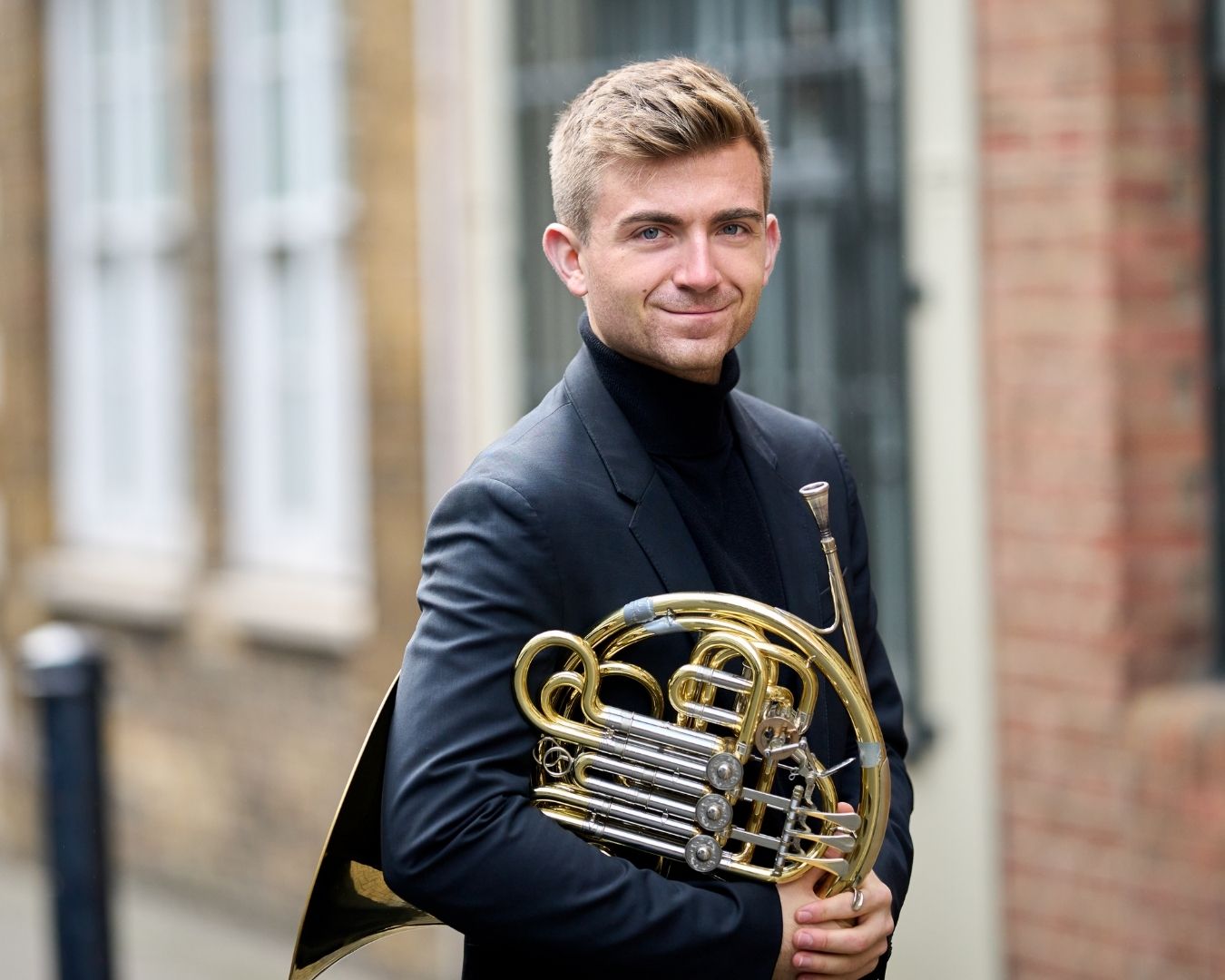
Ben Goldscheider
Horn
Born in London, Ben Goldscheider completed his studies with Radek Baborák at Berlin’s Barenboim-Said Akademie in 2020. He was an ECHO Rising Star in the 2021–22 season and has since appeared at some of Europe’s most prestigious venues, including Amsterdam’s Concertgebouw, the Vienna Musikverein, Hamburg’s Elbphilharmonie, London’s Wigmore Hall, and the Cologne Philharmonie. At the Pierre Boulez Saal, he regularly appears as a soloist and as a member of the Boulez Ensemble. He has premiered more than 50 new works for horn to date, including solo works and chamber music as well as horn concertos by Gavin Higgins, Huw Watkins, and Brian Elias, and has performed as a soloist with the BBC Symphony Orchestra, City of Birmingham Symphony Orchestra, Royal Philharmonic Orchestra, Academy of St Martin in the Fields, Britten Sinfonia, the London Mozart Players, and the Deutsche Kammerphilharmonie Bremen, among others. He has also collaborated with artists such as Daniel Barenboim, Martha Argerich, Sergei Babyan, Kirill Gerstein, Stephen Hough, Sunwook Kim, and Michael Barenboim and is a member of the West-Eastern Divan Orchestra. His discography includes a solo album in honor of the 100th birthday of British hornist Dennis Brain as well as horn concertos by Malcolm Arnold, Christoph Schönberger, and Ruth Gibbs. Ben Goldscheider has been artist in association at the Royal Welsh College of Music and Drama since 2023 and was appointed professor at the Royal Conservatory in Antwerp in 2025.
November 2025
Philip Dawson
Live Electronics
Philip Dawson is a musically led media artist whose work has been heard widely in the UK and Europe. He describes his concert works as “one-off” designs for the stage, and also explores alternate forms in the mediums of virtual reality and online art. He is an alumnus of the Royal Birmingham Conservatoire and the Royal Academy of Music, where he was a Leverhulme Scholar. He is a recipient of the 2012 RPS Composer Prize and from 2013 to 2016 was resident artist with Aldeburgh Music Open Space. He is currently completing his PhD, funded by the Arts and Humanities Research Council, at the Royal Academy of Music.
November 2025