Thu, February 19, 2026 at 7:30 PM
DAVID VIRELLES
feat. Eric McPherson, Vicente Archer, Gilbert Nouno
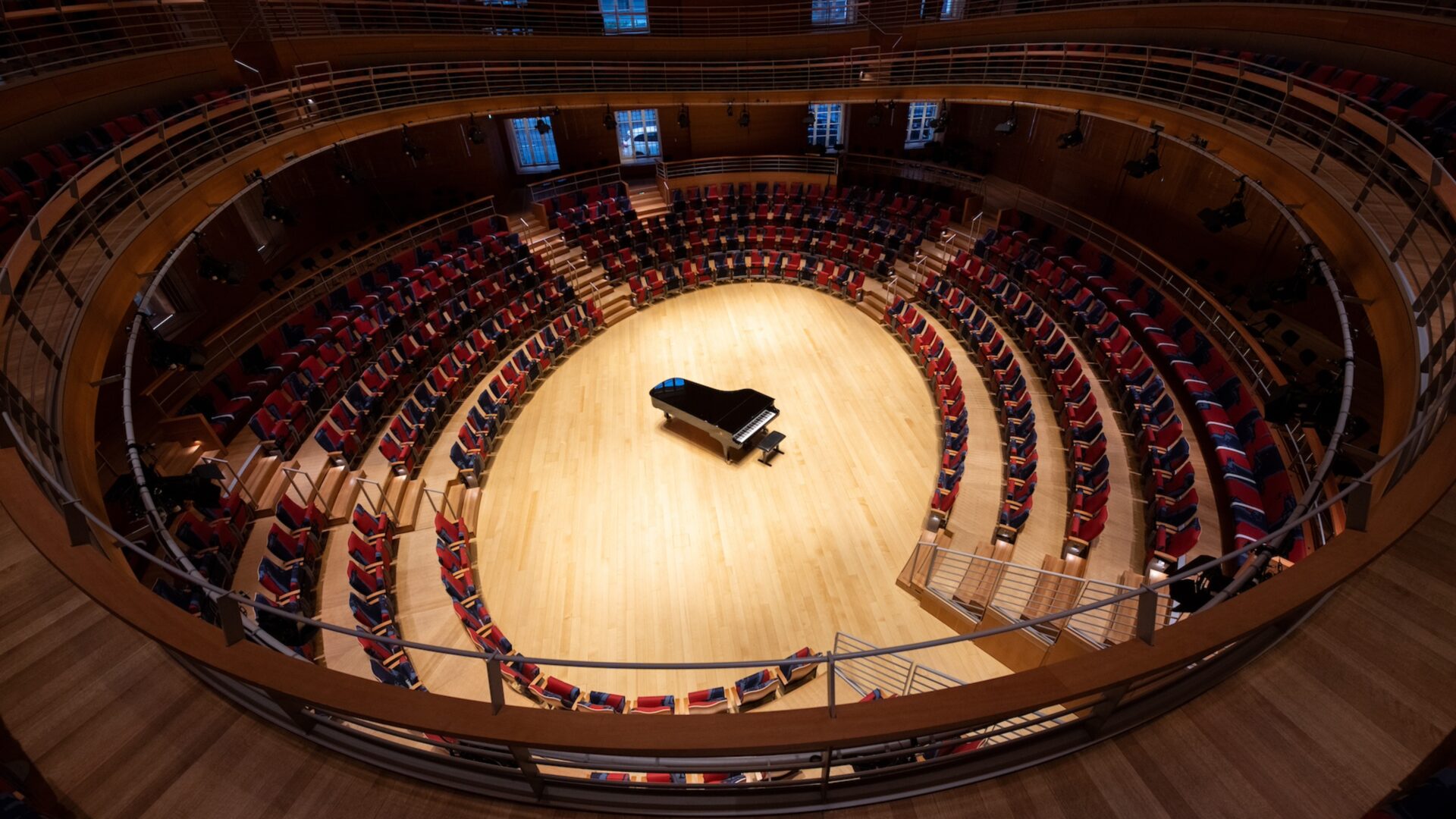
Pierre Boulez Saal
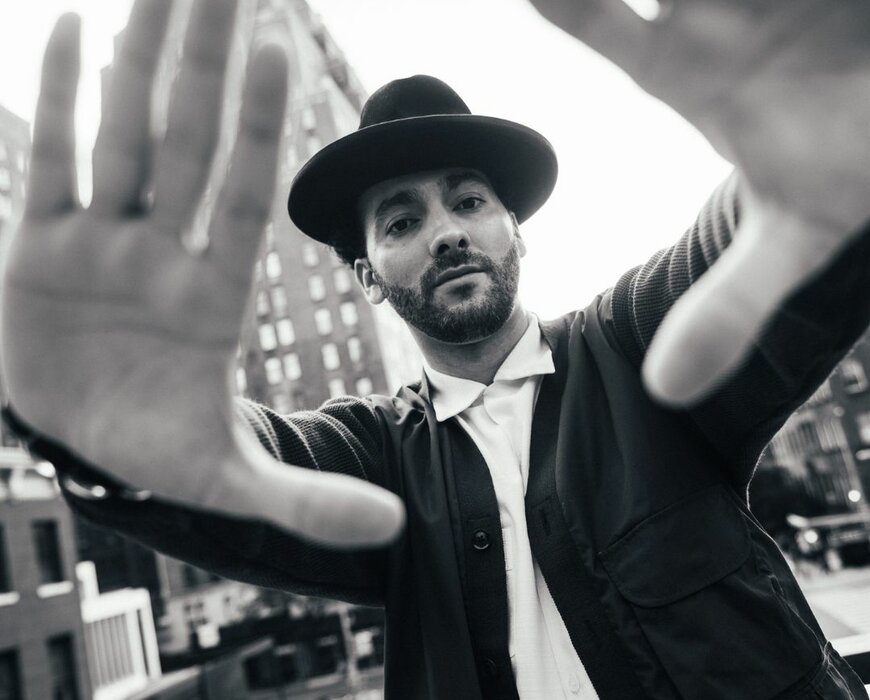
For David Virelles, tradition and modernity are not opposing forces but a single continuum, where ancestral knowledge shapes new creative possibilities and where past and present exist as one. Commissioned by the Pierre Boulez Saal, he has created Vaivén, a cycle of Cuban-inspired sones that explore the rhythmic, timbral, and harmonic resonances of his trio, in which he is joined by Eric McPherson and Vicente Archer. Gilbert Nouno’s electronic sound design will further blur the boundaries between tradition and abstraction.
Artists
Piano, Synthesizer, Harmonium
Double Bass
Drum Set and Percussion
Sonic System
EVENT TIMELINE
vaivén
A Cycle of Sones, Related Forms, and Evolving Expressions
World Premiere
Vaivén is grounded in the idea that tradition and modernity form a single continuum. Textures, harmonic fields, and rhythmic codes shape the work’s structure. The music explores the trio’s expressive range, as acoustic and electronic elements blur timelines and create a sensorial space that feels both familiar and uncharted. At the Pierre Boulez Saal, this dialogue extends into the room through a multichannel sound design, with a three-dimensional realization of the onstage electronics created specifically for this space, in collaboration with electronic musician Gilbert Nouno.
The piece also draws on the music of Carlo Borbolla (1902–1990), an overlooked figure in Cuban musical history whose pioneering work has served as an important blueprint.
Son is a foundational Cuban musical form that has continually evolved as it moved through different instrumental formats and contexts. Central to this music is the relationship between son clave (the heartbeat and rhythmic framework upon which everything is built) and the back and forth (vaivén) of its harmonies.
Not all of the works in this cycle were conceived strictly as sones, though each maintains a direct or indirect connection to the form. Some pieces also draw on punto, guajira, contradanza, danzón, and mambo, remaining in conversation with son through history, rhythmic designs, harmonic fields, and abstracted montunos.
—David Virelles
the artists
David Virelles grew up in a musical family in Santiago de Cuba, steeped in the music of the Afro-Caribbean diaspora and Western classical music. After graduating from Humber College in Toronto, he moved to the U.S. in 2009 to study with Henry Threadgill. Since then, he has established himself as one of the most sought-after pianists of his generation, working and recording with musicians such as Ravi Coltrane, Andrew Cyrille, Bill Frisell, Terri Lyne Carrington, John Patitucci, Wadada Leo Smith, and many others. He has released several critically acclaimed albums, including Continuum, Mbóko, Antenna, and Gnosis, the electronic EP Transformación del Arcoiris, the solo piano disc NUNA, and most recently Igbó Alákorin Vol. III, the continuation of a series dedicated to the musical history of Santiago de Cuba. His current projects include solo performances on acoustic piano and/or electronics, his trio with long-time collaborators Ben Street and Eric McPherson, and work with other groups including the Andrew Cyrille Quartet, Trio Imagination (featuring Cyrille and Reggie Workman), and the Ravi Coltrane Quartet, of which he has been a member for 11 years. In 2024, he premiered his multidisciplinary work ORO featuring Grammy Award-winner Dafnis Prieto, commissioned by Carnegie Hall in New York. David Virelles is a fellow of the Guggenheim Foundation and the Shifting Foundation and a recipient of the Herb Alpert Award, the Louis Applebaum Award, and the Grand Prix de Jazz de Montréal. He currently teaches as a professor at the Zurich University of the Arts.
Bassist, guitarist, composer, and producer Vicente Archer hails from Woodstock and attended the New England Conservatory and Northeastern University in Boston. He picked up the double bass while in college, and within just eight months became a member of renowned saxophonist Donald Harrison’s band. Since then, he has worked with artists such as Pat Metheny, Norah Jones, Terence Blanchard, Mary J. Blige, Brad Mehldau, Wynton Marsalis, Kenny Garrett, and many others, and has toured with Grammy winners Robert Glasper, Nicholas Payton, and John Scofield. He teaches at the New School in New York.
A native of New York City, Eric McPherson grew up surrounded by outstanding jazz artists. He began lessons with drummer Michael Carvin at the age of 12 and went on to study with Jackie McLean at the University of Hartford’s Hartt School of Music as well as work and record with pianist and composer Andrew Hill. While still a student, he became a member of the Jackie McLean Quintet, recording several acclaimed albums and performing at major festivals and venues throughout Asia, the Middle East, Latin America, Europe, and the U.S. In addition to his work with Jackie McLean, Eric McPherson has also performed with a wide range of major jazz artists, including Pharoah Sanders, Richard Davis, Claudia Acuña, Jason Moran, Greg Osby, and Avishai Cohen, and released his latest album Double Bass Quartet in 2025. He is on the faculty of New York’s New School.
Gilbert Nouno is a composer, professor of electronic composition and interactive media at the Haute École de Musique in Geneva, and lecturer in electronic music at the Barenboim-Said Akademie. Influenced by the practice of multimedia art with traditional and mixed techniques, his work is concerned with musical research between man and machine at the intersection of various artistic fields. He holds a Ph.D. in computer music and received the Prix de Rome fellowship from the Académie de France as well as the Villa Kujoyama grant from Cultures France. His recent works include Deejay for string quartet and electronics, Iwona, an electronic operetta, Street Music for trio and electronics, and Feedback, a performance for triangles with electronics and video. His artistic collaborations range from Jonathan Harvey, Pierre Boulez, Olga Neuwirth, and Steve Coleman to the flutist Magic Malik and choreographer Léo Lérus.
YOUR VISIT
How To Get There
Pierre Boulez Saal
Barenboim-Said Akademie
Französische Straße 33d
10117 Berlin
_____
Public Transport
U-Bahn U2 Hausvogteiplatz, U5 Museumsinsel, U6 Unter den Linden
S-Bahn S / U Friedrichstraße
Tram M1, 12 Mitte / Am Kupfergraben
Bus 147 Werderscher Markt; 100, 300, N5 Staatsoper
Bicycle
Bicycle racks are available on the street “Hinter der Katholischen Kirche.”
Car
Q-PARK parking garage Unter den Linden / Staatsoper
Bebelplatz 2
10117 Berlin
Theater rate (5.30 pm – 11.30 pm, paid in advance): €10
Please note there is a construction site across from the hall on Französische Straße. The street is narrowed, and cars or taxis are not allowed to stop in front of the Pierre Boulez Saal entrance.
Opening Hours
Box Office
During the summer, the box office will be closed from June 22 to August 7 and from August 13 to 28, 2026.
Monday to Friday 2 pm to 6 pm
Closed on weekends and holidays
On performance days, the box office opens one hour prior to an event on weekdays and two hours on Saturdays, Sundays, and holidays.
Papagena Call Center
Ticket hotline +49 30 4799 7411
Monday to Saturday 9am to 8pm
Sunday and public holidays 2pm to 8pm
Food & Drinks
Casalot Catering welcomes Pierre Boulez Saal visitors before and after concerts, serving a variety of dishes of Arab cuisine.
On concert nights, the bar opens one hour before the start of an event and remains open after the performance. You may also place pre-orders for intermission right at the counter.
More informantion on our catering can be found here.
Coat Check
Small bags up to a maximum size of A4 (21x30 cm) and jackets may be taken into the concert hall. Luggage, helmets, large umbrellas, and other bulky items must be stored at the coat check.
The coat check is free and located behind the staircase in the foyer, on the left-hand side.
Accessibility
To book wheelchair-accessible seating, other seats for visitors with disabilities, or companion seats, please contact us directly.
+49 30 4799 7411
tickets@boulezsaal.de
All wheelchair seats are accessible by elevator. All visitors, including patrons using a wheelchair, will enter the Pierre Boulez Saal through the main entrance. Tickets will be checked at the hall doors.
In order to make access as easy as possible, we kindly ask that you inform us of your requirements when booking your tickets.
Restrooms for visitors with disabilities are located in the basement and on the balcony level and are accessible by elevator.
Four parking spaces for visitors with disabilities are available on the street Hinter der Katholischen Kirche.